Brilliant Lives
By John W. Arthur
Second edition
Published by the author in 2024
First published in Great Britain in 2016 by
John Donald, an imprint of Birlinn Ltd
Copyright © John W. Arthur 2016, 2024
All rights reserved.
Contents
8.3 Work on George and Dorothea’s Future
8.4 The Rise of Dumcrieff and Middlebie
8.7 Lord Treasurer’s Remembrancer to the Exchequer
8.8 The Jacobite Rebellion of 1745
8.9 Commissioner for the Forfeited Estates
8.10 The Forth and Clyde Canal
8.14 Other Activities and Interests
8 The First Clerk Maxwells
The origins of the first Clerk Maxwells, George and Dorothea, have already been briefly mentioned. George Clerk was the third son of the Baron, Sir John Clerk, and his second wife Janet Inglis (§6.6) while Dorothea Clerk (§5.3) was the only child of the Baron’s younger brother William Clerk and his wife Agnes Maxwell, heiress of Middlebie (§§6.2‒6.3). George and Dorothea were therefore first cousins. How they came to be Clerk Maxwells will now be revealed in this first detailed account of George’s life and career. On Dorothea’s part, the fact that she brought the estate of Middlebie into the Clerk family was to be a major influence in shaping the lives of the second Clerk Maxwell, her grandson John, and in turn his son James, who was the third and last of the line.
8.1 George’s Early Life
In Scotland, until fairly recent times, children were usually named after family members from earlier generations. This was certainly the case amongst the Clerks of Penicuik, but the naming of the Baron and Janet Inglis’ second surviving son was a departure from this protocol:
… it pleased God to make up the loss of my son Hary by the birth of another son, whom I christned George, after the patron of the cause which I had espoused during the Rebellion. He was born 31 octobr 1715. (BJC, p. 96)
The significance of the date and name was later clarified by Lord Eldin: [1]
… the day on which the [Jacobite] Rebels under Brigadier McIntosh advanced to Jock’s Lodge with an intention to surprize the City. He was named George after the King as testimony of loyalty’.
The eagerness of the Baron to call his son after the King was no doubt presaged by him already having called his second son James, as was customary, in honour of his wife’s father; the name of the Old Pretender was not at all popular with the House of Hanover, especially in 1715. We hear nothing more of George (or James either) for some time, but he seems to have been sent to Dalkeith grammar school[2] as were his younger brothers after him. He was boarded at the school and seldom brought back to Penicuik because it had unsettled him.[3]
While George was away at school his mother would write to him, for example, to remind him that he should pray, read the scriptures and keep the Sabbath.[4] In the following year, however, he was sent away to Lowther School[5] near Penrith in Cumberland, just before his fifteenth birthday (BJC, p. 138). The Baron had heard about the good reputation of the school and the progressive outlook of its master, Mr Wilkinson; the bad memories of his own school days (see §4.1) no doubt helped persuade him, but it was ever in the Baron’s mind that his sons should learn ‘the English language’. However, he did not go so far as sending him to Eton, as he had done with his first son, John, for while it had been a great success he had concluded: ‘… there was this bad consequence from an English Education, that Scotsmen bred in that way wou’d always have a stronger inclination for England than for their own Country’ (BJC, p. 99). Penrith was in England, but only just, and it would have been hard to find any school in England that was closer to home. George was therefore packed off to Lowther with this encouragement from his father:
You have nothing else to depend on but your being a scholar and behaving well. (BJC, p. 139n1)
The same theme was expanded on in a letter to George the following February. The Baron hoped that his son was beginning to love learning, was acquiring English language, and following the good example of his teacher. He reminded him that he should be good towards his schoolmates since they could well be of help to him later on in life, and that if he were to be seen as being a mere trifler and a bad scholar, he would never be able to live it down.[6] After visiting Dumcrieff that August, the Baron proceeded to Penrith to pay his son a visit at Lowther. He stayed three days and ‘found all going very well with him’ and likewise he found that Mr Wilkinson fully lived up to his expectations (BJC, p. 139). While George received plenty of letters, he seems to have been a reluctant correspondent; his mother longed to hear from him and told him so in May 1732 when she wrote telling him of his new baby brother, Matthew, and of Mr Wilkinson’s good opinion of him.[7]
A year later, however, both his mother and his sister Betty were still chiding George for not writing. Betty in particular, who was some ten years his elder, complained that she never heard from him, and when she sees him next she fears they will be strangers. Apart from once more reminding him of his failure to write, his mother asked him what sort of career he had in mind.[8] Interestingly, his cousin Dorothea, then aged twelve, also wrote to him.[9]
The year 1734 finds George nearly nineteen and still at Lowther.In the August of that year, the usual time for his annual peregrinations, the Baron had George brought up to join the family at Dumcrieff, and thereafter they all set off for Carlisle so that his wife Janet and daughter Anne could see a little of England. Having stayed only a few days, they returned to Drumcrieff (BJC, p. 143), but the Baron omits to say whether George came back to Penicuik with them then or went on back to Lowther. It would seem that the approach of his nineteenth birthday would have been an appropriate time for him to proceed to university. Lord Eldin (Clerk, 1788, p. 51) informs us that he duly went to the University of Edinburgh, but there is no mention of him graduating there (Laing, 1858). Even James Clerk Maxwell, George’s great-grandson, did not do so; they both went on to complete their education elsewhere. For George, it was a case of following in the footsteps of his father, his uncle William and his brother James, who all went to Leiden.
8.2 An Early Marriage
The decision to send George to Leiden, or at least the timing of it, was affected by a singular event, for on 17 July 1735, while George was still only nineteen, he married his cousin Dorothea,[10] who was then just a month short of her fifteenth birthday (§5.3). Since her father William’s death in 1723 the Baron had been one of Dorothea’s tutors, and following her mother’s death some five years later, she had been brought into his care and presumably would have lived with him and his family at Penicuik. She and George had therefore ample opportunity to become acquainted. In spite of her young age, the marriage was legal, for the legal age of marriage for girls was then just twelve (Lorimer, 1862), and amongst the upper classes marriages between such young couples had often taken place as a way of binding the families together with the real business of married life beginning sometime later when the young couple were judged mature. Nevertheless the marriage was irregular. According to the Baron, the marriage took place ‘privately’ (BJC, pp. 144−145), which probably means that they went before a minister without proclamation of banns or any other of the usual formalities. There were indeed ministers who might do this sort of thing,[11] and perhaps for a suitable consideration. We know for a fact that the wedding was irregular because some years later George paid a ‘fine’ to the kirk session of St Mungo’s in Penicuik: ‘1740 Jany 20 Given in [i.e. a fine] by George Clerk for his Irregular marriage with Dorothea Clerk’.[12] Presumably in return his marriage to Dorothea then became regular.
The Baron later said of the liaison:
I had no hand or concern in the Match, but I hope it will prove a happy Marriage to both. I never recommended her to George, since I was her Tutor, but she had this advantage, that her Mother, before she died, frequently recommended George to her. (BJC, pp. 144−145)
She was just seven years old at the time of her mother’s death, and George was then only twelve. One wonders if his remarks here were simply to gloss over how the marriage would have looked to others. Is the Baron therefore trying to distance himself from the notion that it may have been his own wish, for the young heiress would have made an excellent ‘prospect’ indeed for one of his own sons? In his Life of James Clerk Maxwell, Lewis Campbell clearly felt obliged to indicate a hint of incredulity at the idea of it being Agnes’ idea.[13] Agnes could indeed have said such words to her daughter in the playful sort of way that one does with children, but hardly more. If she seriously had any such match in mind, it would have been something that she would have put to the Baron himself, for without his approval it would be no more than a fond wish.
As Dorothea’s tutor and latterly curator, the Baron had had many years to ponder over Dorothea’s future, for although she had a decent legacy from her stepfather Major Le Blanc, her inheritance through the entail of Middlebie was heavily burdened with a string of debts (§6.2) a messy problem that the Baron would have to untangle. First, we can be fairly sure that the Baron did his best to see that Dorothea was brought up in his own Protestant religion. Not only would that have been natural for him to have done so, it also meant that there would be no problem with the troublesome 1701 Act. Furthermore, her marriage, just short of her fifteenth birthday, to one of his own sons would be likely to dampen any mention that her mother had been Roman Catholic. This would help to avoid her having to take the oath prescribed under the Act, which she would have been required to do, by the age of fifteen at the latest, if she were not by then accepted as being manifestly Protestant. Failure in this matter would have resulted in Dorothea being debarred from her inheritance. But she could not marry his eldest surviving son, James, for he would inherit Penicuik, the requirements of which were mutually incompatible with those of the Middlebie entail. Moreover, he also needed to provide a decent future for his next son, George. It would have to be George and Dorothea.
That settled, his next task would be to unburden the Middlebie estate from debt, to which end it was necessary to find a means of getting out of the entail. Furthermore, the times being what they were, he would have had to worry about what would happen if Dorothea died without issue. It would be a pity if Middlebie ended up being lost to the Clerk family and went instead to the Areskines who, as the heirs of Grizzel Grierson, were the next in line to succeed (see §6.3 and §6.4 and note 31 of Chapter 4).
8.3 Work on George and Dorothea’s Future
After the marriage, the Baron got to work arranging things for the young couple. First of all, he got Dorothea to make a will in George’s favour,[14] which was followed up sometime later by a disposition and assignation to him of all the non-entailed lands, goods and monies that might belong to her on her decease.[15] We may guess that the intent of this was to secure matters for his son as far as was possible under the constraints of the entail.
The accumulated debts on Middlebie were a different matter, some of them dating as far back as 1720, they came to a total of £1,759 1s 6½d.[16] Against this, the property entailed by John Maxwell in 1722 comprised the following:[17]
- In the County of Dumfries
- The Twenty Merk Land of Middlebie
- The Merk Land of Kirktoun of Kilmahoe
- In the Burgh of Dumfries
- The south-most tenement of a land near the Friars Vennel, with yard
- A tenement in Bells Wynd, near the port of the Friars Vennel, with large yard
- A yard in Friars Yard
- A house at the head of the White Sands, with yard
- Five acres of land at the back of the Castle Gardens
- A yard adjacent to the above land, with barn at the foot of the Upper Green Sands
- A quarter’s salmon fishing on the Nith, west and south of the town, from Powson’s to the Powfall Burn
- In the Stewartry of Kirkcudbright
- Nether Corsock
- Over and Nether Blackhills
- Little Mochrum
The locations of the major parts of the estate and Middlebie itself can be found from Figures 2.1 and 8.1, while the original plan for Middlebie town is reproduced in Plate 8.1. Figure 8.2 shows the location of one of the main properties in Dumfries, indicated in the list by an asterisk, which in James Clerk Maxwell’s time was the Crown Inn. Who would have thought that James Clerk Maxwell owned a ‘pub’?
The Twenty Merk Land of Middlebie would sell for £2,225 4s 4⅔d, calculated as twenty-three times the annual rental. The debt of £1,759 1 6½d could then be paid off leaving a surplus that could be put to the purchase of some other small property nearer to the remainder of the estate in and around Dumfries. But in order to do this, a private Bill had to be introduced into the House of Lords to obtain the requisite Act of Parliament allowing the entail to be broken: the Baron certainly had the legal skills and the necessary connections to ensure that it would succeed.

There are eight such pen and ink sketches depicting the individual parcels of land that made up the Middlebie estate as shown in Figure 8.1. The Middlebie Town property, shown here, is very irregular in shape and almost split in two by being squeezed in by Church land on the north and the Duke of Queensberry’s property on the south. In addition, the Marquis of Annandale owned an enclosed area within the western part the property, while the Duke of Queensberry had a similar piece out of the eastern part. The ‘town’ itself is just a few buildings. We must assume that this, either on its own or together with some of the contiguous pieces of land, was the originally entailed Twenty Merk Land of Middlebie. The Merkland of Kirtoun of Kilmahoe, however, was entirely separate and lay a few miles north of Dumfries (See Figure 2.1).
From DGA: GGD56/19, 18th C, by courtesy of Dumfries and Galloway Libraries Information and Archives.
In the meantime, however, following the marriage of George and Dorothea the Baron sent George to Leiden to continue his studies, while Dorothea remained in the care of the Baron and his wife at Penicuik, his reasons being:
As my s[ai]d son seemed very intent to study the Law in Leyden, and his Wife and he being too young to live together, I sent him to Holand in January 1736, where he had the advantage of staying with his eldest Brother James. (BJC, pp. 144−145 )
Despite them ‘being too young to live together’ it seems as though the marriage was consummated, for a child was born in the following year.
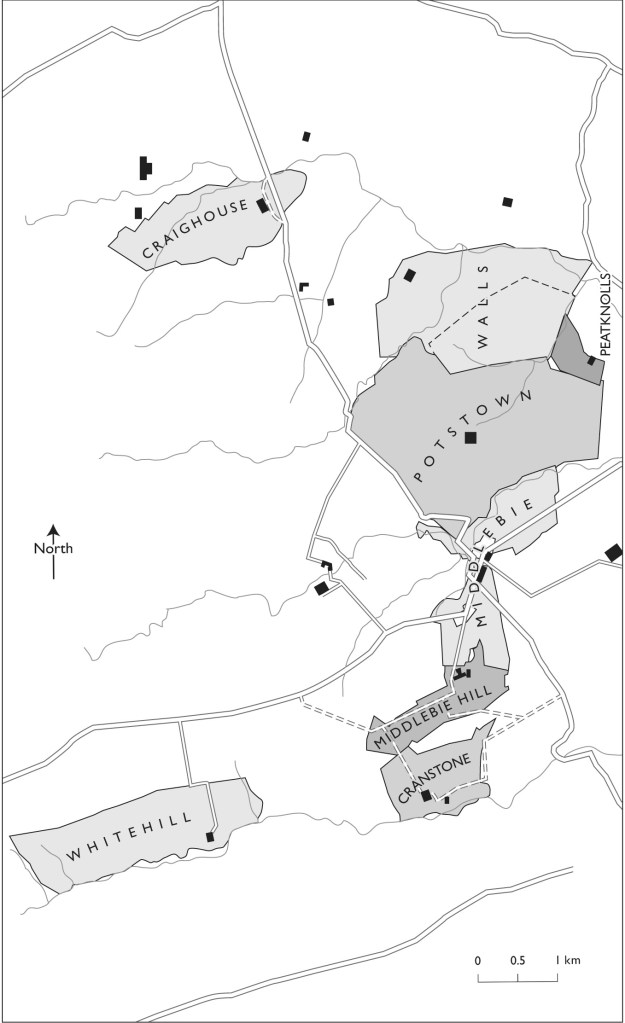
Constructed by the author from the eight individual sketches in DGA: GGD56/19, Plans of Middlebie Estate.of which Plate 8.1 is one example.
While George actually departed in January 1736, the intention of sending him away was already raised by the previous October, for his uncle Hugh had found him a travelling companion.[18] But from George’s standpoint, it was probably just a bit too soon, for not only did he have a marriage ball to give, he would also be reluctant to be parted so quickly from Dorothea. Moreover, by then they may also have been aware that their first child was on its way, which we will examine in more detail later on in this chapter.
George eventually set off for Leiden in the New Year and while he was ever the reluctant writer when at Lowther, he may have found some consolation in exchanging letters with Dorothea. However, only his general correspondence seems to have been preserved; for example, letters concerning his classes at Leiden, an intended tour of Germany with his brother James, the sighting of a comet, and failed attempts to get his father a Great Dane.[19]
In the meantime, Dorothea spent some time back at Dumfries, having visited an uncle, Robert Maxwell, there in the autumn of 1736.[20] Just who he was is not absolutely clear. Agnes Maxwell had a younger brother Robert who, if he was still alive in 1722, was not mentioned in the Middlebie entail, but her father, ‘the Entailer’ did have a half-brother, Robert Maxwell of Shalloch,[21] who died in the winter of 1737 and was therefore alive when the letter was written.[22]
On finishing his studies at Leiden in the summer of 1737, George accompanied his elder brother James to Germany, where he visited Hamburg, before returning home.[23] James, on the other hand, lingered on and extended his stay, just as his father had done before him (see §4.3).
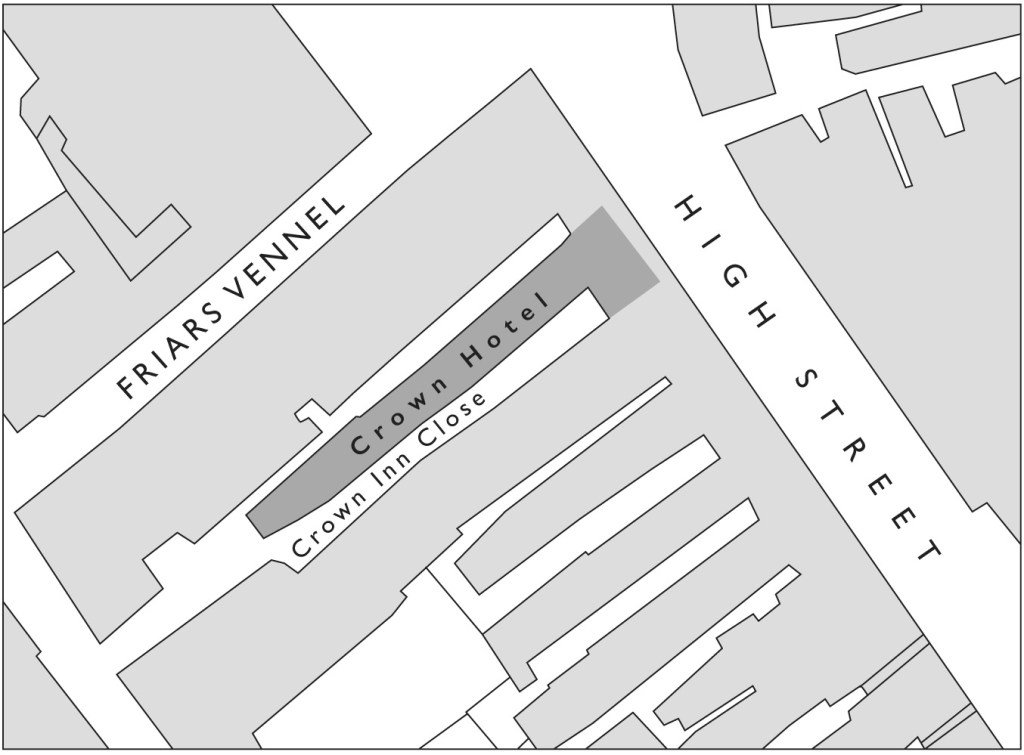
This was one of the properties in Dumfries which came to Dorothea Clerk Maxwell through the Middlebie entail of 1722. A consequence of this was that it was inherited by her great-grandson, James Clerk Maxwell, in 1856.
8.4 The Rise of Dumcrieff and Middlebie
When George returned from Leiden in 1737, he had reached his majority and was, as we know, already a married man. While the Baron had at first diverted him from setting up house with his young bride, he was now in for a rather pleasant surprise. The Baron, having finished building a new estate and country house at Dumcrieff only four years before, now presented it to George for his very own country seat. He had spent five and a half long years building it, and no doubt a considerable amount of money, but he had its use for only five summers. Nevertheless, he would have been thinking all the while about his future provision for George and Dorothea, and the fact that he had given it away to George was of no great consequence in the grand scheme of things, and perhaps as it would turn out even a convenience. Since Penicuik would come to his eldest son James by right, he was already provided for, and he could also have the use of Mavisbank nearby when it came his turn to manage his father’s coal works at Loanhead (see §4.8).
Moffat lies in Annandale just over twenty miles from Dumfries, from where Middlebie and Nether Corsock lie about twelve miles to the east and fifteen miles to the west respectively. It would therefore be fairly convenient for access to Dorothea’s properties in these three places. Furthermore, when the Baron wanted somewhere to stay at Moffat for the summer season, he and his family could stay as guests of George and Dorothea, and could travel there without having to bring their entire retinue along with them from Penicuik. And so, in a way, he gained as much as he lost by his generous gift! The entire process was complete when George obtained the Crown Charter for his new estate in 1738, and was officially able to style himself ‘George Clerk of Dumcrieff’.[24] But by a different route, by the demands of the Middlebie entail, he was also George Clerk Maxwell.
Once installed as the new Laird and Lady of Dumcrieff, George and Dorothea did not simply settle down and live the lives of country gentlefolk, for George had to start a career. First of all, the Baron’s plans for sorting out their financial position had to be put into effect, beginning with George and Dorothea signing off on the Baron’s management of their affairs to date.[25] Dorothea no longer required the Baron to act as her curator since she was now the wife of George, who had reached his majority the year after they married. Just coming up to the tenth anniversary of Agnes Maxwell’s death, the Baron had Dorothea served as heir of entail to John Maxwell of Middlebie[26] This was followed by the private Bill which he was able to have introduced into the House of Lords 8 March 1738 (House of Lords, 1738, p. 222ff.). These key steps all took place within the space of a month. This must have been quite a feat, but the Baron clearly had both the necessary acumen and standing to achieve it.
The tenor of the Bill was that all the other heirs of entail had now been exhausted apart from two, first in line being Dorothea Clerk (and any future children) and, second, her distant relation James Areskine [Erskine], then a minor, the younger son of Charles Areskine, his Majesty’s Advocate for Scotland (see note 31 to Chapter 4). The Bill presented the Baron’s scheme of selling off the ‘Twenty Merk Land’ of Middlebie, the proceeds to be used to pay off the debts and to allow Dorothea to purchase in their place ‘other Lands or Tenements, fituated as near as conveniently to the faid George Clerk’s other freehold Eftate of Drumcreif’ (House of Lords, 1738, p. 222ff.). Apart from the substitution of these new lands for the Twenty Merk Land, the original entail was to stand exactly as it was, and to make sure it was all done according to the Act, trustees were appointed to oversee the ensuing transactions. They seem to have been an eclectic bunch, but most likely they were well-chosen friends and associates of the Baron, with some input from Charles Areskine.
The Bill’s progress through both Houses of Parliament was fairly rapid by today’s standards and was given the Royal Assent on 20 May 1738 (House of Commons, 1738). The plan to clear the debts on Middlebie was then put into action. In addition, since George and Dorothea’s financial state of affairs had now been made reasonably clear and secure for the foreseeable future, the terms for a marriage contract could be agreed;[27] and it is here, apparently, that the name Clerk Maxwell emerged for the first time. The lands of Middlebie were duly sold, only to be bought back by the Baron himself and made over to George. Why, if he had the money to do this, had he simply not handed over to George and Dorothea just half of that amount, which would have cleared off the debt without the bother and expense of the legal fees and Act of Parliament?
The Baron was, as usual, simply being astute. No doubt he would have mentally written off the issue of the debt many years before. Dorothea had brought a good deal into the Clerk family by way of land and legacies, but unfortunately it was she, not George, who had title to the entailed property. While it was she who owned the estate, in practical terms he could treat it as though it were his own ‘by right of his wife’. The sting in the tail was that if he needed to do anything formal, he would require Dorothea’s agreement and signature. But as a married woman, the protocol to be observed was that she would include the words, ‘on the advice and consent of her husband, George Clerk Maxwell’. Of course, his signature would have been accompanied by suitable matching words. It may have been irksome for George, and probably just so for Dorothea too, but to some extent it created a balance of power between husband and wife – neither could act without the agreement of the other. From the point of view of an eighteenth-century gentleman, however, he would be in much better standing if the property were his alone.
One of the intentional effects of an entail is that the property in question cannot be signed over to a second party, George for example, nor could this be done in the Act of Parliament, because that would have been more than strictly necessary for the purpose of clearing the debt. By disentailing and then repurchasing the Middlebie lands, the debt was paid and the property could become George’s. Possibly George and his father felt that it would prove a constant source of embarrassment if the Clerk Maxwells of Middlebie did not own the land whose name they bore. Although he did not obtain his official charter over Middlebie until much later,[28] he could now justifiably call himself either George Clerk Maxwell of Middlebie or George Clerk of Dumcrieff. In fact, he seems to have used whichever of them he felt best suited the occasion, and this is reflected both in his correspondence and elsewhere. Whatever may have been the Baron’s motivation, first with Dumcrieff and now Middlebie, George had done very well out of him.
Dorothea’s succession was not technically complete until sasines for her properties had been recorded in her favour. The sasines on Nether Corsock, the two Blackhills and Little Mochrum were registered in September 1738;[29] others are recorded in the Index to the Register of Sasines for Dumfries etc … 1733−1780 (SRO: 1931) from which it appears that, in due course, George also held property there.
8.5 Career and Family Life
Thanks to the Baron’s good planning, his acumen and generosity, by the end of the year 1738 George and Dorothea were comfortably set up to make their own way in life. They were well-off indeed, for not only did they have a splendid country seat with parkland, plantations and a farm at Dumcrieff, they also had the entailed Middlebie estate as a further source of income. George had done little to achieve such good fortune other than through circumstance and simply being his father’s son. This is reflected in the words of Lewis Campbell, in his commentary on the notes on the Clerk family written for him by James Clerk Maxwell’s cousin, Miss Isabella Clerk;[30] they amply capture the general tenor of George Clerk Maxwell’s progress through life:
This George Clerk Maxwell probably suffered a little from the world being made too easy for him in early life … In some respects he resembled John Clerk Maxwell, but certainly not in the quality of phlegmatic caution’ (C&G, p. 18)
However, it is not that he was some sort of wastrel incapable of lifting a finger to do anything on his own behalf. Far from it, he was an imaginative and industrious man, ready to turn a hand to anything that interested him; but therein lay the problem:
His imagination seems to have been dangerously fired by the “little knowledge” of contemporary science which he may have picked up when at Leyden … (C&G, p. 18)
As to what others may have thought about George, Campbell says:
in all relations of life, he seems to have won golden opinions … The friendship of Allan Ramsay [senior] and the affectionate confidence of the ‘good Duke and Duchess of Queensberry’, sufficiently indicate the charm which there must have been about this man. (C&G, p. 19)
Although George had been keen to study law at Leiden, he had soon come to the realisation that he was not cut out for it. Clerk (1788) gives us a good idea of where his aptitudes really lay:
… a skilful engineer and draughtsman, as appears from various roads, bridges, and other public works [31] … executed under his direction, or on plans which he delineated. Nor were his talents in designing confined to this more mechanical species of drawing.
It therefore seems that he was naturally of a technical bent and so it is unsurprising that the minutiae of legal work would have left him uninspired. He wanted something rather more ‘hands on’,[32] and he began with some farming. This is evident in a letter he received while at Dumcrieff from his brother Patrick, who was then at Penicuik, enclosing an improved recipe (a pint of honey to a pint of tar) for making an effective paste with which to smear his sheep, presumably to kill off ticks and parasites in much the same way as dipping does today.[33] Such things he dutifully preserved in his personal notebook, wherein there is another recipe for a sheep salve that he recorded almost exactly thirty-six years to the day thereafter.[34] It seems it was something he took quite seriously, for he wrote about it to the Trustees for Manufactures and they ordered the publication of two of his letters ‘Observations on the Method of Growing Wool in Scotland’ and ‘Proposals for Improving the Quality of Our Wool’ (Clerk Maxwell, 1756).
By the following year of 1739, however, George had set his sights on a fresh line of interest when he embarked on a more philanthropic yet seemingly practical venture that aimed to encourage and improve local manufacture by the setting up of a spinning school in Dumfries.[35] His petition to the Trustees for Manufactures in Scotland met with success.[36] At the same time, he also set up a linen factory there. While the spinning school’s purpose was mainly to teach girls to spin local wool, their skills would also have been employable in spinning flax to make linen yarn for the factory, of which, unfortunately, no details have been discovered. George and Dorothea based themselves in Dumfries for this purpose, and while we do not know for certain where they lived, we can at least be certain that they did live there by August 1739 because the Baron recorded it, ‘Drumfrise, where my son George and his wife had taken up their residence’ (BJC, p. 154), and in addition about this same time George also received letters addressed to him as George Clerk ‘at Dumfries’ and ‘at his house in Dumfries’.[37] It will be noted that his surname was then still largely known as being Clerk rather than Clerk Maxwell, an issue that we will return to in due course.
In August 1740, in continuation of their longstanding custom of vacationing at Moffat, the Baron and his wife stayed at Dumcrieff, with George and Dorothea, for a month. They visited the local spas and the menfolk, at least, enjoyed the shooting and fishing. He made a note of his stay there that gives us some idea of what the house was like inside.[38] It had been finished nine years before, and for the last three years it had been in George’s possession. Given its relative newness, it should have been in good condition, and there had been ample time to get it suitably furnished. The biggest room in the house, which was on the upper floor and about seventeen feet square was ‘ill provided with furniture’ and could have done with some sort of sofa bed. The ceiling was corniced, but the walls were bare and needed to be decorated with some printed linen wall hangings. As to the similarly sized dining room on the ground floor below, it was ‘not in order’; it needed to be decorated with painted wallpaper and some decent framed prints. Money may have been tight for George at this time, for during his stay his father paid for all of his family’s living expenses, including the mutton they had eaten and the grazing for his horses. Ever the kind and thoughtful father, the Baron also gave George one of his horses, and intended giving him the feu on a property in Moffat that would bring him a reasonable amount of money.
If the interior of the house was not to the Baron’s entire satisfaction, evidently the house as a whole was not to George’s, for two years later he had it extended and remodelled to such an extent that the central part had to be pulled down.[39] It would be reasonable to assume that he was now financially better off and able to afford such an undertaking. According to Window Tax records, sometime between 1748 and 1772 the house may have been enlarged once again, for the number of windows increased from twenty-one to thirty-five (Prevost, 1968, p. 204). However, since many householders took measures to avoid paying the tax, such as blocking off all but essential windows, the increase could equally well have been as a result of unblocking some that already existed. As to the progressive laying down of plantations, which had been one his father’s great passions, George was not quite as diligent. He did, however, lay down one fairly large plantation in 1774 at Aikrig, which borders the old Moffat to Carlisle road. It covered nearly twenty-five acres, but only the central part lying mostly to the north of the road, survives today (Prevost, 1968, p. 204).
As already mentioned, at this time George’s main residence was in Dumfries where he had his linen factory, but in 1748 there was an abrupt change for he was forced to close the factory down. Prevost (1968, p. 205) gives no details, but all the signs seem to point to it having taken place in that year for it was then that he took up a post with the Forfeited Estates, in consequence of which he and Dorothea moved to Edinburgh.[40] The post-1745 Board of Commissioners had not yet been set up and the Forfeited Estates had been placed under the control of the Barons of the Exchequer, of whom, needless to say, his father was one. At the same time he borrowed, together with his father, £320 from Archibald Tod, a businessman from West Lothian, who had been one of the trustees under the 1738 ‘Act for Dorothea’.[41]
8.6 Children
While the available evidence relating to the births of George and Dorothea’s children is somewhat fragmentary, a fair reconstruction is given in Appendix A17.4. They were, in chronological order:
- John, born in 1736 (with an outside chance it was late 1735!)
- Janet, baptised 7 July 1738, at Penicuik
- Agnes, born September 1739
- Joan, baptised 16 March 1741 at Dumfries, died November the same year
- George, born November 1742
- William, born 14 June 1744, died about May 1746 following inoculation against smallpox
- James, baptised 20 September 1745 at Dumfries
- Dorothea, baptised 27 February 1747 at Dumfries
- William, Robert and Johanna, all probably born at Edinburgh
- Janet, known as Jenny, married William Anderson WS, Clerk to the Signet, in 1775. Widowed in 1785, she was still alive in 1791.
Agnes married John Craigie, a Glasgow merchant who was the second son of the Lord President of the Court of Session, Robert Craigie of Glendoick.[42] Their daughter, Barbara Craigie, married Colonel Lewis Hay, and in turn their daughter, Agnes Clerk Hay, forged a link with the Irving family by marrying John Irving, half-brother of Janet Irving, James Clerk Maxwell’s paternal grandmother (see §§12.3‒4). A son, Captain George Craigie of the 40th Regiment of Foot, was killed in the final years of the American Civil War at the battle of Groton Heights, New London, Connecticut, in September 1781, of which more later, (Ladies Magazine, 1781, p. 613; Clerk, 1788).
John served in the Royal Navy but retired sometime after 1777, when he married Mary Dacre (also known as Mary Dacre Appleby and later Rosemary Dacre Appleby) of Kirklinton in Cumbria (1745−1834). She was the granddaughter of Baronet Fleming of Westmorland, the Bishop of Carlisle. John succeeded as 5th Baronet on his father’s death and died on 24 February 1798 (Foster, 1884).[43] As he had no children, his young nephew George Clerk, the eldest son of James Clerk HEICS and Janet Irving (see §9.2) was retoured as his heir. An account of what little is known of this John Clerk and his wife Mary Dacre is given in §9.1.
There is little information on George other than that he was admitted as an advocate on 21 December 1767, lived at the same address as his parents in James’ Court in Edinburgh’s Old Town Edinburgh and died unmarried on 5 October 1776. [44]
The third son was James, who also became a seaman but in the merchant fleet rather than the Royal Navy; he eventually joined the HEICS[45] as a lieutenant and possibly reached the rank of captain. He then settled in Edinburgh, where he married Janet Irving in 1786 (see §9.2). They were to be in due course the paternal grandparents of James Clerk Maxwell. James Clerk never lived to inherit the Middlebie estate from his mother, Lady Dorothea, who, by dying on 28 December 1793, outlived him by just two weeks (Mackay, 1989).
Dorothea married David Craigie of Dunbarney WS (d. 1796) who was the brother of John Craigie of Glendoick, her sister Agnes’ husband, in 1779 (Grant, 1922). They had a son who was named after his grandfather as George Clerk Craigie;[46] he became an advocate, married and had children.
William, the fourth surviving son, was so named in memory of his dead brother, which was not an uncommon practice at the time. Robert was the sixth born and last son. Both he and William went into the army and became lieutenants in the 1st and 56th regiments of foot, respectively. Sadly, both died in service. Robert died towards the end of 1781 at Gibraltar, where the British garrison had been held under siege by the French and Spanish since the winter of 1779. If he was killed in action, then this would possibly have happened during the sortie that took place on 27 November, when a party of the besieged British troops left the safety of their garrison by night in an attempt to forestall an imminent all-out assault by the enemy. The sortie was successful in delaying the assault for many months.[47] William died just a few months later during the siege of Brimstone Hill, at Basseterre on St Kitts, which began on 19 January and ended with surrender to the French on 13 February (Clerk, 1788, pp. 55−56; Foster, 1884).
Johanna, the second daughter mentioned by Foster (1884, p. 52)), was doubtless a later daughter named in memory of the earlier Joan who died in 1742. According to Lord Eldin (Clerk, 1788), ‘about 1782’ an unmarried daughter of Sir George Clerk, 4th Baronet, died of grief over the loss of her nephew and brothers in the war. As Janet, Agnes and Dorothea had all married, the unmarried daughter John Clerk was referring to must indeed be Johanna. The records do show that a Miss Johanna Clark died in November 1781 from ‘decay’,[48] which in the language of the time meant that she had simply wasted away. William did not die until after Johanna, who in fact died almost exactly at the same time as Robert. Such a tragic coincidence must have left a great impression on the minds of her friends and family.
8.7 Lord Treasurer’s Remembrancer to the Exchequer
In 1743, George Clerk was appointed Lord Treasurer’s Remembrancer to the Exchequer in Scotland. This obscure administrative office was quite different from the present day combined office now called the Queen’s and Lord Treasurer’s Remembrancer which, despite the incomprehensible title, deals with such things as ownerless goods, treasure trove, heirless estates and the like. It seems that the function of the original Lord Treasurer’s Remembrancer was to audit the accounts of the sheriffs − presumably their personal accounts for sitting in court and perhaps extending to the expenses of the trials that they conducted. At any rate, in return for a broad range of benefits and expenses the incumbent was not expected to know too much about it, nor was he expected to attend his office ‘but infrequently’. That was how the system worked.
Such positions were obviously highly sought after, and for a man of appropriate standing and connections, the only reason for not seeking such an office would be seeking one that was even better. In July 1742, George was but yet only twenty-six years old and still accustomed to his father doing things for him; for example, by the age of twenty-three he had been given one estate and had the debts and legal entanglements of another resolved. Now his father was starting to pull some more strings to help him find a regular source of income. According to Scott (1981, pp. 162−163), William Allanson, the incumbent Lord Treasurer’s Remembrancer, had not attended the court for over twenty years. The Baron had therefore approached him in the hope of persuading him to make way for George. It was not quite as straightforward as that, however, because Allanson’s nephew, Wyvill Boteler, was already acting as his deputy during the interim. The Baron’s angle was that Allanson’s nephew and George could share this post worth £200 a year. Allanson was not to be moved, but the Baron continued to press the matter and, to sweeten the request, he eventually offered Allanson a pension of £100 a year for life to step aside.[49] The offer was at first refused but when it was eventually accepted in the year following, 1743, George and Wyvill Boteler were appointed jointly to the office of Lord Treasurer’s Remembrancer (Shaw, 1903). In a letter to the Duke of Queensberry some twenty years later, George revealed that he was only getting £86 10s out of it;[50] possibly the final negotiation ended up somewhat different from the anticipated 50/50 split, or George was having to pay back his father.
8.8 The Jacobite Rebellion of 1745
According to Lord Eldin (Clerk, 1788), it had been one of George’s fancies to see action as a soldier, and so when came the Jacobite rebellion of 1745 he joined the Royal Hunters, a private brigade of gentlemen volunteers who, equipped and provided for at their own expense, had come out in support of the government army led by the Duke of Cumberland (Prevost, 1963). Also known as the Yorkshire Hunters, they were commanded first by Major-General Oglethorpe, and from 1746 by General Hawley (Ferguson, 1889). Having joined General Wade at Newcastle, they were deployed in gathering information on the progress of the rebel forces. They followed Wade on his journey south to join forces with Cumberland[51] and thence followed the retreating rebels northwards in December 1745 as they headed back from Preston to Carlisle. While Lewis Campbell says that the Hunters assisted in retaking Carlisle (C&G, p. 192), Lord Eldin is more cautious, saying only that George was:
… on different occasions, employed by the Duke of Cumberland, (who knew him well) and, in particular, to conduct the forces to the proper ground for opening the siege of Carlisle.
This rings true, because George had first-hand knowledge of the area around Penrith from his schooldays. In a footnote, Ferguson gives some fragments of the pursuit:
a column under General Bland … [including] some Yorkshire Hunters … was endeavouring to get in front of the Highland artillery by a lane through the Lowther enclosures. The Duke with the main body was three miles behind.
We can imagine George being to the fore and, remembering the lane, suggesting it as a way to gain ground on the rebels. Notwithstanding George’s efforts on behalf of king and country, we find a slightly less daring impression of the Hunters from one of the Baron’s letters to his son during the campaign; it was sent from Durham where he was taking refuge with his wife and eldest daughter:
Tuesday 29th October 1745
General [Oglethorpe] was very friendly and told me that you was amongst the Hussars and that he wou’d take particular care of you. He regretted that his regiment was not more numerouse but said that you all wou’d be safe, tho’ you should never come within gun shot of the ennemy, and said he never designed to expose any of you. He told me you had marched to Morpeth to intercept deserters … I expect James every day. (Prevost, 1963, pp. 237−238)
The Baron’s concerns for his son’s safety are understandable given that another son, Patrick, had died at the battle of Cartagena in 1741. Also on his mind was Patrick’s twin brother Henry, who was then somewhere in the East Indies, and by now his concerns for him were growing by the day. It is clear that regiments such as General Oglethorpe’s allowed cautious young gentlemen to uphold family honour by serving their king and country without unduly exposing themselves to any real danger, and so the Baron had been much happier that George was serving his king in this way rather than enlisting in the army itself. Nevertheless, it was by no means ‘a picnic’. Not only was the late December weather very severe, the Hunters got close enough to the rear-guard of the rebels to get involved in a couple of dangerous situations. One such had taken place when they were marching on Lancaster. Having been surprised by some Highlanders who were hanging back at the rear of the rebel army, one of the Hunters was killed and another taken prisoner.
On 18 December, the Hunters were involved in a skirmish at Clifton, a village about halfway between Lowther and Penrith, an area George would have known intimately. Indeed so, for he sent his father a detailed sketch of the area, showing the dispositions of Cumberland’s troops and the rebel forces, and the locations where the engagements took place.[52] During the retaking of Carlisle at the end of December, the Hunters were stationed two miles to the north at Kingsmoor, but there is no mention of them having taken any further part in the campaign. They were dismissed from service on 30 December, upon which George, having acquitted himself well, returned to his wife and children at Dumfries. Dorothea had been forced to billet rebels, but they had caused little trouble and were now long gone and heading for Glasgow. From then on it was simply a matter of Cumberland’s army pursuing the rebels further and further north until a final battle became inevitable.
It is intriguing that so much is known about George’s exploits with the Hunters. In part we owe it to the surviving correspondence between him and his father, as reported by Prevost (1963). George, ever sparing with his replies, was now writing regularly, but the really surprising thing is that the correspondence kept flowing even in the thick of a military pursuit. Despite the times and conditions, the weekly post seems to have been able to find the Hunters wherever they went!
The final battle of the rebellion took place to the south-east of Inverness at Culloden Moor in the April of 1746. The Jacobites were done for, and although Bonnie Prince Charlie escaped, many of his loyal supporters, both high born and low, either perished on the field of battle or were ruthlessly hunted down by Cumberland and his men. Little mercy was shown, and so many were captured and condemned to die that it was decided that a bloodbath on so large a scale was unconscionable; lots were drawn for those who were to hang, with the remainder being transported as slaves to the West Indies and Australia, and this was seen as no act of mercy. One of those executed was Sir John Wedderburn of Blackness, who went to his death on 28 November 1746. His son James, having fled to Jamaica, returned to Scotland and settled at Inveresk near Edinburgh, marrying into the Blackburn family. In due course his son, James Wedderburn, became Solicitor General for Scotland and married George and Dorothea’s granddaughter, Isabella Clerk, of whom we have already heard in Chapter 2; we will hear more of the Blackburns and Wedderburns in Chapter 9.
8.9 Commissioner for the Forfeited Estates
After the 1745 rebellion and the ensuing reprisals, most of the Jacobite lords and lairds who had taken part had either fled to the Continent or had suffered death, either in the field of battle or on the scaffold. Their property was, by default, escheat to the Crown. In Scotland, the final number of confiscated estates amounted to forty-one, and covered a vast area of the Highlands (Smith, 1975), so much so that it would have been possible to travel from Kippen in the south-west to Cromarty in the north-east without ever stepping outside it. When an estate or title was forfeit, the king would bestow it upon someone favoured, in reward for their good services, as in 1581 when the 8th Lord Maxwell briefly gained the Earldom of Morton (Chapter 6). But here the scale of things was so immense that this was not possible; for example, the clans living on these estates would be hostile and unmanageable, few trustworthy people could be found there, while any that could be found elsewhere would be unwilling to take on a far-flung and usually debt-ridden estate in ‘the Land of the Mountain and the Flood’.[53] Furthermore, absentee landlords would simply create the sort of conditions that would allow further rebellion to foment.
In those remote areas of Scotland which are generically known as ‘the Highlands’, most of the inhabitants were spread out thinly over rough land from which only a subsistence could be wrought, and many found that stealing cattle offered better prospects. The men, being proud and warlike, were disinclined to do ordinary work. Scores were settled by combat, and feuds between clans endured for generations. Allegiance to one’s laird and clan was supreme, and the Highland laird not only possessed his land, he possessed his people. The following quotation from Prebble (1968) gives a flavour, unpalatable though it may be, of how they lived:
… [southern visitors] were usually disgusted by the houses in which these heroic figures lived, comparing them to cow-byres, to dung-hills … Windows where they existed were glassless … Peat smoke thickened the air … [yet] Each house was an expression of the people’s unity and interdependence.
For the government, the problem was plain enough: the Highlands needed the imposition of ‘civilisation’. Nevertheless, it took them a long time to get round to doing anything about it. In the interim, the Barons of the Exchequer had to deal with the consequences of the forfeitures as best they could, for example, they organised factors to look after the day-to-day running of things and the collecting of rents, but the social circumstances remained unaltered, and if anything disaffection worsened. Rather than face the possibility of a third rebellion, in 1752 the government eventually set up a Commission for the Forfeited Estates[54] with the remit of implementing a document entitled Hints Towards a Settlement of the Forfeited Estates in the Highlands of Scotland (Smith, 1975, Appendix C, pp. 387−390). Although its ideals were liberal and seemingly benevolent, its aims were essentially practical: to bring about a great transformation in the Highlands through the imposition of sweeping changes; the old order had long been at fault and it had to go.
Amongst other things, it recommended: the widespread building of roads, bridges and harbours; suppression of cattle thieving; suppression of tartan and Highland dress except in regimental uniforms; tight control over leases to make sure every tenant would be law abiding; creating villages to provide decent housing and work; and the formation of strategically placed towns where travellers would converge and soldiers could be stationed. Ministers of religion were to be settled in communities and act along with the factors as Justices of the Peace. The general idea was that the income from the estates would be ploughed back in as a means of financing the necessary improvements. It was to be radical social re-engineering, but by and by it would bring about some semblance of normal civilisation.
A survey of the forty-one forfeited estates having been carried out, thirteen were selected as a manageable number to be permanently annexed to the Crown; it was an action gauged to break up the Highlands permanently, for areas with strong Jacobite sympathies would be isolated from each other. The annexed estates would be the easiest to supervise and control, and so they could be prevented from following any clan figurehead that might lead them astray. When a Board of Commissioners surfaced at last in 1755, it was headed by the reformer Archibald Campbell, 3rd Duke of Argyll, otherwise known as Lord Ilay, first governor of the Royal Bank of Scotland (Murdoch, 2004).
In 1764, when the Commission had been going for nine years and Lord Ilay was already dead, George Clerk Maxwell was appointed as one of the Commissioners (Smith, 1975, Appendix D, p. 394). It was just the sort of appointment that would have appealed to him. One of the things he became involved with was the building of the three-span bridge at the head of Loch Tay. This bridge, built by John Baxter[55] in 1774, formed a key component in a route cutting through the Highland glens from Crianlarich in the west to Ballinluig, on the road from Perth to Inverness. George Clerk Maxwell and Lieutenant-General Adolphus Oughton (1719−1780), deputy commander-in-chief of the army in ‘North Britain’, were keen to authorise the project but extra funding had to be requested from the Crown. Clerk and Oughton were involved again in the inspection of the foundation-work. It certainly seems to have been satisfactory, for after 240 years it is still the crossing over the Tay at Kenmore. At least fifty-eight bridges throughout the southern Highlands were funded by the Commissioners (Smith, 1975, p. 304).
Harbour improvements were another concern of the commissioners. George Clerk Maxwell was involved in the work carried out at North and South Queensferry, between which was the principal ferry crossing on the Firth of Forth. John Smeaton estimated £980 for repair work and the erection of new piers to accommodate the ferry. The Board awarded an initial £400 towards the cost and paid out a further £100 based on George Clerk Maxwell’s expression of confidence, in 1776, that good progress was being made (Smith, 1975, p. 330). George also reported on Peterhead harbour proposals.[56]
Before the arrival of canals and railways, getting fuel to the places where it was most needed was always problematic. The provision of decent roads and bridges helped, but in the latter half of the eighteenth century only canals could carry bulk freight at a reasonable cost. As the nascent canal fever in England had not yet spread across the border to Scotland, the Commissioners initially acted by funding surveys seeking out viable canal developments. Some of the ideas they considered would be thought risible today. One such was for a canal from Perth to Coupar Angus. George Clerk Maxwell was satisfied with the engineer James Watt’s conclusion that the project was not worthwhile, but not so with his cost accounting, saying:
[He has a] great share of genius … he is particularly fortunate in arranging his thoughts but [I] am sorry to observe that he is not so good at stating his account. (Smith, 1975, p. 335)
On the other hand, a canal from Loch Fyne through to the Sound of Jura would provide the Clyde fishing fleet much better access to the herring grounds along the Atlantic coast by cutting about eighty-five nautical miles off the journey around the Mull of Kintyre. Over six hundred years before, Magnus Barelegs, King of Norway, had claimed the peninsula of Kintyre from Malcolm III, King of the Scots, by having his men carry his longboat over the narrow neck of land that separates the head of West Loch Tarbert from the fishing village of Tarbert on Loch Fyne. On the face of it, this would appear to be an ideal location for such a canal. Watt was once again engaged to do the necessary surveys (Watt, 1771−73); George Clerk Maxwell duly went through Watt’s report and made his recommendations to the Commissioners.[57] Watt recommended a seven foot deep canal along the longer route from Arisaig to Crinan, and George agreed that, at an estimated £35,000, it would prove the most cost-effective solution and his assessment was accepted by the Commissioners. It was indeed the route that was eventually taken.
By applying themselves to the well-intentioned policies in the guidance document, the Commissioners had started in earnest a process of transforming both the Highlands and its traditional way of life. But even so, the roads, bridges, churches and new settlements affected only a proportion of the population, and so the rest remained wedded to the old way of subsistence amongst the hills. While the Commissioners were working in one direction, many Highland lords and lairds began working in another. Rather than move the indigenous population to the new villages where they could find some sort of work, a look at their account books told them that they would be better off just replacing their tenants with sheep. And so began the saddest and sorriest episode in Highland history, ‘the Clearances’, described so well by Prebble (1982). Nothing that the Commissioners could ever have dreamt of could have been more effective in breaking up the old way of life. From time immemorial the clansfolk had been the lairds’ children, with whom the lairds could do as they pleased, and now it pleased the lairds to forsake them.
Today, much of the Highlands still lies beyond the reach of public roads, and its vast empty regions of mountain and moorland are home mainly to the sheep, the grouse and the deer. Given the immense task the Commissioners faced, it could hardly have come out any differently. An idea of what they did achieve is given in the Appendices of Smith’s thesis (1975) and in Telford (1838). In addition to twenty-three harbour works and fifty-eight bridges (all of which had to be connected up by roads) and the subsidies for canal building all mentioned by Smith, there were numerous disbursements for improvements on a smaller scale. Even after the Commission was stood down in 1784, the spirit of improvement continued, and notably forty-three so-called ‘Parliamentary Churches’ were built at the hands of Thomas Telford in the early nineteenth century.
8.10 The Forth and Clyde Canal
While the Commissioners for the Forfeited Estates were surveying the Highlands, one of the major works going on outside their purlieu was the Forth and Clyde Canal. George Clerk Maxwell, however, was very much involved.
In September 1754 George received an interesting letter from one John Smeaton (1724−1792), then in Edinburgh, telling him that he had obtained the backing of both the Duke of Queensberry and the Earl of Hopetoun for his plan to drain the Lochar Moss in the Maxwell heartlands.[58] He submitted his report to the Duke shortly after writing to George, but nothing came of it (Skempton, 2002, p. 622 & 625; Smeaton, 1754 [publ. 1812]). In the same letter, however, Smeaton mentioned that he had also just delivered his plan for the development of Leith Harbour in response to a Parliamentary Act for the project passed in the previous year. Unfortunately for Smeaton, the Act had neglected to provide the wherewithal to carry out the necessary work, and nothing came of that either. But it was the start of something, for John Smeaton was later involved with Lord Hopetoun, George Clerk Maxwell and the trustees of the Board of Manufactures, to construct a canal from Falkirk to Glasgow with the object of greatly facilitating commerce between the ports on the Clyde and the Forth. Edinburgh, in particular, would then be able to benefit from the riches that were flowing into Glasgow from the new world; sugar, tobacco and cotton. Smeaton delivered his report in 1767 (Smeaton, 1767) and an Act enabling the project was passed in March 1768.
Now, two Commissioners for the Forfeited Estates chose to invest in the canal; one was Lord Elliock (1712−1793), a judge, MP and landowner, and the other was George Clerk Maxwell. Although the route of the canal was south of the ‘Highland line’, and consequently outwith the ambit of the Commissioners there were some who considered the project to be of such great importance that they pressed for money from the Forfeited Estates to be used to subsidise it. It is to the credit of these two Commissioners that this did not happen, and instead the Act required that the initial capital should be raised from 1,500 shares, to be subscribed for by interested parties at £100 each. George Clerk Maxwell went in for five shares, as did his friend the geologist Dr James Hutton (1726−1797), (Perman, 2022; O’Connor & Robertson, 2004a) who had also been involved in promoting the grand design and advising on its route. Both men served on the project’s executive committee from 1767 to 1774, and were amongst those directly involved in the on-site management of works (Daiches et al., 1986, p. 120).
Although Smeaton was able to complete half the work by the end of 1770, he withdrew because of ongoing difficulties with landowners and because the funding was running out. He had another crack at it in 1775, but the money ran out again when the canal was just six miles short of its Clyde terminus (Priestly, 1831). The war with the American colonies that began in the following year and dragged on until 1783 had a double impact; firstly, the cost of the war was a huge drain on the national purse, and secondly, trade with the American colonies and elsewhere was effectively brought to an end. Imports into Glasgow were badly hit so that the income from the completed section of the canal was less than half of what the investors had been hoping for. The project was left in limbo until things recovered after the war. It was at this point, in 1784, that £50,000 was eventually loaned from the Forfeited Estates account[59] to finish the job under a new engineer, Robert Whitworth, who may have previously worked under Smeaton on the Calder and Hebble waterway (Skempton, 2002). Even so, the canal was not finished until 1790 (Groome, 1885). But the money came too late for George, who had by then been dead for several months, and since it had been granted under the 1784 act for winding up the Commission, it could no longer have represented a moral dilemma for the one shareholder to have been on the Commission until the end, Lord Elliock.
George ended up losing out, for by 1775 not only were the canal shares worth only 40 per cent of their original value, there had been extra calls for cash along the way.[60] Amongst other woes regarding his finances, fifteen years of protracted tribulations with the project must have contributed to the deterioration of his health in his final years − something we should bear in mind.
8.11 Commissioner for Customs
Realising that he could well benefit from a boost to his regular income as joint Remembrancer to the Exchequer, in 1762 George Clerk asked for the help of his friend the Duke of Queensberry in finding an administrative post for him, preferably as Postmaster in Scotland. The word ‘friend’ in this context needs to be treated with caution, for their relationship was essentially that of patron and henchman. Just as had been the case between their fathers at the time of the Union of the Parliaments (Chapter 4), friendship under these circumstances could only go so far. However, the Duke turned out to be favourable to the suggestion and sounded out the Prime Minister, Lord Bute,[61] who seemed well disposed to the idea but introduced a note of caution, saying that ways and means would have to be found. The Duke therefore advocated to George that he should make some proposals for improving the revenue so that he might better his chances.[62] George duly complied with the Duke’s request and sent him his observations and ideas on the subject, which Lord Bute was well pleased with.[63] Negotiation about ways and means, however, was still ongoing by the end of the year.[64]
At the start of the following year, the Duke was at his estate at Amesbury.[65] Writing to George, he reassured him that the position was his, and went on to say that when he got back to London he would speak to Baron Mure,[66] a close friend of Lord Bute, in an effort to expedite matters.[67] Despite the Duke’s fairly positive indications, the outcome some two months later was that George was instead offered a position as a Commissioner for the Board of Customs. According to the Duke, Lord Bute thought this post would actually work out better.[68] It certainly carried a useful annual salary of £500, as much as his father had been getting as a Baron of the Exchequer. George wrote back to the Duke expressing his thanks and saying that he would gratefully accept the offer.[69] He received the Duke’s and Duchess’s congratulations a few days later,[70] but having hardly had time to celebrate his good fortune, he received a further letter from the Duke which betrayed the Duke’s true position; he could be charming and helpful, but in the end George was merely his minion. Having got George the post, he was now requesting that he should forgo the salary of £82 10s from his existing post as Remembrancer to the Exchequer. He brushed aside any protest by insinuating that he was asking this out of courtesy, for otherwise someone else would come along and demand it from him. It would understandably have been a slap in the face for George to be treated in this manner, but he stood his ground and told the Duke that he could not afford to comply, stating that he had to put out twice that much on fees for his new post. Unfortunately, we do not know whether the Duke simply dropped his demand or whether he left George no choice in the matter.
In spite of not getting his preferred appointment, George took to his new post of Commissioner of Customs with his characteristic enthusiasm and a determination to make something of it. He started by addressing the problem of smuggling from the Isle of Man, which lies in the Irish Sea some fifteen miles south of Burrow Head on the Mull of Galloway. The nub of the problem was that it was not part of the United Kingdom; back then it was the sovereign property of the Duke of Atholl rather than the British Crown, and as such it was beyond the reach of the excisemen. The level of smuggling from Man into Galloway was such that it seriously curtailed revenue on imports such as rum and brandy. All the smugglers had to do was to get incoming ships to unload their goods on Man and then wait for a suitable opportunity to land the contraband on some remote area of the mainland coast, for which purpose they could use small local craft that would pass unnoticed by day or night. The smuggling was particularly rife along the south-west coast of Scotland which, from the Solway Firth to the Mull of Galloway, forms the nearest landfall north from the Isle of Man.
In 1764 the Prime Minister, George Grenville, tasked the Board of Customs in Scotland to come up with a plan to suppress this illicit trade, and the Board in turn asked George, perhaps because he knew the area around Dumfries, to make a survey of the problem and report back to them. This George duly undertook, but he soon came to the conclusion that not only was the coastline too vast and remote to be effectively patrolled, the local inhabitants were fully complicit in the smuggling. He therefore decided that it would be very difficult to achieve any measure of success by simply trying to suppress it:
… every farmer’s servant who could purchase half a cask of spirits, was engaged [in the smuggling] for his share … the whole inhabitants on the south-west coast … had followed scarcely any other employment than this pernicious traffic. (Clerk, 1788)
The problem needed a radical solution, and he offered one: the government should buy out the sovereignty of Man from the Duke of Atholl. It was a sound idea but an expensive one, and Grenville had a different plan, for he was ready to send out additional naval ships to patrol the seas between Man and the Scottish coast. Although William Craik of Arbigland[71] was not actually a Commissioner of Customs, he was a local inspector that lived near the Solway coast. This position was something of sinecure that gave him status, income and a sizeable share of the proceeds of all seized goods.
He was a friend of George and no doubt one of the first people that George would have consulted about the problem. When the proposal to buy the Isle of Man was made, however, both men went to London to put the case to the government. It seems that George brought Craik to London as a reliable expert witness (Farmer’s Magazine, 1811).[72] After several months of discussion, however, Grenville was at last persuaded that naval patrols would eventually cost more than the purchase of the Isle of Man. Although Man became part of George III’s realm by July 1765, and the Duke of Atholl became £70,000 richer, it retains its own peculiar status as a British Crown dependency (Cahoon, 2014). As to the effect its purchase had on the smuggling, Lord Eldin tells us the eventual outcome:
… the whole inhabitants on the south-west coast … now earn their subsistence by a more honest application of their industry. The face of the country, which formerly never could raise a sufficient quantity of grain to support its own inhabitants, is totally changed. (Clerk, 1788)
A great success perhaps, but we cannot let it pass without mentioning some additional information about William Craik that seems not to have come to George Clerk Maxwell’s notice or, if he did know about it, he was keeping his cards very close to his chest. Kirkbean Heritage Society has in its possession an old letter from an excise officer at Dumfries who, in a report to Edinburgh, stated: ‘Sloop in Arbigland Bay … would not go so far as to say that the Laird was involved … but many of his servants and horses were’ (Blackett, 2010).
The article goes on to assert that Craik was making a fortune out of playing the game on both sides. If George had suspected him, then it may have been the very thing that convinced him that neutralising the Isle of Man was the only way forward; if he did not suspect, then his survey of the problem had failed to get to grips with the real issues involved. Given that the solution he opted for was the right one, there is a fair chance that he did indeed suspect Craik and was playing his own double game in taking him to London to see Grenville!
▪ . ▪ . ▪ . ▪ . ▪ . ▪ . ▪ . ▪ . ▪
Robert Burns was an exciseman in Dumfries from 1788 to 1796; the smuggling, of course, was still going on. In March 1792 Burns was personally involved in the capture and impounding of the Plymouth schooner Rosamond, which had run aground in the Solway river at Sarkfoot Point, immediately south of Gretna. Sarkfoot is quite far up the Solway, a firth notorious for tidal sands that the smugglers had badly misjudged. But the incident demonstrates George Clerk Maxwell’s contribution to the suppression of smuggling in the region, for there was no longer any point in the smugglers dropping off their wares on the Isle of Man. The master, Alexander Patty, was forced to take his chances by bringing a sizeable ship far up the Solway laden with cargo, and he had paid dearly for it. While he lost both his ship and his cargo, he at least managed to escape the gallows. After putting up a stiff resistance involving several exchanges of cannon fire, he and his crew were able to get over the side of the vessel and make it along the treacherous sands onto the English coastline, where they soon disappeared (Burns Encyclopaedia, 2014).
▪ . ▪ . ▪ . ▪ . ▪ . ▪ . ▪ . ▪ . ▪
In his time at the Board of Customs, George worked closely with two particularly interesting people. The first was an ex-soldier, Basil Cochrane (1701−1788)[73] who had also been appointed a Commissioner in the same year, 1763. Cochrane was the great-uncle of the journalist James Boswell, but more interestingly, in his military capacity he had been governor of the Isle of Man from 1751 to 1761, which makes it a bit harder to believe that the purchase of Man had been entirely George Clerk’s idea. The other interesting party was none other than Adam Smith (1723−1790), author of the Wealth of Nations. Appointed as a Commissioner in 1778, Smith was also a friend of James Hutton and, along with Joseph Black, George Clerk Maxwell and his younger brother John Clerk of Eldin, they were members of the Oyster Club that met regularly to dine and converse in an unobtrusive Grassmarket tavern.[74]
▪ . ▪ . ▪ . ▪ . ▪ . ▪ . ▪ . ▪ . ▪
In the Correspondence of Adam Smith (1987, pp. 405−412) there appears an account of a remarkable incident that took place off the Scottish coast in September 1779, during the War of Independence with the American colonies. The account comes to us via Smith because the Commissioners at the Customs House in Edinburgh[75] had been particularly tasked to keep an eye out for any such occurrence, and four ‘French’ warships had been seen out at sea somewhere between Dunbar and Eyemouth. Commissioners Adam Smith, George Clerk Maxwell and Basil Cochrane were in attendance, and they duly alerted the shipping in the Firth of Forth to the danger. On 16 September they sent a customs cutter out to reconnoitre, and it seems that her captain got within ‘a pistol-shot’ of what he took to be a fifty-gun French warship off the Isle of May;[76] in reality it was the 42-gun colonial Continental Navy warship Bonhomme Richard [77] under the command of Captain John Paul Jones (1747−1792). Jones was a native of Kirkcudbright and, coincidentally, the son of a gardener on William Craik’s estate at Arbigland. Born plain John Paul, he became a merchant sea captain. He later fled to Virginia after killing one of his crew, and changed his name to cover his tracks. When the War of Independence was declared, Jones did not hesitate, and in a few short years he was in command of a colonial frigate and back in British home waters looking for a fight.
The captain of the cutter briefed Clerk Maxwell and Smith on the situation and although they gave orders for three revenue cutters to be placed in readiness, Jones did not sail up the Forth. Instead he engaged the British Baltic merchant fleet a week later and claimed his first great naval victory, thereby earning himself the title of ‘Father of the United States Navy’ (Potts, 2011).
8.12 Mineral Spas and Mining
George Clerk Maxwell was ever interested in what the land could be made to produce, and its natural resources were no exception. In his sketch of George, Lewis Campbell portrays him thus:
We find him, while laird of Dumcrieff … practically interested in the discovery of a new ‘Spaw’ [spa] and humoured in this by his friend Allan Ramsay, the poet:– by and by he is deeply engaged in prospecting about the Lead Hills, and receiving humorous letters on the subject from his friend Dr. James Hutton. (C&G, p. 18)
From an early age, George would have taken part in his family’s annual peregrinations to take the goat’s whey and the spa waters for the benefits of their health (see §6.6 and §6.9). He would therefore have been well acquainted with spas both as a source of public benefit and as a means of making money. A letter from the Duke of Queensberry[78] provides some detail concerning George’s involvement with the recently discovered ‘spaw’ on the slopes of Hart Fell, about three and a half miles north of Moffat.[79] Being on the Duke’s land and near Dumcrieff, the Duke would have been certain to get George busy on it. Indeed so, for it was over a mile from the nearest track, not to mention a considerable uphill climb. In 1753, George visited the spa and offered to help with making a better access road. The entrance to the well also needed shoring up with some stonework to prevent it from becoming blocked. While the Duke was prepared to spend £30 on the work, in laying out such a sum he would have had the health of his coffers in mind rather than the health of the populace, for such healing waters could be bottled and sold.
Each spa was associated with a specific range of benefits as indicated by its characteristic chemical composition. There was consequently a great deal of interest in seeing what a newly discovered spa could offer. The new spa in question may have been awkward to get to, but there would always be people eager to try it in the hope that it might be just the one for them. As it turned out, the Hartfell spa was of a complementary composition to the local Moffat waters, for it contained salts of iron rather than calcium, and it was still rather than effervescent. It had been discovered in 1748 by a local eccentric, John Williamson,[80] who is said to have been involved in some mine workings nearby (Groome, 1885, vol. 3, p. 248). Although Williamson would have needed the water for the mine works, it appears that he did not start to take it regularly until 1751, when he noticed that it relieved a persistent stomach problem (Horsburgh, 1754).
Although the water at the Moffat Well could be taken away in bottles for later consumption, it was effervescent and did not keep so for long. The new spa had the commercial advantage that, being still, the bottled water could be kept more or less indefinitely, meaning that it could be distributed to a much wider market. Seeing such an opportunity, the Duke suggested building a well-house in the following year. The undertaking of such projects made people like George useful to the Duke, and in return, it would be hoped that he would help them, as George knew only too well.
The Duke was as good as his word, for in Horsburgh (1754, p. 1) we find the footnote:
… his Grace the Duke of Queensberry … was, for the public benefit, generously pleafed to give money to make a convenient road ; and to build a fhade or arch over the fpring to preferve it from dirt and rubbifh …
The bottled product was even exported to the West Indies (Turnbull, 1871), from which trade the Duke may have benefited from a percentage, as he did with his mines. Turnbull also mentions that George was the one behind the erection of a memorial to Williamson over his grave in Moffat churchyard:
In Memory of Jno. Williamson, who died 1769,
Protector of the Animal Creation,
The Discoverer of Hartfell Spa, 1748:
His life was spent in relieving the distressed.
Erected by his friends, 1775            (Turnbull, 1871, p. 101)
Indeed, George had been Williamson’s friend and fellow traveller in prospecting for spas and minerals. In fact, he was ‘as great an enthusiast in mineralogy as Williamson, and what is more, as little successful in his theories and operations’ (Ramsay, 1888, p. 335).
The bulk of John Ramsay’s account appears to be first-hand, and his visits to the area are contemporaneous; he would therefore have been in a very good position to take note of what was being said about George Clerk Maxwell’s reputation in that sphere of activity, that is to say prospecting and mining. Gray (BJC, p. 96n1) said of George: ‘he also set on foot various mining schemes for lead and copper, through some of which he suffered great loss’. It is perhaps because of this purported lack of success that there is little said about what he actually did achieve; it is important that we should explore this, for George did run into a severe financial crisis during the last few years of his life. How then did it come about?
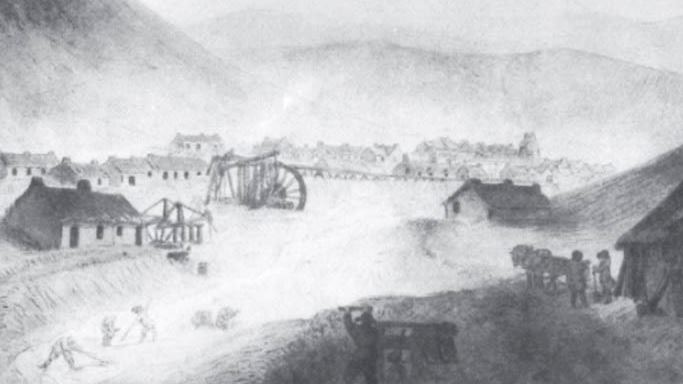
(By courtesy of Dumfries and Galloway Libraries Information and Archives (local studies collection: CO003976. Photograph J J Byers))
George’s interest in mining came naturally; firstly he was interested in just about anything that was either agricultural or industrial, and secondly, mining was in his blood. His brother James mined coal at Loanhead, as did their father, the Baron, and their grandfather, the 1st Baronet (Chapter 4) before them. In addition, in 1739 the Baron went out of his way to see how coal was hewn from under the sea at Whitehaven, and he was called on by his patron the Duke of Queensberry to inspect his mines at Wanlockhead (BJC, pp. 153, 165, 175). As far back as 1718, he and his father had also had their own designs on mining for minerals rather than coal. He says that they went to Leadhills, ‘to view the Lead works belonging to the Earl of Hop[etoun], for we had then a design of purchessing the lands of Glendorch in the nighbourhood’ (BJC, p. 97).
These lead mines at Leadhills and neighbouring Wanlockhead cover an area of many square miles just below the tops of the Lowther hills between Elvanfoot and Sanquhar. Plate 8.2, from an engraving by George’s younger brother, John Clerk of Eldin, gives a realistic impression of what they were like. At an altitude of some 1,300 feet, their environs are truly inhospitable when the weather is anything other than fair and but for the mines the separate villages of Wanlockhead and Leadhills would not, and could not, have existed. Mining had been going on in the area for some hundreds of years by the time the Duke of Queensberry let out his mines to Ronald Crawford’s company in 1755. Ronald Crawford of Restalrig was an Edinburgh merchant who had the capital for this sort of operation. The system was that the landowner owned the mineral rights and he could either do the mining on his own behalf or lease them for a ‘tack’ (take) of the product, for example, in the case of the Duke one bar of lead in every six. But mining was not an easy operation, particularly in these locations and with no mechanisation other than waterwheels. In August 1758, for example, lack of air at the Cove vein was a problem:
The small progress made was owing to the miners not having air enough to enable them to work. (Museum of Lead Mining, 2014)
In August 1762, this same vein had a problem with flooding, which led to George Clerk Maxwell again being consulted by the Duke. Any decrease in output would have directly affected the Duke’s tack, and so he wanted to know what could be done about it, and George was the man who would know. Months later, in December, the problem apparently was just the opposite, a lack of water. The mine manager proposed cutting a drift (horizontal passage) to collect the water from local burns, but the Duke once again wanted George’s views.[81] However much or little it was that George knew about mining, the Duke certainly had confidence in him.
At other times, and with other veins, they met with more success. Production fluctuated because old veins would run out and new ones had to be found. For the year ending January 1762, production was seriously down, having progressively slumped to 40 per cent of what it had been just three years before (Harvey & Downs-Rose, 1976).
8.13 A Mine of His Own
There is no mention of George Clerk Maxwell being directly involved in the Crawford mining partnership, and his connection with Wanlockhead itself seems only to go so far as his occasional intercessions on behalf of the Duke of Queensberry. A tantalising hint from Lewis Campbell, however, implies that he was actually concerned in some other mining venture in the area:
… by and by he is deeply engaged in prospecting about the Lead Hills … After a while he has commenced active operations, and is found making fresh proposals to the Duke. (C&G, p. 18)
The traces of what transpired are to be found in correspondence and agreements between George and his business partners[82] and from the hints these give in turn.
In 1755, Cuthbert Readshaw, a merchant from Richmond in Surrey who dealt in lead, had turned his mind to improving his profits by producing the raw material for himself. However, a venture of that sort always needed a good deal of capital to fund it, so that some sort of partnership was required in order to put it together. He and an associate William Hynd corresponded with George Clerk Maxwell and William Carruthers, a mining master from Dumfries, about the possibility of a joint venture to prospect for lead and copper in Dumfriesshire,[83] where George had probably done a good deal of prospecting already.
As already mentioned, mining had for some time been one of the Clerk family’s business interests. Some forty years after his father and grandfather had visited Glendorch, about three miles south of Crawfordjohn, it fell to George and his associates finally to take up the idea of mining there. According to Irving & Murray (1864, p. 63n2) there was indeed a seam of high quality lead ore in the area: ‘About the end of the eighteenth century “an astonishing and unprecedented width of 18 feet of pure galena [lead sulphide]” was discovered in the Glendorch mines.’ The nearest surviving trace of mining in that area is actually in neighbouring Glendouran. [84] We can guess that the ore had originally been found in Glendorch itself, but once it was played out fresh seams would have been looked for nearby. It was therefore a natural place for George to consider mining, but it is interesting that it was only in the year that his father died that he acted on it. Whereas George was inclined to leap into things, his father and grandfather had been ‘canny’, that is to say, they achieved their good fortune through patience and shrewdness, qualities that were not reflected in George. His father would have exerted what calming influences he could on George, but now George would not only have been free to act as he pleased, he would very likely have found himself with the wherewithal to do it.[85]
In the following year, George and his partners reached an agreement with the owner of the land around Glendouran, William Maxwell 5th Baronet of Calderwood (d. 1789), for 50 per cent of all mines and minerals there.[86] From the scale of what remains to be seen at Glendouran, any operations there were limited and it appears they were too early to be the ones who made the big find mentioned by Irving and Murray.
It seems that the partnership continued to go through a formative period while a more suitable site was looked for. James Hutton may have been consulted, for he mentions in a letter to George that he had investigated a site around Leadhills and found some signs of metal ore.[87] On 1 January 1758, however, George and his partners took out a thirty-one year lease on the Earl of Hopetoun’s property at South Shortcleugh.[88] Since this was over three miles to the south-east of their original mine, they were clearly starting afresh.
Only days later, further agreements were entered into. While one of the partners, Hynd, dropped out, Joshua and Caleb Readshaw came into the discussions along with Samuel Smith of Washton, a smelter. Nevertheless, the scheme to mine at South Shortcleugh was overtaken by events in 1763 when a soldier working on the new military road from Dumfries to Port Patrick happened to discover a quantity of lead ore at Blackcraig (Statistical Accounts, 1791−99, pp. 54−55), about two miles south-east of Newton Stewart[89] on the land of Patrick Heron of Heron and Kirroughtrie, a banker and later MP for the Stewartry of Kirkcudbright, and the rights were his.[90] Although it was in a different area altogether from the mines in the Lowthers, in fact some sixty miles to the south-west, there were several attractions to mining there: it was not an inaccessible, inhospitable area; it was near both to the sea and the new military road, so that shipping lead or even the ore would be straightforward; and there were as yet no competing mines in the immediate vicinity.
The new mining venture began slowly to get under way. Discussions on the structure of the partnership were still being held in 1764, and when the company articles of the Craigtown Mining Company were finally signed in 1766, Smith had dropped out to be replaced by Philip Jackson, another London merchant. Although Patrick Heron did not come in as an actual partner in the company, he would get the customary tack on any lead produced. However, as ‘joint-adventurer’, he would have had some additional form of interest for in it, for example, he could have put up some capital. The partners being now fully focused on Blackcraig, the lease over South Shortcleugh was duly abandoned in 1769.[91]
A drawing[92] dated 1768 shows the site plan. The first mine was probably adjacent to the original find on the old military road where it passes Blackcraig farm on the present map. The group of buildings at Craigton, or Craigtown, is clearly the source from which the partnership took the name of their company. Although some of the houses there are now of a much later construction, the company were granted permission to build accommodation, offices and works buildings in and around the settlement. While a few of these older houses are still to be seen where the old military road forks uphill away from the single street, the name Craigton has disappeared from modern maps and only the names of individual houses are left as reminders.
Operations at the mine must have started by 1770 because a suit for damages was filed by neighbouring prospectors, Thomas Paton and Richard Richardson, who were businessmen from the north-west of England. Alerted by news of veins of lead ore, these gentlemen had taken a lease on the adjacent property of Patrick Dunbar of Machermore,[93] which ran between Patrick Heron’s property and the river Cree and was where Blackcraig itself actually lay. Calling their venture the Blackcraig Company, these wily opportunists clearly thought that since the veins were near the boundary line, there would be a good chance of them extending over onto their side. Not only did their hunch turn out to be right, George and his partners began to suspect so as early as 1768, a stark warning for them about the highly risky nature of their business.[94] At least it turned out that the ore on the Blackcraig Company’s side appeared not to amount to much.
Meanwhile, the Craigtown mining company got into production. Later in the same year, George and his brother Sir James borrowed £1,500 from the Royal Bank of Scotland, an enormous sum at the time.[95] Though not a partner, Sir James had been in the background of George’s project, presumably providing advice and financial backing, for there are accounts of the dealings between themselves and with the Bank of Scotland during this period.[96] At this stage, with the mine now in production, James clearly had sufficient confidence to put his name alongside George’s on a bond of this magnitude for the purpose of funding the substantial investment that was required to get the mine producing in earnest.
By 1778 at the latest, William Mure had been put in charge of the Craigtown mines[97] and he regularly reported to George on how things were going; there was a smelter on site (but evidently not a very effective one); an ore crusher; a water wheel to power the ore crusher; water to power the wheel and to wash the ore; and lades to bring in the water from the hill. With forty or so employees, annual production reached about fifty tons of lead, representing about £1,000 of output, by comparison only a tenth of Wanlockhead’s (Donnachie, 1971, p. 122). At first the lead cost more to produce than it sold for, but even in a year when a profit of £150 was achieved through cost cutting, the dividend of each partner would hardly amount to much. It was certainly not the kind of return that would have been needed to pay off the capital costs, not to mention the ongoing investment that would be required to boost production to a sustainable level. It is hard to see how the investors would have ever got their money back. Nevertheless, a shot mill was built at Creetown in 1780 so that they could get some added value on the lead produced, but even if that doubled their profits, it had also added to the total investment of capital. The fact that war with the American colonies and its European allies ended shortly afterwards could hardly have helped matters, for the demand for lead shot would have plummeted as a consequence.
By 1791, output had fallen to very low levels, only thirty tons a year (Statistical Accounts, 1791−99, p. 55) and at some point production must have ceased with huge losses all round. In the meantime, however, the Blackcraig mining company had continued, quite literally, to ‘dig around’ with some success and they had eventually been rewarded with 450 tons or so of lead ore per year, far more than the Craigtown company had achieved. Even so, their luck was short-lived, and the ore began to run out (Donnachie, 1971, p. 124).[98] The consequences of all this for George Clerk Maxwell were to be grave indeed.
8.14 Other Activities and Interests
In the eighteenth century, travel in the Highlands involved many privations and was not to be undertaken lightly. Nevertheless, in May 1739, George had accompanied his father on a tour of the north of Scotland via Perth and Dunkeld to Inverness, where they had visited their relative, Duncan Forbes of Culloden (see note 30 to Chapter 3). They returned by the coastal route by way of Elgin, Aberdeen and Dundee (BJC, p. 152). In 1764 he was to repeat the experience in the company of his friend Dr James Hutton. They followed a similar route to George’s earlier journey, but from Inverness they went on through Easter Ross to Caithness (Playfair, 1803, p. 45), perhaps because the area around Helmsdale is rich in geological interest, notably the Helmsdale fault. George was interested in Hutton’s geological work and may even have done some field sketches for him, but having been appointed as a Commissioner for the Forfeited Estates in the previous year, he would have been taking in all that he saw by way of opportunities for improvement.
Hutton was also the close friend both of George’s younger brother, John Clerk of Eldin, and later his son John, who became Lord Eldin, and between them they accompanied him on three other excursions to Glen Tilt, to the south-west of Scotland, and to the Isle of Arran. The Clerks recorded many of the places they visited in etchings and drawings, especially John Clerk of Eldin (Bertram, 2012a and 2012b).
It seems, however, that George made at least two separate journeys to the Highlands around June of both 1766 and 1767, most likely on Forfeited Estates business. One of the places he visited at that time was Rannoch, about thirty miles west of Pitlochry (Millar, 1909, p. 242), on the forfeited homelands of Clan Robertson, where a barracks had already been constructed in 1746. The record of this event is a petition that he received from one Donald Robertson of Rannoch, who had a workshop there with three looms and was endeavouring to obtain three more, but the trouble was he could not afford them. In his petition, he reminded George that, during his visit of ‘June last’, he had offered to have the additional looms funded by the Commissioners.
▪ . ▪ . ▪ . ▪ . ▪ . ▪ . ▪ . ▪ . ▪
In 1760, George Clerk Maxwell was appointed to yet another office when he was named as one of the trustees for Fisheries, Manufactures and Improvements (Clerk , 1788), a role which fitted well with his own involvement under his father’s tenure of this office, such as the spinning school mentioned above that he had set up at Dumfries some twenty years before and was still going in 1751. However, a few years later, at the time he was appointed as a Commissioner for the Forfeited Estates, the two roles tended to overlap since the Commissioners were trying to encourage the Board of Manufactures’ efforts to be applied within their own sphere of activity. As to George’s efforts to promote manufacturing closer to home, he now proposed to the Duke of Queensberry that weavers in various parts of Dumfriesshire should be offered subsidies to spin wool and to knit stockings.[99] In the same year there was also mention by the Duke of being in favour of proposals, in which Lord Elliock was also involved, for setting up a paper mill,[100] but sadly little more information than this appears to be available.
Having been appointed a trustee for the Board of Manufactures and Fisheries, George then became involved with the Edinburgh Society for the Encouragement of Arts and Sciences and Agriculture [101] under whose aegis a drawing school, the Trustees Drawing Academy, was set up in 1757. There was an existing drawing school, the School of St Luke, which operated during the winter from a room in the Old College. The Society offered attractive cash prizes to those pupils who produced the best drawings featuring some practical subject matter, such as a landscape design, a carpet design, or some floral patterns for prints; what is more, the offer applied equally to girls as well as to boys. In 1760, the year George joined the board of trustees, it appointed a permanent drawing master with a decent salary, and it thereafter became known as the Trustees Drawing Academy of Edinburgh, the precursor of Edinburgh College of Art. The third drawing master there was Alexander Runciman who, on his return from Italy in 1772, was painting scenes from Ossian on the walls and ceilings of the hall of the new Penicuik House, for George’s brother, Sir James Clerk, the 3rd Baronet (Runciman, c. 1772; Laing, 1869).
▪ . ▪ . ▪ . ▪ . ▪ . ▪ . ▪ . ▪ . ▪
George Clerk Maxwell is recorded as being a founder member of the RSE, that is to say he was already a fellow of the Philosophical Society of Edinburgh of which both his father, Baron Sir John Clerk of Penicuik, and his father’s cousin, Dr John Clerk, had been co-vice-presidents (see note 32 to chapter 4).. He submitted an article on agricultural improvement which was read in 1761 and later published in their Essays and Observations Physical and Literary (Clerk, 1771). Shallow ploughing, where only the top three inches of soil was turned over, was practised in Norfolk and he was making the suggestion that it might do well in Scotland. Lord Kames, however, disagreed and his viewpoint on the subject was published in the immediately following article. This was not, however, the only article of George’s to be published by the Philosophical Society, for in Clerk (1756) he had already reported on bones, supposedly of an ancient elk, that had been found near Dumfries.
George’s article on shallow ploughing, however, also reveals something of himself as a practical man, one for trying things out rather than learning from books:
Some are convinced from what they hear or read; nothing will make impreffion upon others but occular demonftration; and, for my part, I am of the laft clafs, an unbeliever that could not fee the weight of arguments advanced in fupport of the practice, till I had an opportunity of … obferving. (Clerk, 1771, p. 56)
This chimes with his own preference to take up a practical profession rather than to become a lawyer. The initial pages of the same article also inform us that some time before his paper was read in February 1761, he had had the opportunity of travelling to England to observe for himself the farming methods in Norfolk and Lincolnshire, and possibly even Derbyshire. Since we already know that it was in 1764 that he went to London with William Craik to discuss his proposal for purchasing the Isle of Man with the prime minister, this was clearly an earlier and entirely separate expedition.
George was also a founder member of the Society of Antiquaries of Scotland[102] that was formed shortly before the RSE gained its charter. He was a keen antiquary and assisted the military surveyor General William Roy (1726−1790) in his search for Roman remains in Annandale (Prevost, 1968). In 1764 Roy had discovered a temporary camp at Cleghorn near Lanark, whereupon ‘he requested his friend, Mr Commissioner Clerk’, to search for similar camps in Annandale. George subsequently found the remains of two possible camps, one of which was at Torwood Moor, half a mile west of Lockerbie. While the discovery of this site is attributed to Roy,[103] the camp’s original finder was obviously George Clerk Maxwell (Macdonald, 1920, p. 90).
▪ . ▪ . ▪ . ▪ . ▪ . ▪ . ▪ . ▪ . ▪
Given the great number of things that George Clerk Maxwell was involved in, it is perhaps surprising that he had the time to be involved in anything more. Nevertheless, on five occasions between 1763 and 1780 he was the commissioner representing the Burgh of Sanquhar[104] at the Convention of Royal Burghs (Brown & Anstruther, 1894, Appendices B and C). This ancient convention was held annually in Edinburgh for the purpose of advising parliament on local regulations and bye-laws, particularly those affecting trade. The manner in which George’s name is recorded gives clear evidence of its variability. It appears first as ‘George Clark Maxwell of Drumcrieff’, then ‘George Clerk of Middlebie’, and finally as ‘George Clerk of Drumcrieff’. In 1768, it seems that the role was instead given to his son George, who is described as ‘George Clark, younger of Drumcrieff’, who appears to have also represented the burgh at the General Assembly in 1769−70.
8.15 The Fall of Dumcrieff and Middlebie
In 1774 George Clerk Maxwell had laid down a large plantation of trees at Aikrig on the south-western edge of his estate at Dumcrieff, and consequently we may well think that shortage of cash was not one of his problems at the time.[105] By 17 January 1777, however, he was being asked by Dumfries Kirk Session to pay off his debts to them, with a further request on 21 July 1778.[106] Such debts may have been relatively trifling, but they certainly seem to indicate that he was financially embarrassed at the time.
In the language of his era, George was an ‘adventurer’, what we would now refer to as an entrepreneur. He had taken a number of chances over the years, and that he was impetuous is suggested by his ‘irregular’ marriage to his cousin Dorothea in 1735. His first significant enterprise had been the linen factory that he opened in Dumfries, c. 1739, but then had to shut down in 1748. There had been some farming in the background and later an involvement in road building which, admittedly, may have been contributing to the public good. Then there had been his investment in the Forth and Clyde Canal, which cost him £500 plus further cash calls. Nevertheless, on the plus side he had secured three government posts and some other minor appointments which paid him well and, as was common at the time, probably brought him a number of additional perks and opportunities. Not only was he managing to undertake these things with great energy, he somehow also found time to go casting around Dumfriesshire for mining opportunities, and when he finally got the Craigtown Mining Company together, the effort of prospecting was simply replaced by the problem of getting it to yield enough lead.
But if he had travelled this road in hopes of succeeding with mining, his arrival was quite a disappointment. As we have seen, instead of profiting from his ventures, it had probably bled him dry by consuming his capital without ever yielding anything like a proportionate return. He had borrowed the necessary capital with the help of his brother James, by then Baronet, but whereas for James his Penicuik estate and his income from the coal mines probably gave him some extra slack with his creditors, for George it was a different story:
Sir George Clerk, by Disposition of [April] 1782, registered in the Books of Council and Session 15th January 1783, in which he is designed George Clerk Maxwell, Esq. of Dumcrieff, one of the Commissioners of His Majesty’s Customs, conveyed with consent of Mrs. Dorothea Clerk Maxwell, his spouse, inter alia, these lands[107] to Alexander Farquharson, accountant in Edinburgh, as trustee for his creditors. (BJC, pp. 249-250, Note N)
That is to say, he had had to surrender to an administrator all the properties that his father had given him as his start in life . Of course, we have found no direct evidence that it was principally the mine that occasioned this financial misfortune, but its failure to repay anything but a fraction of its total capital cost seems to make it fairly certain.
George’s difficulties would have been exacerbated if his brother James’ financial position had also been severely stretched, for example, as a result of all the expenditure he had laid out on building and lavishly appointing the new Penicuik House. James was very ill by late 1782, a fact which must have impressed on their creditors some urgency in calling their bonds in, and upon George and James the necessity, above all else, of saving Penicuik. It was therefore decided between them that the best thing to do would be to set aside the debt that George owed to James and concentrate on paying off the external creditors (Mackay, 1989, p. 2).
In financial terms, the situation was not fatal, just very bleak; George had no prospect of eventually paying off his debts out of his income alone, for the lack of return on his speculations was the very root of the problem. Whatever lesser measures were taken to claw back money for the creditors we do not know, but by his action in April 1782, Dumcrieff and the lands at Middlebie proper were put into Farquharson’s hands as security for his creditors, to be sacrificed, if necessary, to save Penicuik. It would have been difficult to do anything similar with the rest of the Middlebie estate, that is to say Dorothea’s collection of properties in and around Dumfries, because the greater part of them were still under the entail of 1722.
The calamity took place amidst all the other family tragedies that beset him and Dorothea in that year; the disposition was formalised in the courts at Dumfries the following month,[108] and thereafter in the Court of Session in Edinburgh in January 1783 (as mentioned above).
The pains of an illness that he was now developing must have been as nothing compared with the pangs of regret that he must also have been feeling at this time. How diligently his father had conceived and executed his plans for Dumcrieff, only for George to lose it by risky speculations that were the antithesis of his father’s measured way of proceeding. How skilful his father had been in freeing the Middlebie estate of its burden of debt and buying the property back again to put in George’s hands, only for it to be lost for good. How great the loss of face, to lose the two names, Dumcrieff and Middlebie, that had been synonymous with him for most of his married life. How low the standing of a man once so esteemed and now found to be sadly wanting. Despite all his good deeds, he would seem to be only a faint shadow of what his father was before him.
On the death of Sir James in February 1783, George became the new Baronet and his debts to his brother were consequently eliminated. Even so, in stepping into his brother’s shoes, he still did not have the wherewithal to save Dumcrieff and Middlebie, and so Farquharson proceeded with the usual humiliating form of disposal by public roup.[109] By the sale of Dumcrieff he hoped to raise £5,600, and it went at the first attempt for £5,300, not far from the valuation: ‘Farquharson, as trustee, with consent of Sir George, disponed [Dumcrieff] on 22d May 1783 to Lieutenant-Col. Wm. Johnston, of the Royal Artillery’[110] (BJC, pp. 249−250nN). The parcels of land at Middlebie had been expected to raise £7,200, but they did not sell at the first attempt. They were offered separately on two occasions, but each time with no success. Finally, the price was dropped and they eventually went in 1787 for £6,300 to David Ewart, a writer in Edinburgh.[111]
By the time Dumcrieff was sold, George’s own health was failing. According to his nephew John Clerk:
the most acute bodily pains gradually wasted his constitution. He bore all his distresses with unshaken fortitude to the last, and attended to the duties of the publick Boards of which he was a member, with the same assiduity and perseverance as ever. (Clerk, 1788)
In the last few years he had lost a brother, two sons, a daughter and a grandson; his mining venture had done poorly; and the total consequence of all that he had worked for was that he had been nearly bankrupted and had suffered the humiliation of not only losing Dumcrieff and Middlebie as properties, but from his name. It could have given him little comfort to succeed as 4th Baronet of Penicuik. Nor did he live to put these dreadful years behind him, for he died on 29 January 1784, less than a year after succeeding his brother. It would be left to the next new baronet, his son John Clerk, and his widow Dorothea, to cope with the aftermath.
Soon after George’s death, Dorothea moved out of James Court in the Old Town to Princes Street, the New Town’s splendid main street overlooking the sunken gardens newly being created in the basin of the now drained Nor’ Loch (Plate 8.3).[112] We cannot exactly say whether this was consequent upon her husband’s death or if the move had already been planned in the wake of George inheriting the baronetcy from his brother in 1783. Having been ill for some time, he may have wished to retire to the more salubrious surroundings of the New Town. Dorothea’s house number was not given until the next issue of the Post Office directory, in 1786, when it was number 30 Princes Street, but from 1788 it was given as number 52; as frequently turns out to be the case, this could simply have been a numbering issue rather than an actual move of house.

The houses were then uniform and plain-fronted, in obvious contrast to the present mish-mash of heavily modified frontages and modern buildings. The extension of the earthen bank across the drained Nor’ Loch, seen in the centre of the picture, indicates the commencement of the Mound emerging to the west of the gap between the buildings at Hanover Street.
From the etching by Elphinstone in (Arnot, 1788). There is an earlier version of this print in which the buildings on the far left are unfinished.
George and Dorothea’s second surviving son, James, having come home from sea, lived with his widowed mother at Princes Street and continued to do so upon his marriage to Janet Irving in 1786. Unfortunately, Dorothea suffered a stroke in 1788 from which she did not properly recover, leaving James to manage her day-to-day affairs.[113] James died on or about 14 December 1793, and she followed him a fortnight later (Mackay, 1989), on the 28th of that month.[114]
Notes
[1] DGA: GGD56/(Unsorted Box), Life of George Clerk Maxwell, c. 1788. This detail was omitted from the published version (Clerk , 1788, pp. 51−56). Jock’s Lodge is on London Road to the east of Edinburgh (Figure 13.1).
[2] Described by the Rev. Mr William Scott in Statistical Accounts (1791−99, vol. 12, p. 24).
[3] NRS: GD1/1432/1.14, 2/5/1732.
[4] NRS: GD1/1432/1.45, 17/5/1729
[5] This school is unconnected with the later Lowther College in Lancashire and thereafter in Wales. It was in the village of Lowther, near Penrith in Cumbria and less than a half mile west of the present M6 motorway, about three miles south of the Penrith Junction. The school was founded by Sir John Lowther Bt, afterwards Viscount Lonsdale, who was born in the parish of Lowther, then in county Westmorland. Based on his own experience of school he formed the opinion:
… if a parent send his son to the university to be educated as a gentleman, he should by all means engage a governour to attend him, who should be so much of a scholar, as to improve his school-learning, yet so complacent and polished in his manners, that his pupil might respect and love him, and delight in his company. (Lowther, 1808)
Having rebuilt the church at Lowther, in 1698 he built and endowed a school, Lowther College, in fulfilment of these philanthropic notions. In George Clerk’s time the master was a Mr Wilkinson, who the Baron thought to ‘answere the charecter I had got of him, for he was indeed a learned, honest, diligent, careful man’ (BJC, p. 139). At the behest of the then Viscount Lonsdale, the school closed when Mr Wilkinson retired in 1740, in order to allow the charitable funding to be directed towards manufacturing, making use of the local wools, rather than for the benefit of the education of young gentlemen. George would no doubt have approved, for it was in 1739 that he was also setting up a similar scheme in Dumfries for the manufacture of linen (Curwen, 1932).
[6] NRS: GD1/1432/1.16, 25/2/1731.
[7] NRS: GD1/1432/1.14, 2/5/1732.
[8] NRS: GD1/1432/1.15, 18/4/1733 and GD1/1432/1.17, 19/4/1733.
[9] NRS: GD18/5396, 8/11/1732.
[10] NRS: GD18/2338, 1735.
[11] For example, Henry Walker (d. 1730) of Blackfriars Wynd in Edinburgh was accused of conducting irregular marriages (Scott, 1915, vol. 1, p. 278). He could well have been the very man as the Baron’s town residence was in that same street (note 5 of Chapter 4).
[12] SOPR: Marriages, 697/00 0030 0093 Penicuik.
[13] The betrothal of George Clerk and Dorothea Clerk Maxwell is said by the Baron:
… to have been in accordance with her mother’s dying wish. (Dorothea was seven years old when Agnes Maxwell died! ) (C&G, p. 19)
The all-important exclamation mark is Campbell’s.
[14] NRS: GD18/1973, 11/10/1735.
[15] NRS: GD18/1975, 28/12/1737
[16] DGA: GGD56/5, Extract Interlocutor in the process of Sale … 9/2/1738.
[17] DGA: GGD56/27, An Act to Enable Dorothea Clerk to Sell Lands … 1738;
GGD56/36, Copy of the Middlebie Entail (9/6/1722), 9/10/1735.
[18] NRS: GD1/1432/1.2, 14/10/1735.
[19] NRS: GD18/5396, 25/9/1736 and 22/4/1737.
[20] NRS: GD1/1432/1.44, 6/10/1736.
[21] Shalloch was to come into the Clerk family at a later date, for it was given to John Clerk Maxwell in 1826 by his brother George, 6th Baronet of Penicuik, as part of his wedding settlement (see later). Dorothea must have inherited the property sometime after 1737, for she got little out of her uncle’s will when he died in that year.
[22] NRS: GD1/1432/1.12, 14/12/1737.
[23] NRS: GD1/1432/1.23, 4/4/1738.
[24] NRS: SIG1/32/18, Signature of the lands of Drumcrief etc … 13/2/1738.
[25] NRS: GD18/2606.3, 24/2/1738.
[26] See documents cited in Inrollment of George Clerk Maxwell in DGA: GGD56/ (Unsorted Box), ?/5/1741. The relevant item is General Retour in Favour of Dorothea Maxwell alias Clark as Heir to the Said John Maxwell, dated 6 February 1738. The fact that Dorothea was returned as heir meant that it was accepted beyond doubt that she was not a Roman Catholic.
[27] NRS: GD18/1880, 15/8/1738.
[28] NRS: SIG1/35/21, Signature of the Lands of Middlebie, 6/8/1765.
[29] DGA: GGD56/ (Unsorted Box), Inrollment of George Clerk Maxwell, ?/5/1741.
[30] Miss Isabella Clerk was the seventh child of Sir George Clerk, 6th Baronet of Penicuik, and therefore James Clerk Maxwell’s first cousin. Being born after 1828, she was probably of a similar age (Foster, 1884). She lived with her older brother, Major-General Henry Clerk, at Hobart Place, Eaton Square, London (London Gazette, 25/2/1880, p. 1537).
[31] He was involved in projects such as: the repair of a road at the Bield near Tweedsmuir to the north of Moffat (NRS: GD1/1432/1.25, 18/4/1749); a scheme to realign the road at West Linton (NRS: GD18/5396, 13/9/1749); roads to the Hartfell Spa and the Moffat Well (Prevost, 1968, pp. 204−205); and a new turnpike built alongside Annan Water, which required the building of two bridges in 1763 (Prevost, 1968, pp. 204−205).
[32] NRS: GD18/5396, 2/10/1738
[33] NRS: GD1/1432/1.18, 25/10/1738
[34] DGA: GGD56/ (Unsorted Box), Notebook of George Clerk Maxwell, 1/11/1774
[35] NRS: GD18/5396, 13/3-10/9/1739 & 12/11/1739
[36] George’s father, the Baron, had been a trustee of their Board since 1727, which no doubt helped. John Cockburn of Ormiston (1685−1758) had already established such a school at Ormiston in East Lothian in the same way (NRS: GD18/5905, 1739; Gazetteer for Scotland, 2013a). George Clerk Maxwell’s spinning school in Dumfries is cited in: DGA: GD18/5903, 1738−39, which mentions the Board’s approval for setting up the school; DGA: GD18/5916, 28/11/1748, which concerns the school itself and purchase of linen yarn; and DGA: GD18/5918, 1748−49, which refers to letters from the spinning mistress, Elizabeth Hill, about school matters and her salary. In 1751 the school was still going with forty pupils (McDowall, 1873, Chap. 42)
[37] NRS: GD1/1432/1.46 25/9/1739 and GD1/1432/1.47, 28/9/1739
[38] NRS: GD18/2232, 1740 and Prevost (1969).
[39] NRS: GD18/5396.43, 29/3/1742 and GD18/5396.48, 14/4/1742.
[40] His post was Clerk of Discoveries (see e.g., NRS: E749/1, 1748-49; E769/6 1749-52). In the earliest available directory of 1773, his address is given as James’ Court off the Lawnmarket. The records of the marriages of his daughters Agnes and Dorothea suggest the Clerks had been there or nearby since 1758, as they are given as being in the Tolbooth Parish, which covered the Castlehill area. James’ Court dates from c. 1725. David Hume also lived there until the early 1770s, after which he let his apartments to James Boswell. George Clerk Maxwell must therefore have known Boswell and Hume fairly well, and indeed Boswell records having been at a dinner in 1780 where George was amongst the party (Boswell, 2013, p. 397).
[41] DGA: GGD/13.22, c. 1748.
[42] SRS: Edinburgh Marriage Register 1751-1800, 3/12/1758; NRS: GD18/1883, Antenuptial Marriage Contract…, 4/12/1758.
[43] He was buried at Penicuik Churchyard (St Mungo’s) on 24 February but the actual date of death is unstated in SOPR.
[44] Foster, 1884; EPD: 1773, 1774, 1775; Grant, 1944, p. 36 (wherein it wrongly gives ‘Dunbarney’ for ‘Dumcrieff’).
[45] The East India Company had started out with a charter giving them the monopoly of trade with India and soon formed settlements there on the East Coast. Before long they virtually ruled a large portion of the country, had an army on land and merchant fleet at sea. By the monopoly of their exports back to Great Britain they created fantastic wealth.
[46] Foster (1884) confuses this George Clerk Craigie, advocate, with Captain George Clerk, son of Agnes Clerk and John Craigie of Glendoik, who died in the US war of Independence in 1781.
[47] http://en.wikipedia.org/wiki/Great_Siege_of_Gibraltar
[48] SOPR: Deaths, 685/010970/0266 Edinburgh, 27/11/1781. It is still possible, however, that this record was for her aunt.
[49] NRS: GD18/2327, 17/3/1742.
[50] NRS: GD1/1432/1.59, 1763.
[51] General George Wade (1673−1748) is better known as the builder of the first system of military roads and barracks in the Scottish Highlands (1724−36). His bridge over the river Tay at Aberfeldy still stands. The Duke of Cumberland (1721−1765) was William, third son of George II, who became notorious for his merciless pursuit of the Jacobite rebels after Culloden, earning himself the soubriquet ‘the Butcher’.
[52] NRS: GD18/3249, 1745.
[53] The Land of the Mountain and the Flood is the very apt title of the 1887 overture by Hamish McCunn. For an idea of the old Highland way of life, see the works of John Prebble. Lion in the North (1971) is a concise history of Scotland, while Culloden (1967) gives a comprehensive account of the ’45 and its immediate aftermath. Glencoe (1968) and The Highland Clearances (1982) are also rich in their discussion of two other highly dismal episodes of Scottish history.
[54] It was in fact the second such Commission, the previous one having been set up in 1716 in the wake of the first Jacobite rebellion. Forts William, Augustus and George, and Wade’s military roads had all been built as a result.
[55] Son of the John Baxter (d. 1770) who had been a builder to the Baron (Chapter 4). While it was the father who built the new Penicuik House to Sir James Clerk’s design, the son, having studied in Rome as one of Sir James’ protégés, did some of the finishing details (DSA, 2014).
[56] NRS: E728/33, 1774−79.
[57] NRS: E730/21, 1771−79.
[58] NRS: GD1/1432/1.55, 2/9/1754 and Smiles (1904, p. 203).
[59] Fresh income had become available because the forfeited estates were now being returned to the heirs of the attainted owners. Those who benefited by the return of an estate had to pay money to the Crown in order to clear off the debts lying on the estate at the time of the forfeiture. Baron Sir John Clerk noted that almost all of the estates were far in debt for, if it had been otherwise, the proprietors would have thought twice about coming out in the rebellion (BJC, pp. 220−221).
[60] NRS: GD18/2615, 1768−1778.
[61] John Stuart (1713−1792), Prime Minister 1762−63, later 3rd Earl of Bute.
[62] NRS: GD1/1432/1.28, 15/6/1762.
[63] NRS: GD1/1432/1.29, 7/8/1762 and GD1/1432/1.56, 1/11/ 1762.
[64] NRS: GD1/1432/1.30, 14/12/1762.
[65] Charles Duke of Queensberry had become one of a growing breed of lords to leave his factors to attend to business at home while he himself was in London or at his Amesbury estate in Wiltshire. Amesbury is a few miles north of Salisbury and over 360 miles distant from Drumlanrig. The Duke’s mansion there was built by Inigo Jones (Virtue & Co., 1868).
[66] William Muir of Caldwell had been MP for Renfrewshire and was appointed Baron of the Exchequer in 1741 (Hamilton, 1894).
[67] NRS: GD1/1432/1.31, 10/1/1763.
[68] NRS: GD1/1432/1.32 and GD1/1432/1.33, ?/3/1763.
[69] NRS: GD1/1432/1.36, 17/3/1763.
[70] NRS: GD1/1432/1.37, 22/3/1763 and GD1/1432/1.34, 24/3/1763.
[71] William Craik (1703−1798). Arbigland is on the Solway coast due south of Dumfries. John Paul, father of the US naval hero John Paul Jones had a gardener’s cottage on that estate; it is now preserved as a museum.
[72] The date given for the visit to London in this article is 1761, but since George was not appointed until 1763, it is likely to have been a misreading for 1764. In the same article, it is said that Craik could have been a Commissioner for the Board of Customs, but he would not go to Edinburgh to take up the post. That being the case, George must therefore have had to be regularly in Edinburgh.
[73] Frandzen, 2014; Kay & Paton, 1877, vol. 1, no. CLIII, pp. 384−385.
[74] Rae, 1895, Chap. XXI, pp. 325−338. The Grassmarket is an open low-lying area at the west end of the Cowgate to the south of Castlehill. In years gone by it was the livestock market, from the French ‘grasse’, meaning ‘fat’, as in fat-stock.
[75] The customs house was then in the town itself, not at the later site on Commercial Street in Leith. The legend to John Ainslie’s 1780 map of the city shows it to be at ‘K’, which is off the High Street in the exchange building, now the city council chambers.
[76] Not to be confused with the Isle of Man, mentioned previously. The Isle of May is yet another island. This one lies off the east coast of Scotland at the entrance to the Firth of Forth.
[77] The ship had been loaned to the colonial Continental Navy by the French, hence the possibility of confusion.
[78] NRS: GD1/1432/1.27 12/9/1753.
[79] CANMORE: ID 48491.
[80] Ramsay, 1888, vol. 2, pp. 327−335. John Ramsay (Horn, 2004) wrote a letter to George Clerk Maxwell in which he praised the new spa and referred to Williamson as a ‘so-called daft man’ (NRS: GD1/1432/1.51, 18/4/1750). The mine workings may have been a copper mine lying on the same contour only a few hundred yards west (Pococke, 1887; CANMORE: ID 48490).
[81] NRS: GD1/1432/1.29, GD1/1432/1.56; GD1/1432/1.30, 7/8/1762−14/12/1762.
[82] NRS: GD18/1123, GD18/1164‒66, GD18/1168‒70, GD18/1173; GD18/1179, 1755−82.
[83] NRS: GD18/1164, 1755.
[84] On the 1864 6” OS map recommended by the NLS for looking for old workings, the nearest old mine lies about a mile north of Glendorch at Glendouran (CANMORE: ID 258031), but there is no indication at Glendorch itself. The mine is an isolated spot high up in the glen.
[85] A wealthy father would generally leave individual bequests, in the form of bonds of provision, for those children who were not in the fortunate position of being his heir. For example, the Baron mentions the individual bequests left by his own father (BJC, pp. 110−111), in particular the 15,000 merks (about £750 sterling, a considerable amount of money roughly equivalent to £60,000 today) left to his half-brother James. We may consider that George would have benefited from at least a similar sum on the death of the Baron.
[86] NRS: GD18/1165, 10/9/1756.
[87] NRS: GD1/1432/1.26, 26/5/1757
[88] DGA: GGD56/18/11, Lease or Tack by the Earl of Hopetoun to George Clerk Maxwell & his Partners of Three Fourth parts of the Mines in South Shortcleugh. 11 years from 1st Jan’y 1758, 1758−69. The opening words were later overwritten with ‘Renounced’.
[89] It was near Blackcraig farm (Donnachie, 1971, p. 121) just to the north of the present A75.
[90] Patrick Heron, landowner and ‘joint-adventurer’ with the Craigtown Mining Company, was struck by a calamity in 1773 when the bank Douglas, Heron & Company was caught out with too many loans on their books. They went bankrupt with a loss of over £663,000 to its 225 shareholders, the Duke of Queensberry amongst them (The Archive Hub, 2014; RobertBurns.org, 2014). Although he was only a co-adventurer with the Craigtown Mining Company it is feasible that some of the partners felt the shock of this collapse. Though Heron himself managed to recover from the collapse of his bank, it was a great scandal.
[91] DGA: GGD56/1811, 1758−69.
[92] NRS: RHP3849, Sketch Plan of Daltamie and Blackcraig, 1768 (Donnachie, 1971, p. 121).
[93] A distant cousin of Patrick Heron.
[94] NRS: GD18/1173, 1770.
[95] DGA: GGD56/18.12, 8−11/5/1770.
[96] NRS: GD18/2254, 1766−77.
[97] NRS: GD18/1126, 21/11/1778.
[98] The mines in the area enjoyed a revival between 1853 and 1880 as Blackcraig East and Blackcraig West, the workings that were eventually recorded by RCAHMS. They produced an average of 130 tons of lead a year between them, and so it was still not a huge yield.
[99] NRS: GD1/1432/1.34, 24/3/1763.
[100] NRS: GD1/1432/1.35, 5/1/1763.
[101] An offshoot of the Select Society (Emerson, 2004) of which he had become a member around 1755.
[102] The Society of Antiquaries of Scotland (2014). Amongst their proceedings is the article on the Trustees Drawing School referred to above (Laing, 1869).
[103] CANMORE: ID 66815.
[104] Sanquhar was not close to home. It lies on the Nith some twenty-five miles up river from Dumfries, and it is some thirty miles distant from Moffat by a difficult route.
[105] It seems unlikely, therefore, that he was one of the unfortunate people to have made substantial losses as a result of the 1772 banking crisis, or, despite his close business association with Patrick Heron, the ensuing collapse of the Douglas and Heron Ayr Bank in 1773
[106] NRS: CH2/537/8, Dumfries Kirk Session Records, pp. 20 and 79.
[107] All of Dumcrieff and the disentailed lands of Middlebie that had been repurchased by his father. That he needed Dorothea’s consent is an indication that there was some further complexity to it. Alexander Ogilvie Farquharson of Haughton was an Aberdonian who had a significant reputation as an accountant (Brown, 2004). He may well have been known to George beforehand, for one of his tasks had been reporting on the finances of some of the forfeited estates.
[108] DGA: GGD56/29, Roup of Dumcrieff and Middlebie, 29/12/1787. The date on this document is 1787 because the document quoted as evidence was drawn up for a separate process in the Court of Session that took place some five years later. It refers to the roup, for which it gives ‘the tenors’. James Boswell and Charles Hay, his friend at the time, were the advocates in the case.
[109] DGA: GGD56/29, 1787.
[110] The Rev. John Walker, minister of Moffat, acted as an intermediary on Lt Col Johnson’s behalf at the roup presumably because the latter had not yet returned home from service. The ownership of Dumcrieff after Col Johnston is given by Prevost (1968, p. 210). Dumcrieff was at one time rented by John Macadam (1756−1836), the road-building pioneer, whose original sandstone roller is said to remain there:
[111] With thanks to Catherine Gibb at Dumfries and Galloway Archives for extracting this information out of the articles of roup.
[112] See Figure 1.1. It was progressively drained between 1759 and 1763. (Royal Scottish Geographical Society, 2014)
[113] DGA: GGD56/18/1, Statement of Lady Dorothea’s and James Clerk’s Affairs, 1794.
[114] DGA: GGD56/18/14, Statement of Account, 1796.
 Brilliant Lives