Brilliant Lives
By John W. Arthur
Second edition
Published by the author in 2024
First published in Great Britain in 2016 by
John Donald, an imprint of Birlinn Ltd
Copyright © John W. Arthur 2016, 2024
All rights reserved.
Contents
9.1 Sir John Clerk, 5th Baronet and Lady Mary Dacre
9.2 Captain James Clerk HEICS and Janet Irving
9.3 Isabella Clerk, James Wedderburn and ‘Old 31’
9 The Successors of George and Dorothea
George and Dorothea had five sons in all: John, George, James, William and Robert. John and James were the only two of the brothers to survive their father. John, being the eldest, was his successor to the baronetcy of Penicuik, in consequence of which James became the heir apparent to Middlebie, his mother’s estate.
9.1 Sir John Clerk, 5th Baronet and Lady Mary Dacre
Sir John Clerk, 5th Baronet of Penicuik, was the eldest son of George Clerk of Dumcrieff, later known as George Clerk Maxwell, and his wife Dorothea, heir of entail to John Maxwell of Middlebie (§6.2 and §6.3) and was probably born in 1736 (see Appendix A17.4). In January 1784, he succeeded his father who had been baronet for only a year. The new baronet was then about forty-one years old and a retired naval captain. Unfortunately, we know very little of him and what he achieved in his lifetime. His wife, Lady Mary Dacre, on the other hand, was comparatively well known, and we shall hear rather more of her later.
John Clerk was probably born at the old Penicuik House, Newbiggin, which was the home of his parents George and Dorothea, who were then too young to have a home of their own. In Chapter 8 it was surmised that he attended Penicuik school when his parents were living at Dumfries. When we first hear of him being at sea, he was already about twenty-one years of age.[1] Since it was more usual to sign up for a naval career as a boy of about twelve or so, it seems likely that he had been afforded the opportunity of continuing his education, perhaps at university, with the prospect of taking up a profession but, like his father had done in his time, he had decided that he wanted some other sort of career. His father’s brothers Henry and Adam had also been to sea (see §4.6) and a cousin, Charles Inglis, was then a lieutenant aboard the 74-gun HMS Monarch and was destined to become a rear-admiral (National Galleries of Scotland, 2014).
While service in the army and navy did provide opportunities for intrepid young men to distinguish themselves, and hopefully thereby gain promotion and a share of booty or prize money, it was not the ideal preparation for an eldest son whose prospect would be to take over the running of a family estate. At one time, George himself had a hankering to serve in the army, and did get a little taste of it with the Royal Hunters during the ’45 rebellion. In the end, two of his sons, John and James, went to sea; another two, William and Robert, went into the army; while the remaining son, George, was the exception who stayed at home, studied for a profession and qualified as an advocate.
During 1768−70, however, John Clerk seems to have had the opportunity of travelling in France and Italy, and when in Rome he had his portrait painted by his third cousin, Ann Forbes.[2] In 1775−76 he was back at sea aboard HMS Enterprize,[3] a newly commissioned 28‑gun frigate that served throughout the American Revolutionary War as cruiser and convoy escort (Wikipedia, 2014). Meanwhile John’s uncle, Sir James Clerk, 3rd Baronet of Penicuik, was pulling strings with the intention of getting him promoted, and by November 1776, he had gained the assurance of the old Clerk family ally, Charles Duke of Queensberry, that he would do all he could.[4] Nevertheless, by October of the year following, John Clerk had left his ship with the intention of finding a shore job somewhere in the Admiralty[5]. Presumably this was with the intention of settling down, for within weeks, he had pipped William Scott, later Baron Stowell, to the post by marrying Mary Dacre of Kirklinton[6] in Cumbria on 23 December 1777. Mary had received William Scott’s proposal just days before her marriage to John Clerk, but she held fast to her original acceptance, saying in reply to Scott that she would indeed have married him, but he was too late (Wilson, 1891, p. 159)!
In the following year, however, despite his marriage and earlier wish for a shore position, John was back at sea, only to return again complaining of a recurrent malady.[7] Several men in the Clerk family suffered from gout and ‘the gravel’ (stones in the bladder), including his father, uncle and grandfather, and the Baron had concluded that it was hereditary.[8] John’s ill health is confirmed in letters to George Clerk Maxwell, from his friend Lord Eliock who was in London.[9]
In early 1780, John Clerk of Eldin wrote to Henry Dundas requesting a transfer for his nephew, then a lieutenant on HMS Alfred at Spithead.[10] Dundas replied that he had approached Lord Sandwich, then First Sea Lord, and within weeks John had heard some favourable news and was hoping to be transferred to no less a ship than HMS Victory.[11] Whether this actually took place, and whether he was ever formally promoted to the rank of captain, we do not know. If he had been on the Victory, it is likely that he would have been present at the second battle of Ushant (1781) and possibly the relief of Gibraltar (1782).
In 1782, he was given a charter for part of his uncle Sir James’ estate around Penicuik, including Mountlothian and Ravensneuk.[12] Sir James must have been by that date quite ill, and he died within six months, whereupon John’s father, George, who was himself an ailing man, became the 4th Baronet, with John as the heir apparent to Penicuik. It will be recalled that George held his baronetcy for just one short year, and so on his death on 29 January 1784, Captain John Clerk became the 5th Baronet of Penicuik and his wife became Lady Mary. A well-known backlit double portrait of the middle-aged couple was painted by Sir Henry Raeburn in 1791 (Plate 9.1).[13]

The National Gallery of Ireland via Wikimedia under Creative Commons Attribution 4.0 International licence
Sir John had become, like his father George and his uncle John Clerk of Eldin, a fellow of the RSE on its formation in November 1783, by right of having already been a fellow of the Philosophical Society of Edinburgh. In addition, he was a director of the Highland Society of Edinburgh[14] from 1785 (Waterston & Shearer, 2006). According to Wilson (1891, p. 100), Sir John was well regarded, and a good landlord, but other than that there is little known about his life as 5th Baronet.
Before his marriage, Captain John lodged with a Mrs Shaw at James Court in Edinburgh, near his parents who lived in the very same ‘land’ (EPD, 1774 and 1775). Since he was in the Royal Navy, we take it that this is where he stayed when he was on leave, and so he simply kept it as a forwarding address while he was at sea. The first Post Office directory to appear after his marriage in 1777 to Mary Dacre, however, was for 1784,[15] the year in which he succeeded to the baronetcy, when we find his address given as Parliament Square, while for her we find the entry ‘Clark Lady, Crichton Street’, which is just off the east side of George Square (Figure 1.1). We find her there listed alongside a ‘Clark Miss, Crichton Street’, who we may infer was her husband’s Aunt Barbara, or Babie, one of the Baron’s unmarried daughters. This Miss Clerk was also listed at that address in each subsequent directory until the year 1788, and since she would have then been only about sixty-three years of age this is not at all improbable. In the year 1784, ‘Clark Lady (Dowager)’ is also mentioned, living at Dickson’s Close, but because the qualification Dowager is explicit, it is clear that this must refer to Sir James the 3rd Baronet’s widow (see §10.1). From 1786, however, the new baronet, Sir John Clerk, is listed as being at 37 Princes Street,[16] whereupon Lady Clerk’s independent entry vanishes.
As to the question of when it was that John finally left the Navy, the prospect of him falling heir to the baronetcy would have become evident after his uncle James’ death in 1783 when his own father’s health was also beginning to fail. By the autumn of 1783, the war with the American colonists was effectively at an end and it may then have been possible for John to think of returning to dry land for good. Nevertheless the business of retiring from naval service may have been protracted, delaying his permanent return. His 1784 directory address being different from Lady Clerk’s seems to concur. Parliament Square also suggests another forwarding address that would have been more appropriate for an office than a residence. His cousin, the advocate John Clerk, may have had a room there, but the directory is definite ‘Clark, Sir John, of Pennycuick’. It is therefore likely that his permanent return was not until sometime later that year.
Sir George Clerk or Clerk Maxwell died at the end of January 1784 whereupon he was succeeded by John who then became the 5th Baronet. He died on 24 February 1798 at the age of about sixty-two, and was buried at St Mungo’s kirkyard in Penicuik beside his forefathers.. We now turn to the interesting story of his wife, Mary Dacre.
▪ . ▪ . ▪ . ▪ . ▪ . ▪ . ▪ . ▪ . ▪
Mary, or Molly, Dacre was born on 2 or 3 November 1745,[17] during the second Jacobite uprising just at the time when the Jacobite army was setting out for Carlisle. Mary’s father was Joseph Dacre of Kirklinton Hall,[18] who was descended from the Dacres of Lannercost and was a distant kinsman of Lord Dacre of Naworth Castle (Family Tree 5). Although Joseph was born in 1711 as Joseph Appleby-Dacre, in 1743 he dropped the Appleby, presumably as a result of inheriting the manor of Kirklinton in Cumberland, not far from Carlisle (Nicolson & Burn, 1777); consequently, his youngest daughter Mary’s surname was simply Dacre. Joseph had married Catherine, daughter of Sir George Fleming, the Bishop of Carlisle,[19] in 1736. A well-connected and comparatively well-to-do couple, they already had six children by the time Mary came along (Prevost, 1970, facing p. 176).
In view of the possibility of the Jacobite army advancing on Carlisle rather than Newcastle, Joseph had previously taken the precaution of sending his family out of harm’s way to Rose Castle,[20] which was then the residence of his father-in-law the Bishop. It was just as well, for Joseph was then colonel of horse in the King’s army, and he was one of the soldiers responsible for guarding Carlisle Castle when it surrendered to the rebels on 15 November 1745. While the surrender had been ignominious, a Mr Dacre, in all likelihood Joseph, dared to speak out while the rebels enacted a ceremony of surrender in which the city magistrates were compelled, on their knees and in their ceremonial robes, to present the keys of the city to Prince Charles Edward Stuart, better known as ‘Bonnie Prince Charlie’. In the teeth of this, Dacre shouted out a toast to the health of King George II, to which the Prince responded graciously, in the tradition of a Highland gentleman, in saying that Dacre should not be punished for expressing his loyalty (Jefferson, 1838, pp. 62−83).
During the siege of the Castle or shortly thereafter, the Jacobites came to Rose Castle looking for any King’s militia in hiding and hoping, in the course of events, to plunder victuals for themselves and fodder for their horses. Mary Dacre would then have been just two weeks old. The occupants of Rose Castle, probably fearing the worst, had sent out a servant to plead with the leader of the rebel soldiers, one Captain Macdonald, that Mrs Dacre and her children should be left in peace, particularly in view of her only recently having been delivered of a child. It is said that the Captain then took the white cockade[21] from his bonnet and placed it in Mary’s crib, saying that it would be honoured by any Jacobite as a token of immunity, and they would come to no harm (Prevost, 1977, p. 163; Jefferson, 1838, p. 70n).
Even after their main army headed south, the Jacobites continued to hold Carlisle until it was relieved on 30 December (Jefferson, 1838, p. 77), some six weeks later.[22] When Joseph Dacre got back to Rose Castle shortly thereafter, he would have been thankful to find that his family had come to no harm, but he was much concerned that he and his fellow officers would face a court martial for letting Carlisle Castle be taken. In the event, nothing was said and Joseph was appointed to the bench of judges who tried the rebels that had been captured and imprisoned there (Prevost, 1970, p. 180). One of those unfortunates was a Henry Clerk, a relative of the Baron,[23] who was sentenced to death for consorting with the rebels, notwithstanding testimony that he did not seem to have done so of his own free will. At least he died of fever before the sentence was carried out.[24] Mary Dacre was to keep her white cockade as a treasured memento, and she adopted the habit of wearing it every birthday, as a result of which she became known as the ‘White Rose of Scotland’. It was thought that it had been lost sometime after her death, but it was rediscovered by the Clerk family about 1974 amongst some old family letters (Prevost, 1977).
In later years, when all the turmoil and bloodshed of the rebellion had died down, Mary Dacre became friendly with the Macdonalds of Kinlochmoidart, to whose family the gallant Captain Macdonald is believed to have belonged.[25] About 1794 the young Donald Macdonald 7th of Kinlochmoidart presented her with a dress made in his own clan tartan. The wearing of tartan had been proscribed after the rebellion (Chapter 8) and this had only been repealed about the time when the Commission for the Forfeited Estates was abolished in 1784. Even in 1794, many people would still have had clear memories of the invasion of Edinburgh by a tartan army nearly fifty years before. An Edinburgh gentlewoman in a tartan dress would have been an oddity indeed, if not an outrage.
It was not until nearly thirty years later, when Mary’s friend, Sir Walter Scott,[26] orchestrated King George IV’s visit to Edinburgh, that tartan was fully rehabilitated. King George himself appeared at the royal ball given at Holyrood Palace in the outfit of a Highland chieftain, and Scott had let it be known that, unless in uniform, all the gentlemen attending should wear Highland dress. The irony was that Scott had persuaded the 4th generation Hanoverian monarch that he was a Stuart, as indeed he was by direct descendancy from Elizabeth Stuart, daughter of James VI of Scotland, albeit five generations previous. He came to visit Scotland in Royal Stuart tartan, the same tartan that his distant kinsman, Charles Edward Stuart, had worn to raise it in rebellion. On this occasion, however, Mary did not see fit to wear her tartan dress, but wore a dress of white satin (Prevost, 1970, pp. 169−170).
Let us turn now to the question of how Captain John Clerk, who was frequently away at sea on long voyages, came to find and marry Mary Dacre in very short order in late 1777. It turns out that Joseph Dacre may have had the opportunity of knowing the Clerks of Penicuik, for he attended Edinburgh University sometime around 1731 to 1734, when he was in his early twenties. Not only may James Clerk, the future 3rd Baronet, have been there about the same time (see §10.1). Joseph had an aunt and uncle in Edinburgh with whom he lodged;[27] and his aunt was Dorothy Gilpin (1703−1797), daughter of William Gilpin, antiquary friend of the Baron (see §4.9 and Gilpin (1879, pp. 10−40, 44−48)). Even on its own, the Gilpin connection might have merited a social introduction between the young Joseph Dacre and the Clerk family.
Further to this, as a teenager George Clerk Maxwell, John Clerk’s father, had been at the Lowther School near Penrith (see §8.1). He was there between the ages of fifteen and nineteen and may well have met with many of the local families, particularly if they had boys at the school. In addition, the Baron made a visit with his family in the late summer of 1734, probably with the idea of doing some sightseeing and bringing George back to Dumcrieff. They visited Carlisle Cathedral, where George Fleming, Mary Dacre’s grandfather, had been installed as Bishop.
Finally, when George Clerk Maxwell was with the Royal Hunters in 1745, he ended up in the environs of Carlisle while the occupation of the Castle was relieved by the King’s army. He therefore had every chance of meeting Joseph Dacre. While there is no actual evidence of any familiarity between the Clerks and the Dacre families that extended beyond the 1730s, it can at least be said they would not have been total strangers, but what particularly brought together Mary Dacre and John Clerk, who were from locales 100 miles apart, remains quite unknown.
Both Lady Clerk’s paternal grandmother and her great-aunt, the sisters Susannah and Dorothy Gilpin, had had a hard time of it in their marriages, particularly Dorothy, for they were left to manage as best they could their husbands’ affairs as well as their households (Gilpin, 1879, pp. 44−50). Lady Clerk seems to have learned the principles of household management by their good example, and since her husband was frequently away at sea, she would have had to put this into practice. And when he became the baronet, according to Wilson (1891, p. 158) he was: ‘much indebted to the wise help and counsel of his wife, who was a woman of excellent abilities, and of great shrewdness and force of character’.
More or less all that we have of Sir John and Lady Mary Clerk as a couple is the Raeburn double portrait of 1791 and the story of an impromptu visit paid to them at Penicuik House by Sir John’s young cousin, William Clerk, and his friends, amongst whom were Walter Scott and John Irving; we can place the story as being sometime about 1790 (Lockhart, 1837, vol. 1, p. 41). After Sir John’s death in 1798, Lady Mary Clerk continued to live at 37 Princes Street, being listed there as ‘Lady Clerk of Pennycook’. In 1807, however, she moved from number 37 to number 57. After 1811, the house was renumbered as 100, which is the house number with which she is more generally associated, for example in Grant (c. 1887, vol. 3, pp. 124−125).
Here at number 100 Princes Street she became something of a local celebrity, someone with her own characteristically quaint ways, such as the wearing of her Clan Macdonald tartan dress. By the year 1800, Walter Scott was living in South Castle Street, not far away from her home; since their meeting when the young Scott visited Penicuik House, they had become firm friends. On one occasion, after he became Sir Walter, he went into Constable’s bookshop at the east end of Princes Street. Lady Clerk happened to be at the serving counter as he made his way to the bookshelves within. Although he had not noticed her (either intentionally or otherwise), she had detected him out of the corner of her eye, and called out:
‘Oh, Sir Walter! Are you really going to pass me [by]?’
Given that she was, as usual, in one of her eccentric outfits, Sir Walter apologised, adding,
I’m sure, my lady, by this time I might know your back as well as your face. (Grant, c. 1887, vol. 3, pp. 124−125)
Clearly, they knew each other very well indeed.
At one time, the area on the north side of the sloping ridge of Castlehill was the only attractive bit of greenery that could be seen from the houses on Princes Street. There were then no enclosed public gardens, the drained Nor’ Loch was unfinished business, and ‘Geordie Boyd’s mud brig’ was the mere beginnings of the earthen ‘Mound’ that now connects the Old Town with the New. It had been proposed that ‘a row of about 20 or 30 little detached brick cabinets’ would be built east to west along the slope, each having ‘a hole in the wall, for a window, looking towards Princes Street’. Lady Clerk was outraged at the intended visual insult and straightaway objected in the strongest terms. When her mere protests did not have the desired effect, she kicked up such a public fuss that there was eventually ‘a sort of Princes Street rebellion’ with so many of the residents backing her campaign that she at last succeeded in having the project abandoned (Cockburn, 1874, p. 322).
Another interesting anecdote about Lady Mary Clerk relates to the aftermath of the relief of Carlisle and the execution of the Jacobite leaders that followed. Sir Archibald Primrose of Dunipace suffered his demise at Carlisle on 15 November 1746 (Hallen, 1891). In later years, his great granddaughter, Susan Buchanan, had a falling out with Lady Clerk, presumably because she had been careless enough to recall the part played by Lady Clerk’s father in the sentencing of the prisoners at Carlisle. Incensed, Lady Clerk told her in no uncertain terms that she should be grateful to the Dacre family for, on finding Sir Archibald’s head rolling about the streets of Carlisle, her father had picked up and given it a decent burial![28]
In later life, Lady Clerk took the idea of the ‘Rose of Scotland’ to heart, no doubt with the encouragement of Sir Walter Scott who was ever recalling romantic stories and conjuring them up anew, for she began adding Rose to her given name. This, however, was informal, for she continued to sign her name simply as Mary, as, for example, she did in her will and codicils (Prevost, 1970, pp. 162, 170−171). That said, in a letter published in 1817 by Blackwood’s Magazine, she gave her own account of how she came to be given the Highlander’s white cockade and she signed ‘Rosemary Clerk’ (ibid., p. 163).
While the year of her death is frequently given as 1835, Lady Clerk actually died at home in Edinburgh on 1 November 1834, just days short of her 89th birthday. She left an estate worth over £8,000 (ibid.), which is perhaps an indication of just how well she had managed her affairs during nearly forty years of widowhood.
9.2 Captain James Clerk HEICS
and Janet Irving
Of the life of James Clerk HEICS we have only a few scraps. He appears to have been born at Dumfries shortly before 20 September 1745, the seventh child of George and Dorothea Clerk Maxwell (Appendix A17.4). Like his siblings, James was not given the surname Clerk Maxwell, a construct peculiar to the circumstances of the entail by which his mother held the lands of Middlebie. His elder brothers were John (subject of the preceding section) who was born in 1736; George, born in November 1742; and William, born in June 1744 (ibid.). Given that William died at about two years old, James is usually referred to as the third son. On 19 August 1745, the second Jacobite rebellion was launched when Bonnie Prince Charlie raised his standard at Glenfinnan to the west of Fort William. The start of yet another Jacobite uprising was certainly not the appropriate occasion for a loyal citizen to christen his son James, the name of Bonnie Prince Charlie’s father and ‘king across the water’ for whom it had been proclaimed. The infant’s grandfather, the Baron, had refrained from calling his own son James during the previous rebellion of 1715, calling him instead George, after the incumbent Hanoverian king. But George and Dorothea already had a son called George, and another called William, the same name as the Duke of Cumberland; it therefore seems that they felt they had already done quite enough to demonstrate their loyalty. The name James had probably been in mind before the rebellion broke out, and it seems the problem was solved simply enough by leaving their new son’s given name blank on the baptismal certificate!
The next we hear of James is in the year 1775, when his father made out a bond of provision for him[29] (see note 1), but in no spirit of generosity, for in doing so he felt compelled to point out to his son that he had already given him substantial sums of money. In the following year, we hear of James in a letter sent by the Duchess of Queensberry to his father (who was both henchman and friend of the Duke). Writing from London, she tells George that James ‘has gone through a great deal of loss and trouble but appears a very deserving person’, and while she had been hoping for another visit from him before his next voyage, he was being kept very busy by the captain of his ship. James was therefore a sailor.[30]
The next trace of him is nearly two years later, when in 1778 he is at Portsmouth on the Hector, having recently returned from India when there was a great storm on the return leg of the voyage.[31] At that time, twenty-two months was about the right duration for a voyage to India and back, the only question being, was he on a naval ship or a merchantman? A 74-gun ship, HMS Hector, was launched in 1774, and no East India Company ship of the same name has been found. In addition, the date of this record is too early to refer to James Clerk, son of John Clerk of Eldin, who was a naval seaman. It is therefore a reasonable conclusion that, at this stage of his career, James Clerk had been in the Royal Navy, and by the age of thirty he would probably have been a lieutenant.
Although he seems to have started his seafaring career in the Royal Navy, some ten months later, he was trying to find a berth as an officer on an East India Company merchantman.[32] Being potentially very lucrative, such positions were difficult to obtain, but while he would get to share in the profits made from each voyage, a hefty down payment was required before he could get taken on. In telling his father about his plans and the consequent need for yet more funds, he also let him know that the Duke of Queensberry had been taken mortally ill, as a result of which James was regularly attending Queensberry House in London on his father’s behalf (ibid.) . A week later, Lord Elliock informed George Clerk Maxwell that he had seen James, but that his eldest brother John, who was then still in the Royal Navy, was unwell.[33]
James must have succeeded at some stage in getting taken on by the East India Company, for Campbell gives him as ‘a naval captain in the H.E.I.C.S.’ (C&G, p. 3). Four years pass, and we find James taxing his uncle, John Clerk of Eldin (see §10.4), with the idea of getting a group of friends together to invest as private shareholders in an East India Company trading voyage which he would lead as the ship’s captain.[34] In the same letter he flatters his uncle with good reports, from Admiral Barrington and Lord Howe, on his book on naval tactics (Clerk of Eldin, 1827).
Now, we do not actually know if James’ proposed voyage actually took place, but C&G (pp. 3−4) informs us that his ship was sunk in the Hugli (anglicised as Hooghly) river, which flows southwards through Kolkata (Calcutta) into the Bay of Bengal and that he ‘retired early’. The East India Company ship Major was lost in 1784 off Calpee,[35] at Diamond Harbour in the lower reaches of the Hugli River and only thirty miles south of Kolkata. Over the years, many ships sank in the Hugli, but the dates and location make Major the most likely fit. The story of James Clerk’s survival of the sinking is that he had with him on the voyage a set of bagpipes, which he could play well, which he used as a flotation device to help him get ashore. He then struck up a tune with great vigour, ‘whereby he not only cheered the survivors, but frightened the tigers away’ (ibid.)! The same bagpipes were in James Clerk Maxwell’s possession many years after and were kept at Glenlair as a curio to show his visitors (C&G, p. 407); even if the original story had been embroidered in telling over the generations, it does seem to have had a basis in fact.
If James Clerk did indeed captain that last voyage of the Major, setting out in late 1782 or early 1783, he had succeeded in his aim of getting together the investors he needed to fund it. Had he managed to return safely to Britain with a ship laden with cargo, he would have made a fortune for all concerned. Instead, there would have been financial losses all round, in which case the sinking in the Hugli would have finished his seafaring career. Having managed to return home by 1785,[36] he settled down to life in Edinburgh. Seeing the difficulty of his situation, his mother made out her will in James’ favour:[37]
… leaving him my Sole Heir & Executor & this I have done Because he has met with many Cases of Difsappointments in the way of his Profefsion & consequently requires to be afsisted, More than any of my other Children.
On 14 October 1786,[38] James married Janet Irving, daughter of George Irving of Newton (see Family Tree 6 and Chapter 12) and in November the following year their first child was born, a son named George after both of his grandfathers.[39] The marriage had not been the usual prearranged affair that had taken place following the negotiation and signing of a marriage contract, which meant that Janet Irving had most likely married James for love rather than for her future security. James himself would have been in no position to offer Janet any more than the possibility that he might some day inherit what his mother had willed him and, in all likelihood, the Middlebie estate; there was even an outside chance of the Penicuik baronetcy. For the moment, however, they had no home of their own and lived with Dorothea at 52 Princes Street. In 1788, things shifted a little in Janet’s favour when her mother–in-law put things right and agreed to a post-nuptial marriage contract whereby Janet would get one third of the income from the Middlebie estate, which of course, was Dorothea’s property in her own right.[40] Furthermore, in the same contract she formally made James heir to Middlebie on the grounds that his older brother, Sir John, was excluded by the provisions of the entail on the estate of Penicuik.[41] In the following December, however, Dorothea, now aged about sixty-eight, suffered a severe stroke that left her incapacitated. James now took on the role of her administrator and looked after her affairs.[42]
On 11 April 1789, a daughter Isabella was born to James and Janet (see Note 39). It would appear that she was named after her maternal grandmother (Isabella Colquhoun, see §12.3) and it was she who was to be James Clerk Maxwell’s Aunt Isabella, Mrs Wedderburn of ‘Old 31’ in Heriot Row. Following Isabella, a second son, John, was born on 10 October 1790, and he of course was James Clerk Maxwell’s father. James and Janet’s last child, a son named James born 24 July 1792, did not survive.
The next morsel about James Clerk comes from an unexpected source, for in May 1793 he took out insurance with the Edinburgh Friendly Insurance Society for the farm of Upper Lasswade.[43] The name refers to a property at Over Lasswade,[44] on the north bank of the North Esk river, a little to the east of Mavisbank (see §4.8). It was a Clerk property that in 1793 would have belonged to his older brother, Sir John. In later days, James’ widow Janet still held the property, renting it from her son George at a nominal sum, for the purpose of subletting it as a source of income.[45] Interestingly, it was rented by Sir Walter Scott as a summer retreat between 1798 and 1803.[46] Scott, as we already know, was on good terms with the Clerk family as a whole.
The next event we have a record for is the death of James’ mother, Dorothea, on 28 December 1793,[47] and it is known from various sources that he predeceased his mother in that year; in fact (Mackay, 1989) gives the interval as being two weeks. In his memoranda, Andrew Wedderburn Maxwell certainly gives us December 1793, but he clearly did not recall the exact date at the time of writing and left a space for the day, which he later pencilled in as ‘28’. Clearly on looking it up he had confused it with the date of Dorothea’s death. Therefore, James Clerk Esq., sometime captain in the HEICS, died on or about 14 December 1793, of what cause we do not know. That his mother followed him two weeks later suggests that it could have been an infectious illness, or that his death somehow helped hasten hers.
After the death of James and his mother, all of the contents of 52 Princes Street that were neither jus relictae nor family heirlooms, were sold off, raising the princely sum of £1,200 [48] and opening up a complex inheritance problem, for a new heir to Dorothea’s estate of Middlebie needed to be found, and both her accounts and James’ needed to be brought up to date. Another essential action was the appointment of tutors to look after the interests of the three children, in particular their financial provision and education. John Clerk of Eldin, James’ uncle, was appointed for George, while Janet’s half-brother Alexander Irving (see §12.3) was appointed for John and Isabella.[49] Meanwhile Middlebie would have been placed in the hands of trustees, who would have mostly been lawyers and the like, with some connection to the family.
At the time of Dorothea’s death, Sir John Clerk and his wife Lady Mary had no children, nor did they have much prospect of having any, for she was then forty-eight years of age. It would have therefore been accepted that the Penicuik and Middlebie estates would now fall to the heirs of James Clerk, who were his two surviving his sons, George and John, by his wife Janet Irving. Their daughter Isabella had no immediate status as an heir[50] and so her tutor, her uncle Alexander Irving, petitioned the court so that she could have £60 a year out of her eldest brother George’s inheritance. In turn, George’s tutor, John Clerk of Eldin, obliged by allowing the provision (see note 47). Of course, that was not the full extent of his concerns for his niece, for it would have been uppermost in his mind that Isabella should marry, and be married well. Since she was pretty, her prospects of a decent marriage were good; she would have an ample settlement out of her marriage contract to whichever well-off gentleman was going to be lucky enough to win her hand.
Janet Irving was no more than thirty-five years old at the time of her husband’s death. She was not without means, for she had one third of the rent of Middlebie out of her marriage settlement and her maiden aunt, Sarah Irving, had left her everything.[51] Where they lived immediately after James and Dorothea’s death we do not know, but it is a reasonable conjecture that an agreement would have been made between her children’s tutors and Sir John Clerk to ensure there was ample provision for both Janet and her children, for after all the boys would become the inheritors of the two major strands of the Clerk dynasty. Sir John and Lady Clerk had no children and the previous baronets’ widows were now all dead.[52] Furthermore John Clerk of Eldin and his family were already well provided for, and so the Clerks had no other major family responsibilities to concern them.
It would have been quite reasonable that Sir John would have taken them under his protection, and they would then have lived at 37 Princes Street or at Penicuik House according to the season. In this light, selling up the surplus furniture and utensils at 52 Princes Street would seem to be the rational thing to have done, and by no means would Janet have been left to look out for herself. Sir John died in February 1798, whereafter everything changed. The provisions made for Janet and her family just three months thereafter seem to support the idea of them having been previously under his care.[53] Consistent with this, by 1800 an independent entry for Mrs Clerk can be found in the Edinburgh directory – at 47 George Square.[54] The directory entries for Lady Clerk of Penicuik (Mary Dacre) and Mrs Clerk (Janet Irving) in 1800 were, ‘Clark, Lady of Pennycuick, No 37. Prince’s ftreet’ and ‘Clark, Mrs, No 47. George fquare’. We know that this was our Mrs Clerk, for in 1805 the same entry appeared under ‘Clerk, Mrs of Pennycuik’.
George Square (Figure 1.1) would have been convenient, because it was in a fashionable location near to where she herself had once lived, that is to say the vicinity of Bristo Street[55] and its continuation, Buccleuch Street, and it was also very close to Buccleuch Place, where her two half-brothers Alexander and John lived. As we have seen in the previous section, Janet’s sister-in-law, Lady Mary Clerk, was an assertive woman, who was free with her opinions and strict with money. One may imagine that once Sir John had died and Janet could well afford to look after herself and her children out of the provisions that had been made for her, and so there was little to recommend them continuing to live all together.
By 1808, while Lady Clerk’s address in Princes Street had changed to ‘Clerk, Lady of Pennycuick, 57. Prince street’ while her sister-in-law was still ‘Clerk, Mrs of ditto, 47. George square’. In the year 1809, however, things changed in a major way, for her directory entry now read: ‘Clerk, Mrs of ditto [Pennycuick], Heriot row’. It is therefore clear that Lewis Campbell was wrong in saying of Mrs Clerk and her son John:
About 1820, in order to be near Isabella, Mrs. Wedderburn, they ‘flitted’ to a house in the New Town, No. 14 India Street, which was built by special contract for them (C&G, p. 4)
On the contrary, it is clear that Mrs Clerk and her brood had been in the New Town, at what is now 31 Heriot Row,[56] since 1809, and as we shall see, she was the original occupant of that house. We can be sure of this because even here she is listed on the line directly below the entry of her sister-in law as ‘Clerk, Mrs of ditto’ and, as will be discussed in the following section, the Wedderburns did not live there until more than ten years later, shortly before James Wedderburn’s premature death.[57]
Number 31 was, and still is, one of the grandest houses in that street, ranking alongside some of the best in the New Town (Plate 2.5). Heriot Row itself was begun at the start of what was effectively a second New Town plan (see §12.2) in which building commenced to the north of the original boundary that ran along Queen Street (Figures 1.1 and 1.2).
The fact that Mrs Clerk had moved with her two sons and daughter Isabella from George Square to 31 Heriot Row in early 1809 is significant inasmuch as George, the young baronet, came into his majority in November of the previous year, whereupon he had unfettered access to his inheritance. He could, if he wished, buy a house befitting his station, and that is exactly what he did do just two months later. It is George’s name that is recorded on the original sasine for the house.[58] That it was to be the house of a baronet perhaps explains why it was one of the grander houses. On the eventual sale of the property in 1851, a further sasine summarised all the transactions that had taken place since the original purchase.[59] It is very interesting, for it first of all makes clear that the house had been tied up in George’s marriage contract with Maria Anne Law[60] whom he married in 1810, the year after the original purchase.
As already suggested, it is more than likely that George’s future had been long considered by his curators and the trustees of his estate, who would be keen to see that he was able to make the most of his inheritance and future prospects. They would have thought about his career and about a suitable marriage. A month past his twenty-first birthday, he was no longer a minor when he purchased the house, and so it is no more likely that George had simply taken it into his own head to do so all by himself. It would have taken some time in the consideration and planning, and so the process must have begun when he was still in his minority. Nor would he have decided all by himself that he was going to marry Maria Anne Law. Even if his future bride was the woman he had set his heart on marrying, the match needed negotiating and the agreement of all concerned, and the fact that the purchase was tied in with the marriage contract underlines the fact.
George and Maria married in August 1810 (Foster, 1884, p. 52), by which time he already owned 31 Heriot Row. Did he and his new wife stay there for any length of time, or did they simply take up Penicuik House as their residence? Certainly, he was at Oxford University until shortly before his marriage, and while he is not listed in the Edinburgh directories from 1809 onwards, in the less frequently issued county directories his seat (though not necessarily his residence) is listed as being Penicuik House. By 1811 he had begun a busy and fruitful political career by becoming the MP for Edinburghshire, which seat he held for many years. It may therefore have been that his focus was then on London rather than Edinburgh itself, and he no doubt would have had more use for a town house there than in Edinburgh. In her memoir, Jemima Wedderburn (Fairley, 1988, p. 123) mentions visiting her Uncle George at Park Street in London sometime in the 1840s, and in 1866, the year Maria died, the couple appear to have been living at Eaton Square, Pimlico (Lundy, 2015). An interesting sketch of Sir George is given in Wilson (1891, pp. 160−163) and his political career is extensively covered in Fisher (2009). Nevertheless, even in the 1830s Sir George was a frequent enough visitor to 31 Heriot Row, when it was his sister Mrs Wedderburn’s house, for it to be taken as his own Edinburgh residence by a mob intent on stoning the windows of prominent New Town Tories (Fairley, 1988, p. 102). It is quite possible he was even in the house at the time!
In reality, therefore, it was Sir George’s mother Mrs Clerk of Pennycuik, née Janet Irving, who was the principal occupant of 31 Heriot Row and lived there with her son John and daughter Isabella. On marrying James Wedderburn in 1813 (see the section following), Isabella left ‘Old 31’, as the house in Heriot Row came to be known (C&G, p. 52), to settle at her husband’s residence at 126 George Street. In the year 1821, however, she returned to her former home with her husband and children. This had been facilitated by Janet Irving vacating the house and moving round the corner to 14 India Street, which she did under the name of plain ‘Mrs Clerk’. Notwithstanding the fact that John Clerk Maxwell had purchased 14 India Street and hitherto had always lived with his mother, he now listed himself as though continuing at 31 Heriot Row (EPD, 1821): ‘Clerk, Mary Lady of Pennycuik, 100. Prince st.’; ‘Clerk, Mrs, 14. India street’; and ‘Maxwell, Clerk esq. advocate, 31. Heriot row’. Janet Irving lived at 14 India Street for at most a year. She died, aged about sixty-four, on 25 March 1822.[61] The fact that her name ceases to be listed in the directory in the following year concurs with this, whereas Lewis Campbell mistakenly states that the year was 1824 (C&G, p. 4).
Little more than six months after her mother’s death, Isabella Wedderburn was widowed, leaving her with six children and another on the way. She did, however, have her brother John to support her, and he was a favourite uncle to her children: ‘Uncle John was a great favourite of mine − he was always kind to me’ (Fairley, 1988, p. 107):
He was the confidential friend of his widowed sister Mrs. Wedderburn’s children, who were in the habit of referring to him in all their difficulties in perfect confidence that he would help them, and regarded him more as an elder brother than anything else. This is abundantly confirmed by various entries in [his] Diary. (C&G, p. 10n1)
John Clerk Maxwell continued to keep his address as 31 Heriot Row, and not until after his marriage did he put his name in the directory under his house at 14 India Street.
9.3 Isabella Clerk, James Wedderburn and ‘Old 31’
In Campbell and Garnett’s biography of James Clerk Maxwell, his aunt, Isabella Clerk, is the ‘Mrs Wedderburn’ who lived at ‘Old 31’ in Edinburgh’s Heriot Row (Plate 2.5 ) where ,as we know, James spent nearly ten years of his life. Isabella was born on 11 April 1789,[62] the only sister of Sir George Clerk and John Clerk Maxwell (see §9.2). According to her youngest daughter, Jemima, she had: ‘naturally a very cheerful disposition but was subject to fits of depression when ill’ (Fairley, 1988, p. 97). In addition, she was regarded as being something of a beauty, for she was often referred to as the ‘Daisy of Pentland’ (Fairley, 1988, p. 97), which her portrait by Raeburn (Plate 9.2) seems to justify.
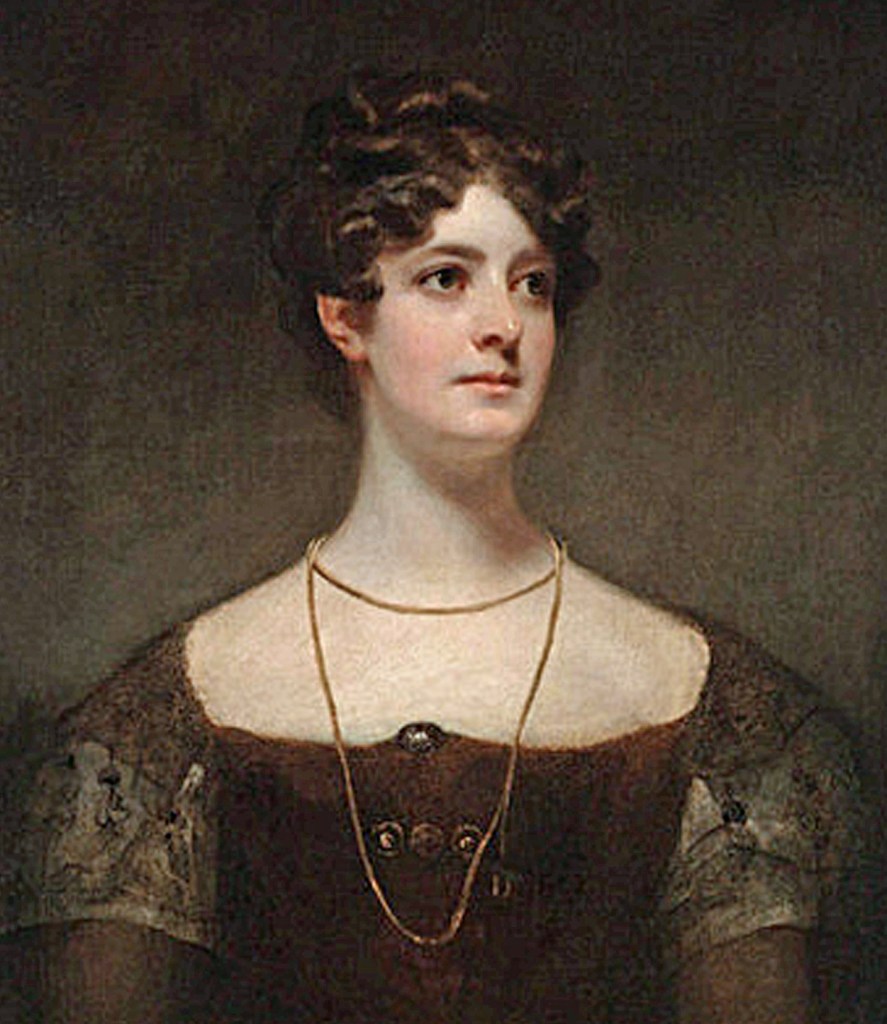
Painted by Sir Henry Raeburn c. 1820.
(Yale University Art Gallery, open access /public domain).
Isabella came by her new name through her marriage to James Wedderburn, Solicitor General for Scotland, in October of 1813 (Grant, 1944). James was one of the Wedderburns of Inveresk, a picturesque village that overlooks the mouth of the River North Esk on its exit into the Firth of Forth, and it will be illuminating to say something about the colourful Wedderburn family history.[63]
James Wedderburn (1782−1822) was the youngest son of Dr James Wedderburn (1730−1807) of Inveresk. The father of this Dr Wedderburn, Sir John Wedderburn, 5th Baronet of Blackness,[64] came out in favour of the Jacobite rebels in 1745. Having been captured at Culloden, he was taken to London to pay the price for backing the wrong side. At great risk to himself, Dr Wedderburn managed to make his way to London to try to help his father, whom he was even able to see, to attend his trial, and finally to witness his life being mercilessly extinguished by hanging, drawing and quartering on Kennington Common:
The recollection of his father’s fate never left him, and till the end of his life he would, when in London or its neighbourhood, make any detour to avoid the scenes connected with that event (Wedderburn, 1898, p. 305)
It was said that Sir John had gambled his life in the rebellion only for the opportunity of restoring his dismal family fortunes, but in the end he lost it all by having his title and estates escheat by the Crown.
James Wedderburn, thus left with no father, no home and no prospects, managed to escape to Jamaica to join his brother John, who was making his living there as a doctor, part of which involved looking after the health of slaves on the sugar plantations. James, by assisting his brother in his practice, acquired the necessary skills to become, albeit without formal qualification, a decent doctor. In this profession he managed to get together the wherewithal to become a planter and, because of the great demand for sugar, he eventually made himself a fortune. To modern eyes, however, the negative side to this was that he was therefore a slave-master. In addition, he had five children to two different slave women, the eldest of which was named Robert Wedderburn (Chase, 2004−13). Having made his fortune, Dr Wedderburn returned to Britain in 1773, when memories of the ’45 had sufficiently faded to make it safe enough to do so. He bought Inveresk Lodge near Musselburgh and by the following year he had married and started his life and his family anew.
Dr Wedderburn’s wife was Isabella Blackburn (1756−1821), daughter of Andrew Blackburn, a wealthy Glasgow banker. Of their four sons, the youngest was an advocate, the very James Wedderburn that married Isabella Clerk, the sister of John Clerk Maxwell. But let us now turn our attention to the Blackburn connection. Andrew Blackburn (Glasgow University Library, 2004; Teevan, 2008−10) was the son of John Blackburn of Househill in Glasgow, and he was also the brother of Peter Blackburn (b. 1728), a Glasgow merchant who was the grandfather of the brothers Peter Blackburn of Killearn MP and Professor Hugh Blackburn, who married, respectively, Jean and Jemima Wedderburn, daughters of James Wedderburn the advocate and Isabella Clerk. The Blackburns and Wedderburns who feature in the life of James Clerk Maxwell therefore had a previous family alliance as a result of which Jemima and Hugh were second cousins once removed.
▪ . ▪ . ▪ . ▪ . ▪ . ▪ . ▪ . ▪ . ▪
Dr James Wedderburn brought the two youngest of his Jamaican children by the slave Esther Trotter back with him to Inveresk. Although they were raised separately from his new Scottish family under the surname of Graham, he did provide for them. Less welcome, however, was the uninvited appearance of his son Robert Wedderburn, who had come to Britain in 1779 and tracked him down to Inveresk some years later (Wedderburn, 1991). He was, however, spurned by his father and sent away with no more than a crooked sixpence. Although he worked in London as a tailor, some time after he had married he fell on hard times and found it necessary to apply to his brother Andrew Wedderburn Colvile, the eldest of Dr James Wedderburns’ Scottish-born sons, for assistance, and was again rebuffed. Such rejection may have led Robert, who was evidently educated, able and of robust character, to turn his mind from gaining the acceptance of his own kin to agitation against slavery.
In 1824 he eventually found an outlet for his anger towards his father and brother by publishing a letter stating his case in Bell’s Life in London, which was met with a swift rebuttal by his brother. While Robert maintained that Dr Wedderburn had never denied that he was his father, Andrew’s case was that Robert’s mother ‘could not tell who was the father’ and consequently ‘her master, in a foolish joke, named the child Wedderburn’ as she had had been carrying the child while she was Dr Wedderburn’s slave. What the outcome of this was we do not hear.
Robert died about 1835 having led a very colourful life. His writings (1991) and the litigation by Joseph Knight (Cairns, 2009), who had been a slave belonging to Dr Wedderburn’s brother John, must have done much to bring home to the British public many of the horrors of the slave trade.[65] In the event, however, any potential scandal was averted when Robert’s attempts to claim kinship with his father were thwarted in the courts by his own half-brother , who may have had a lot to lose if things had gone differently.
John Blackburn (1756−1840), the father of Peter and Hugh Blackburn, had been a slave owner in Jamaica, where he was from about 1772 to 1805 (UCL Department of History, 2014a). After his return to Scotland, however, he continued as an absentee owner until the repeal of slavery throughout the British Empire in 1833 and left a fortune of more than £100,000 on his death.[66]
A further relative of James Clerk Maxwell who was party to the employment of slaves was his great uncle William Bullock[67] whose daughter Emily Bullock had married John Cay, Sheriff of Linlithgow. Having been Secretary to the Island of Jamaica, he was at one time an attorney for absentee plantation owners, and since he occasionally factored for local planters, he conceivably even did so for John Blackburn. In 1832, he registered himself as having eighty-five slaves, but in right of his wife Elizabeth Smart, whose property they actually were (UCL Department of History, 2014c). Also, in the Inventory of Cay Family Papers (Cay Family, 1910), there is an item listed as being ‘Valuation of Slaves belonging to Mrs Bullock − 3rd Octr. 1832’. There is therefore no doubt that slave ownership was still very much current around the time of James Clerk Maxwell’s birth. Many a well-to-do and respectable family had either based its fortune on the profits of slavery, or at least had connections with those that had done so.
▪ . ▪ . ▪ . ▪ . ▪ . ▪ . ▪ . ▪ . ▪
Returning now to James Wedderburn, the husband of Isabella Clerk, he was born at Inveresk on 12 November 1782 (Grant, 1944). He qualified as an advocate in December 1803, shortly after his twenty-first birthday, and by 1806 he had his own house and legal chambers at 61 (later 126) George Street. Within a few years he was appointed an advocate-depute, meaning that he could represent the Crown in the High Court, which is where the serious criminal cases are tried, and in March the following year (1811), he was made the Sheriff of Peeblesshire.[68] This seems like a very significant promotion for someone who had not long turned twenty-eight, but that was much the same age by which his friend Sir Walter Scott had become Sheriff of Selkirkshire.[69] The promotion to sheriff, however, did not mean that he had to move away from Edinburgh, for he would have had a local sheriff-substitute on hand to do his bidding and to cover in his absence.
When James and Isabella married in 1813, they settled down to married life at 126 George Street, the clearest indication of which is to be found from the birth records of their children (Wedderburn, 1898, pp. 313−14). The five children born at their George Street home were:
- James (1814−1863), who became a doctor and died unmarried;
- Janet Isabella (1815−1853), who married James Hay Mackenzie in 1838.[70]
Their son, Colin Mackenzie, was the cousin, once removed, of James Clerk Maxwell. In later life Colin was an advisor to James and was by his side when he died (see §2.10); - George (1817−1865), a Writer to the Signet who never married and continued to live with his mother;
- Jean (1818−1897), the sister who married Peter Blackburn MP;
- John (1820−1879), a major general in the army who married but had no children.
By 1820, however, not only was James an important man, he and Isabella had these five children, and they would have needed the run of a big house befitting James’ status, a place where he could do business by day and entertain the cream of society by night. And the solution to this problem was the purchase of his wife’s former home, 31 Heriot Row, where his name first appeared in 1821. The Register of Sasines (see note 60) makes it clear that it was at the end of this year when James Wedderburn actually bought the house from his brother-in-law, Sir George Clerk 6th Baronet of Penicuik; and since his entry in the Post Office Directory would have had to be made quite early in 1821, the transaction must have been formalised after he and Isabella had been living there for over six months. As was pointed out in the previous section, Lewis Campbell’s version of events is somewhat different (C&G, p. 4) in that he erroneously believed that Isabella and James Wedderburn were already living at 31 Heriot Row and that Mrs Clerk and her son moved to India Street in 1820 in order to live nearby. In reality, they had long been living at 31 Heriot Row, as did Isabella up until her marriage. However, it seems that in early 1820 the notion was conceived that it would suit all concerned to let the Wedderburns take over ‘Old 31’, and it was this that led to the building of a new house for Mrs Clerk at 14 India Street, just around the corner. This plan was put into action when John Clerk entered into a contract with Wallace the builder (see Chapter 15), and Mrs Clerk, at least, moved out in the following year.
After James and Isabella’s move to Heriot Row, they had two more children, the first of whom must have been on the way at the time of their ‘flitting’:
- Andrew (1821−1896), who joined the HEICS and became a senior civil servant in the administration of Madras in India;
- Jemima (1823−1909), a well-known bird water-colourist (Fairley, 1988), who married Professor Hugh Blackburn of Glasgow University in 1849.
Andrew and Jemima Wedderburn had their own particular connections with their younger cousin James. Firstly, it was Andrew who inherited Middlebie and Glenlair on James’ death in 1879. They would have barely known each other, for Andrew entered the HEICS College at Haileybury in 1842 and was thereafter posted to India. He did return to Edinburgh upon his marriage to Joanna Keir in 1847 but, while he may have had further visits home, these would have been few, for the round trip would have taken the best part of a year. Although he was due to retire from office in 1878, he was asked to stay on another year to help deal with an ongoing famine, something which he had had to do on two previous occasions. It is therefore unlikely that he and James ever had the opportunity to reacquaint themselves, and certainly he is not mentioned in Lewis Campbell’s account of James’ final days (C&G, Chap. 13).
Although Jemima was eight years older than her cousin, she was James’ frequent childhood companion both at 31 Heriot Row and during summers spent at Glenlair. Significantly, as a budding water-colourist, it was she who recorded for us some significant events in James’ early life, beginning with a visit with his father to Edinburgh in 1841, through to his visit to the Blackburns’ estate at Roshven in 1857. Jemima was born on 1 May 1823, six months after the untimely death of her father. It seems that James Wedderburn developed some sort of brain fever that began as a chill that he had caught while visiting his sister Lady Jean Douglas, widow of the Earl of Selkirk, at St Mary’s Isle near Kirkcudbright (Fairley, 1988, p. 97). James was buried there on 7 November, just days short of his fortieth birthday. Not only had he been appointed Sheriff of Peeblesshire before he was thirty, he had been subsequently appointed Solicitor General for Scotland, the highest law office in the land after the Lord Advocate, at the age of just thirty-three. By 1819 he had been reaching for the post of Lord Advocate itself[71] but did not live to see it. After barely ten years of marriage, Isabella was left a widow with seven children to look after.
James Wedderburn, however, had not inspired admiration in everyone who knew him; Elizabeth Grant (Grant, E., 1988, p.170) called him ‘a pompous little man’, to which she added that William Clerk (see §10.6) ‘could not bear’ him. However, William Clerk and James Wedderburn were very much opposites. Both were advocates, but in contrast to the talented but indolent Clerk, who got nowhere, Wedderburn had been energetic enough to achieve high office in a short space of time. Even William’s brother, Lord Eldin, who also had a brilliant career as an advocate, did not achieve the office of Solicitor General until he was forty-eight years of age.
After James’ untimely death, Isabella would have come into the settlement that she was due as a result of her marriage contract,[72] together with any further provisions that James had put in his will, written at the time of their marriage (Wedderburn, 1898, p. 313). The will put James’ estate in the hands of trustees, who saw to it in a rather forward thinking way that the their eldest son James jnr did not inherit 31 Heriot Row, for he was, after all, only eight years of age at the time of his father’s death. Instead they got a decree from the courts allowing them to dispone it to Isabella, which they did by 31 July 1824 (see note 60) the rationale being that James jnr would in due course be likely to inherit it anyway.
When James Clerk Maxwell arrived in Edinburgh in November 1841, it was of course to the house of his aunt Isabella at 31 Heriot Row that he came. Although this was several months after the census of June 1841 had been taken, by the greatest of luck we find him there with his father on a visit at the time of the census. The record[73] shows the occupants of the house on the day of the census as being:
| Person | Age | Relationship to Head of Household |
| Isabella Wedderburn | 50 | Head |
| George Wedderburn | 20 | Son |
| James Hay Mackenzie | 30 | Son-in-law |
| [Janet] Isabella Mackenzie | 25 | Daughter |
| Colin Mackenzie | 1 month | Grandson |
| John Clerk Maxwell | 50 | Brother |
| James Clerk Maxwell | 9 | Nephew |
| Caroline Colvile | 14 | Great-niece |
| Alice Douglas Colvile | 10 | Great-niece[74] |
Isabella’s household also reported seven female servants and a governess at the time of the census, though not all of them were necessarily her own. Likewise, the butler ‘Hornie’ mentioned in (C&G, p. 47), and depicted in Jemima’s watercolour of James Clerk Maxwell arriving at the house in the November of that year, was not present at the time, nor was Jemima herself, who was then aged 18 and therefore unlikely to be away from home on a permanent basis.
Isabella continued to live at ‘Old 31’ for many years to come, indeed until 1850, the year her nephew James Clerk Maxwell went off to Trinity College, Cambridge. By then her children were grown up and, apart from a son George who never married, all had left home. Perhaps she and George then found the house too big for their requirements, for they more or less retraced her mother’s move round the corner to India Street back in 1821, only this time the house concerned was number 18, only two doors away. After nine years there, where they were often visited by James and his father, they moved on to 25 Ainslie Place (Plate 2.4).
Isabella Wedderburn would by then have been seventy-two, and so it may have been more George’s idea than hers to move back to a grander house, for he was by then a relatively well-off lawyer. But within a few years, George was diagnosed with a consumption from which he eventually died on 1 May 1865, and his mother Isabella followed him almost exactly six months later, on 2 November, at Killearn, the home of her daughter Jean and her son-in-law Peter Blackburn MP. It was there that she was buried (Wedderburn, 1898, p. 313).
Notes
[1] NRS: GD18/5487, Letter from John Clerk [at Chatham] to his father … , 17/9/1757.
[2] NRS: GD18/5494, 1768−70. The artist Ann Forbes (Sloan, 1997) was a granddaughter of William Aikman the painter, a cousin of John Clerk’s own grandfather, the Baron.
[3] NRS: GD18/5506, 1775−76. The spelling Enterprize was contemporary. NB: this John Clerk was actually John Clerk of Eldin’s nephew rather than his son, who was an advocate.
[4] NRS: GD18/4207, 27/11/1776.
[5] NRS: GD18/5511, 13/10/1777
[6] She is also mistakenly referred to as Mary Appleby Dacre. Later in life, for reasons explained elsewhere, she styled her first name as Rose Mary or Rosemary (Prevost, 1970, pp. 162, ff. 176 and 178−80).
[7] NRS: GD1/1432/1.39, 15/10/1778.
[8] NRS: GD18/2125A, c. 1771−72.
[9] NRS: GD1/1432/1.41, 22/10/1778; GD1/1432/1.60, 27/10/1778; and GD1/1432/1.42, 3/11/1778. James Veitch. Lord Eliock was a Scottish judge and fellow commissioner of George Clerk Maxwell in the ‘Forfeited Estates’. Like his friends the Clerks, he was also a friend of the Duke of Queensberry, who was then seriously ill in London. It appears that Veitch had seen James Clerk HEICS, but not ‘the Captain’, i.e. Lieutenant John Clerk RN, who had been moved to Chatham by Lord Sandwich. Although then a lieutenant by rank, John Clerk had been in command of a ship, for in NRS: GD1/1432/1.39, 15/10/1778 he is also referred to as ‘Captain’.
[10] The battle of Cape St Vincent had taken place on 16 January of that year. HMS Alfred may have been with the fleet but she does not seem to have taken part.
[11] NRS: GD18/4214, 10/3/1780.
[12] NRS: GD18/281, 6/8/1782.
[13] Raeburn got sixty guineas (£63) for it (Greig, 1911, p. li).
[14] Now the Royal Highland and Agricultural Society.
[15] Due to the American War of Independence.
[16] Number 37 Princes Street would be somewhere around where number 70 is today. In 1785, Miss Clerk was still listed at Crichton St, but Lady Clerk was no longer there, ergo, it seems she would then be at 37 Princes St with Sir John.
[17] She was baptised on 3 November 1745 and died ‘in her 89th year’ on 1 November 1834 (Prevost, 1970, pp. 162, 172). Given the circumstances of her birth, she would have been baptised without delay, and so she would have been almost exactly 89 years of age at her death.
[18] See http://list.english-heritage.org.uk/resultsingle.aspx?uid=1335577
[19] Bishop from 1734 to his death in 1747.
[20] Just six miles to the south of Carlisle, near Dalston, see
http://list.english-heritage.org.uk/resultsingle.aspx?uid=1087473
[21] The white cockade was the Jacobite emblem chosen by Prince Charles Edward Stuart for his campaign of the ’45. It was made from some white silken material fashioned to represent a rose.
[22] See §8.8 for George Clerk Maxwell’s part in the pursuit of the retreating rebels through Westmorland and Cumberland to Carlisle, thirty-two years after which he became Mary Dacre’s father-in-law.
[23] NRS: GD18/3263 & GD18/3266, 1746.
[24] The Baron does not refer to this Henry Clerk in his memoirs, but since his own brother and son of that name were already dead, he was probably a nephew. The name Henry seems only to have been introduced to the Clerk family in the Baron’s own generation, in honour of his maternal grandfather, Henry Henderson. If this Henry Clerk got his name in the same way, he could not have been more distantly related than a cousin, or more likely, a nephew.
[25] He is believed to have been Captain Ranald Macdonald, third son of Ranald Macdonald 3rd of Kinlochmoidart. He received a pardon for his part in the rebellion and it may be that his gallant behaviour towards Joseph Dacre’s wife and newborn child had something to do with it, for Joseph was one of the judges.
[26] With the assistance of David Stewart of Garth, who founded the Celtic Society of Edinburgh in 1820, with Scott as one of the original members
[27] This is the subject of a curious but once well-known story of the supernatural (Grant, c. 1887, vol. 5, p. 192).
[28] Ramsay (1861, p. 88). Ramsay erroneously states that Mary Dacre was born in Newcastle and that her father was a Jacobite sympathiser; Prevost’s evidence is quite to the contrary.
[29] DGA: GGD56/27/8, 1775, note 1
[30] NRS: GD1/1432/1.40, 27/4/1776.
[31] NRS: GD18/5512, 12/2/1778.
[32] NRS: GD1/1432/1.39, 15/10/1778.
[33] NRS: GD1/1432/1.41, 22/10/1778.
[34] NRS: GD18/4228, 1782.
[35] The limited information available at https://threedecks.org/index.php?display_type=ships_search gives the ‘Major’ as having been in service during 1781−82, but lost in 1784. Although the East India Company monopoly formally ended in 1783, it is not clear whether the ship could have made its last voyage in private hands. It is more likely that the ship made one successful voyage during 1781−82, but as it did not return from its second voyage, it went unrecorded.
[36] In 1784, we have James Clerk in the Bay of Bengal, whereas he is listed in that year’s directory as ‘James Clark Esq., at Lady Maxwell’s’. In turn, Lady Maxwell’s entry is given as ‘Maxwell Lady Clerk, Princes street’, that is to say, Dorothea, James’ mother. However, James’ brother John, who was also frequently away at sea, provided a forwarding address for the directory during the years 1774 and 1775, namely ‘at Mrs Shaw’s, James’ Court’. Curiously, in the 1786 directory, there is no listing for James Clerk, but he is back in 1788, again at his mother’s.
[37] DGA: GGD56/18/17, 21/05/1785.
[38] SOPR: Marriages, 685/01 0510 0345 Edinburgh; Grant (1922, p. 145).
[39] DGA: GGD56/13, c. 1792−93 containsthree extract baptismal certificates. The outer paper was originally sealed with red wax to form an envelope addressed to ‘James Clark, Princes Street, Edinburgh’. Written on the reverse side is ‘Certificates of the Births of my Children’. This is in James Clerk’s own hand, for it is signed ‘Ja: Clerk’.
The first certificate informs us that a son, named as George, was born on 19 November 1787.
The second is for Isabella Clerk, baptised on 20 May 1789.
The third, dated 14 August 1792, is for a second son, James. It is marked ‘died an infant’ in a later hand.
Unfortunately the baptismal certificate of John Clerk, later Clerk Maxwell, is not to be found with the others. However, the official record (SOPR: Births, 685/01 0380 0216 Edinburgh) gives his baptism as being on 10 November 1790.
[40] NRS: GD18/1887, 4/7/1788 and DGA: GGD56/4, n.d.
[41] The reason usually quoted is that the entail of Middlebie required the inheritor to take the name of Maxwell, but that on its own would not have prevented it, in fact it was forbidden by a like condition of the Penicuik baronetcy, which is actually how it is worded in the marriage contract itself.
[42] DGA: GGD56/18/1, Statement of Lady Dorothea CM’s Account from 1788 to Aug. 93, 1793.
[43] NRS: GD18/1537, 3/5/1793.
[44] CANMORE: ID 150395 and OS 6″ map series, Edinburghshire, Sheet 7, 1854.
[45] DGA: GGD 56/11, Payments made to Mrs Janet Clerk & Rents on the House and Lands of Over Lasswade on Behoof of Mrs Janet Clerk, 1798−1812. The names Upper and Over Lasswade are mentioned together within these papers.
[46] Edinburgh University Library, 2014 and note 44 above,
[47] DGA: GGD56/4, Memoranda by Andrew Wedderburn Maxwell on the Descent of Middlebie, c. 1893.
[48] DGA: GGD56/18/8; it included James Clerk’s whisky, valued in DGA: GD56/18/13.
[49] DGA: GGD56/4, Memoranda on the Descent of Middlebie, c. 1893; DGA: GGD56/11, Various Allowances to be made to Mrs Janet Clerk & Payments made to Mrs Janet Clerk, 21/5/1798; and DGA: GGD56/27/4, Commission for Proclaiming Breve of Service, 1803.
[50] By the entail of 1722, she would have succeeded to Middlebie if she had outlived her brothers and neither of them had produced an heir, but that did not happen.
[51] DGA: GGD56/13, Disposition by Sarah Irving in Favour of Janet Irving, 25/10/1783.
[52] Elizabeth Cleghorn, Sir James’ widow, had died in 1783 and Janet Inglis had died long before in 1760.
[53] DGA: GGD56/11, Various Allowances to be made to Mrs Janet Clerk […], 21/5/1798.
[54] EPD: 1800−09. The first directory entry that unambiguously identifies our Mrs Clerk is for 1805. The entry of her sister-in-law, Mary Clerk (Dacre), in the same directory, is given two lines above as ‘Lady Dowager of Pennycuik’. There was no actual Lady Clerk of Penicuik at that time because the baronet was now Janet’s eldest son George, who was then only eighteen years of age. Janet had missed out on having the title Lady Clerk because her husband James had died while his elder brother John, the 5th Baronet, was still alive, leaving the title to pass on down to the next generation. It is understandable that, as the mother of the young baronet, Janet would have wished her station in life to be recognised and so she was allowed the privilege of appending ‘of Pennycuik’ to her name.
From 1805, we may trace the same Mrs Clerk (or Clark) at that address in the directories back to the year 1800. In 1799, however, the only address given for a Mrs Clerk at George Square is at number 9, which was on the north side, while in the previous directory, which was for 1797, we have simply ‘George’s square, south side’. There is no way of knowing for certain whether or not these relate to our Mrs Clerk. However, at the very least, we can say that Mrs Clerk (Janet Irving) lived at George Square from at least 1800, and indeed the directories confirm that she was there until 1808.
[55] Bristo Street was the continuation of present day Bristo Place. Now obliterated by the University Student Centre, it was once part of the main road south.
[56] In 1809 the house was unnumbered, but in 1810 it was listed as ‘12, west Heriot row’ In the year following, however, the general renumbering exercise made it ’31, Heriot-row’.
[57] James Wedderburn purchased 31 Heriot Row in 1821 (RS: Register of Sasines,PR 1902.277 (688), 24/5/1851).
[58] RS:Register ofSasines,PR 629.142 (13,869), 30/1/1809.
[59] RS:Register ofSasines,PR 1902.277 (688), 24/5/1851.
[60] Maria was the granddaughter of Edmund Law DD, Bishop of Carlisle between 1768 and 1787. Curiously, the maternal grandfather of George’s aunt, the Dowager Lady Clerk, aka Mary Dacre, whose grandfather had been the Bishop of Carlisle between 1734 and 1747 (Chapter 9). Lady Clerk, was still very much alive at the time of George’s marriage.
[61] DGA: GGD56/13, Inventory of the Personal Estate of Mrs Janet Clerk, 1822.
[62] DGA: GGD56/13, Extract of Birth Register for Isabella Clerk, 20/5/1789.
[63] The narrative here broadly follows the information given in Wedderburn (1898) supplemented by other references as cited.
[64] The first edition gave the location as Blackness Castle. However, it has since been discovered that it was another Blackness that lay just to the west of Dundee and has since been enveloped by that city.
[65] In more recent times they have provided the basis for the novel Joseph Knight (Robertson, 2003).
[66] He had 565 slaves on two estates in Jamaica, Wallens and Rose Hall, both in St Thomas-ye-Vale parish (UCL Department of History, 2014b).
[67] He held several important public offices in Jamaica including Island Secretary and Governor’s Secretary, from which he derived a substantial income. His house, Bullock’s Lodge, overlooks the harbour at Port Henderson near Kingston Jamaica (Cundall, 1904, p. 26).
[68] Brown & Lawson (1990, p. 362) give the years of his tenure as 1810−19.
[69] Walter Scott was born in August 1771 and after qualifying as an advocate alongside his friend William Clerk, son of John Clerk of Eldin, he was appointed Sheriff of Selkirkshire on 16 December 1799 (Grant, 1944). He and James Wedderburn were friends, for in a letter to Daniel Terry of 10 November 1822, Scott mentioned having ‘a depression of spirits following the loss of friends (to whom I am now to add poor Wedderburne)’ (Lockhart, 1837, vol. 5, p. 183).
[70] Janet Isabella Wedderburn was referred to by the family simply as Isabella. Her husband, James Hay Mackenzie WS (1809−1865), was the third surviving son of Colin Mackenzie of Portmore (1770−1830) and a nephew of Sir William Forbes the banker. He was Deputy-Keeper of the Great Seal, 1858−65, in which role he was succeeded by his son Colin (James Clerk Maxwell’s cousin and legal adviser). After their marriage,the couple lived at 31 Heriot Row with Mrs Wedderburn, but by 1841 they not only had a house of their own at Randolph Cliff, just east of the Dean Bridge, but also a newly built seaside retreat called Marine Villa or Silverknowe situated in a parkland area of present day Silverknowes. During the winter of 1849−50, Isabella took ill, probably with consumption, and died in 1852 leaving six children, Colin being the eldest (Fairley, 1988, p. 157). Having remarried in 1861 to Selina Jane Norton, James died in 1865. All three, James, Isabella and Selina, are buried side by side in the churchyard of St John’s Episcopal Church off Lothian Road.
[71] NRS: GD495/48/1/60−61, 20−23/6/1819.
[72] She was to be provided for after his death with an annuity of £350 from £9,000 to be made up of £6,000 from his estate, £2,000 from her elder brother Sir George Clerk, and £1,000 from the estate of her mother, Janet Irving (DGA: GGD56/7, Contract of Marriage between James Wedderburn Esquire and Miss Isabella Clerk, 1813.
[73] SC: Wedderburn, Isabella, 685/01 158/00 009 Edinburgh, 6/6/1841.
[74] Granddaughters of James Wedderburn senior’s brother Andrew Colvile, formerly Wedderburn.
 Brilliant Lives