Brilliant Lives
by John W. Arthur
Second edition
Published by the author in 2024
First published in Great Britain in 2016 by
John Donald, an imprint of Birlinn Ltd
Copyright © John W. Arthur 2016, 2024
All rights reserved.
Contents of the Front Pages
JAMES CLERK MAXWELL (1831-1879) was the greatest physicist of the 19th century, and although his scientific contribution is now acknowledged to be on a level with those of Newton and Einstein, he has generally not received the acclaim he deserves. This book goes beyond the life and works of the man himself, it explores five generations of his family, and of the families with whom they were connected through ties of blood, business, marriage, and even enmity, at the centre of which are the Clerks of Penicuik and the Maxwells of Middlebie It takes place primarily in the Scottish Lowlands and gives us a view into some notable middle-ranking Scottish families as they progressed through the centuries from the time of Mary Queen of Scots well into the reign of Queen Victoria. The events are shaped by the eras of momentous change throughout Great Britain that followed the Reformation. These began with the religious and political turmoil that spanned most of the 17th century, then came the Union of the Parliaments of Scotland and England in the early 18th century. In just a few decades came an age of relative stability and prosperity that led to a great enlightenment in Scotland in which Edinburgh shone paricularly brightly. It was fuelled by the actions and ideas of several brilliant individuals who are to be found amongst James Clerk Maxwell’s forebears and their connections. Their brightest scion was undoubtedly James himself, but many of the others also made their distinct impression on Scotland and the wider world.
Born in Edinburgh, John Arthur graduated in physics and mathematics from the University of Toronto before returning to Scotland to complete a PhD in physics at Edinburgh University (in the James Clerk Maxwell building!) before undertaking several years of post-doctoral research. He spent the greater part of his career specialising in the development of electronic and microwave technology for signal processing, communications and radar. In addition to a book on electromagnetic theory, he has published many articles on this and other branches of physics and technology. From 2012 to 2021 he was a trustee of the James Clerk Maxwell Foundation and is presently curator of its museum. He is a fellow of the Royal Society of Edinburgh, the Royal Academy of Engineering, the Institute of Physics, and the Institute of Engineering and Technology.
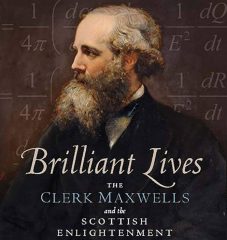
Front cover image: Portrait of James Clerk Maxwell, reproduced by kind permission of the Master and Fellows of Trinity College Cambridge.
Design by James Hutcheson
This book is for my children and for my children’s children.
Preface to the First Edition
The story we tell in this book is not so much about the scientist James Clerk Maxwell himself but, as the subtitle suggests, it is that of his family and of their network of friends and connections. It goes sideways in time crossing from one family or friend to another and, in the case of his most important family connections, follows them through the generations from their origins. Any discussion of science arises only in trying to explain two things: what it was that inspired James Clerk Maxwell to be a physicist, and why his key discoveries were so significant. The timespan is more or less from the Reformation to the end of the nineteenth century. The location is primarily the Scottish Lowlands, with specific focuses in Edinburgh, the Upper Clyde Valley, and Dumfries and Galloway. While the families mainly stem from landed gentry, they did not live in idle docility; they endeavoured not only to survive but to go beyond and improve. The result of the collective efforts of many such families was astonishing. In fact, for some of their leading lights, mere improvement was not enough, nothing less than the breaking of the mould would suffice for them.
James Clerk Maxwell was born in 1831 at 14 India Street, Edinburgh. Nevertheless, through his family he also had connections to numbers 18 and 38 in that street, and to 11, 27 and 31 Heriot Row, 6 Great Stuart Street, 25 Ainslie Place and 43 Moray Place. Each one is in Edinburgh’s Second New Town and within a five-minute walk of 14 India Street. While we do know the names of the people who lived at these addresses, who exactly were they? What part, if any, did they play in Maxwell’s life? How did they come to live in such fine Edinburgh New Town homes? What were their life stories? What did they do for a living to be able to afford such splendid houses? What other properties did they have? What sort of lives did they lead? And whatever happened to them? It is with questions like these that our story begins.
For all that has been written about the life of James Clerk Maxwell, much of it, particularly in the case of his early years, is to be found in the original biography by Lewis Campbell and William Garnett (1882), which is supplemented with copies and excerpts of many original letters and papers. Even so, some of the details Lewis Campbell recalled from interviews, diaries and memory are open to question, and so for a more accurate picture corroboratory sources are desirable. While many of Maxwell’s scientific papers were also published in this first edition of the biography, this part was superseded by the more complete work of W. D. Niven (WDN1 and WDN2, 1890). Much more recently, Harman (1990, 1995, 2002)[i] has also given wider access to much of Maxwell’s scientific correspondence. But, as far as Maxwell’s biography is concerned, one must go looking further afield.
It has consequently been a key aim in writing this book to avoid simply repeating information from various secondary sources and to look further afield at original records such as manuscripts, letters and official documents preserved in archives held by the National Library of Scotland, the National Archives of Scotland, National Records of Scotland, Dumfries and Galloway Archives, Scotland’s People (births, deaths and marriages), RCAHMS (buildings and monuments) and others. With such records generally being limited and often fragmentary, we next look to those near-contemporary published works that give factual accounts of the information being looked for. It often happens that there is more than one such source, and the differences in detail may give a guide as to whether they are independent, or whether one has simply been copied or recounted from another. It has to be said that plagiarism does not seem to have been considered much of a sin during the times that are of interest to us, which is understandable given that the availability of books was comparatively limited. Whenever such sources have been used, we have therefore attempted to recover what seems to be the original version, or at least to sift out the credible facts. As far as possible, we have tried to give links to sources on freely available current websites such as the Internet Archive (www.archive.org) and Project Gutenberg (www.gutenberg.org). However, when the cited version is not available, the closest available on-line version is offered, for example, a later edition.
There are situations in which it is not possible to get all the information that we would like, leaving us with questions that we can only try to answer by analysing whatever information we do have. How it was that some prominent Roman Catholic families managed to pass on their lands from one generation to another in times when the law forbade it is just one such question. It appears that they managed to protect their position by hiding the truth, dissembling in public while privately following God in their own way. When such answers are proposed, it falls to the reader to decide what is reasonable.
As to gathering information about our main characters, while some family trees are available they are often only partial; only the most meagre glimpses of their lives are to be obtained here and there. For example, there are few details on Janet Irving, James Clerk Maxwell’s paternal grandmother, and this is one of the gaps that we have attempted to address. On the other hand, Sir John Clerk, 2nd Baronet of Penicuik (James Clerk Maxwell’s great-great-grandfather along the male line) blessed us with a memoir from which we learn a great deal not only about his family but about many other connected people and events.
Looking back at these sources, it is an uncomfortable fact how little direct information there is about the women who figure in the story. Generally speaking, such information comes only tangentially and must be gleaned from reports mentioning the father, husband, brother or son. There are a few exceptions, for example the cases of Jemima Blackburn, Elizabeth Grant and Mary Dacre but, in the main, the dearth of direct information is simply a reflection of the way things were. Unfortunately, one of the consequences is that it has been impossible to prevent stories about men from predominating in this work.
In the case of properties, official records kept over the centuries are held in the Register of Sasines kept at Register House, Edinburgh. The firm of Millar and Bryce kindly provided searches for 14 India Street within these records. A further search, on 31 Heriot Row, helped to confirm the answer to the crucial questions, whose house was it originally, and did Janet Irving ever live there? The interpretation of the critical record of the Sasine of 1851, on the occasion of Isabella Wedderburn selling the house, was kindly confirmed by Mr Kenneth Robertson of Balfour and Manson, LLP.
As to Edinburgh addresses, and who lived at them, we have a wealth of information in the postal directories of Edinburgh and surrounding counties from the late eighteenth century through to the early twentieth century. Most of these have been scanned by the National Library of Scotland and are readily available online at their website http://www.nls.uk . Since the collection comprises a variety of directory sources, such as those by Williamson, Aitchison, Gray and the Post Office, we shall simply refer to them collectively as the Edinburgh Postal Directories, herein abbreviated to ‘EPD’. The detail of how we have used and interpreted these directories is to be found in note [ii].
Other sources of information have been books such as peerages and biographical dictionaries; family trees from various publications and sources, many of them online; websites such as http://www.gravestonephotos.com and http://www.archive.stjohns-edinburgh.org.uk ; maps and places from Google Maps, Ordnance Survey, Past Maps; the collection of Scottish maps at http://www.nls.uk and the Historic Environment Scotland CANMORE website https://canmore.org.uk/ where the details and locations of almost every historic building and monument in Scotland may be found. Many internet searches have also thrown up odd bits of information in old editions of gazettes, periodicals and newspapers.
In some relatively unimportant areas we have found a great wealth of detail, while conversely we have a dearth of information in some quite crucial areas. This, however, is only to be expected. Occasionally a single scrap of information has proved to be providential in opening up a significant new lead. The main weakness of miscellaneous snippets is frequently the lack of corroboration. This need not concern the reader too greatly, however, for all such information has been treated with caution and we have endeavoured to be clear about the quality of critical evidence. When the evidence supporting an unfolding story is somewhat thin or open to question in some way, we should regard any conclusions drawn as being a hypothesis to be put to the test. Their value is that they are a potential advance in what we know about Maxwell, his forebears and their family connections. Hopefully, the questions raised will be of value in their own right as a basis for further studies to be taken up by others.
On the whole, however, it has been possible to put together a serious and broad-ranging sketch of our subject matter, James Clerk Maxwell’s family and friends, their connections and their homes in Edinburgh’s New Town and beyond.
Preface to the Second Edition
The second edition is a free to use and is an updated and enlarged online version of the hard copy book published in 2016. Chapter 10 has been expanded to include further notable Clerks such as the artist and naval tactician John Clerk of Eldin, his son John, who was the judge Lord Eldin and whose brothers William and James were both intimate friends of Sir Walter Scott. Individual chapters will be made available as soon as they have been converted to webpages.
Some organisations and websites have inevitably changed in the interim. In particular National Archives of Scotland ‘NAS’ are now the National Records of Scotland, NRS, and RCAHMS has given way to Historic Environment Scotland, the present home of CANMORE, the National Record of the Historic Environment. NAS references are still valid, but in the case of RCAHMS sites it is now easier to search CANMORE using the ID alone. All frequently used websites and references have been reviewed: some have been renamed, some have been restructured, and alas some have gone. Where a site or page has disappeared I have been able to find an alternative in all but a handful of cases. Some of the images have also been changed either because better ones have been found or because better licensing conditions have become available. Finally the Epilogue has been dispensed with by reassigning the material within Chapter 15; this has made way for Chapter 16 to accommodate the sections on Peter Guthrie Tait and Lewis Cambell that previously appeared in Chapter 2.
The chapter by chapter translation of the book from paper to webpage has involved numbering individual sections for ease of navigation. It has also placed some restrictions on formatting which I hope will not be too awkward. In addtion, the notes are now conveniently placed at the end of each chapter whereas the bibliography is still separate. Given that there are no paper pages, page numbers have gone along with which the index has also vanished. Readers will be able to use the facilities provided by their browser to search for a name or place within any chapter, and references from one chapter to another will now pin items down to a specific section of the target chapter. Finally the entire process has created scope for new inconsistencies and errors to creep in. Fortunately, in the new medium it is possible to amend such things and in due course I will provide a ‘comment box’ so that readers can let me know of anything needing attention.
John W Arthur
Edinburgh, 2024
Acknowledgements
I would like to express my sincere thanks to the Trustees of the James Clerk Maxwell Foundation for their encouragement of this endeavour, for access to materials at 14 India Street, for their permission to use photographs taken there, and for obtaining the records of 31 Heriot Row. I am grateful to the Master and Fellows of Trinity College, Cambridge for their premission to use the image of their portrait of james Clerk Maxwell for the front page. For their individual contributions I would particularly like to thank Dr Dick Dougal, Prof Chris Eilbeck, Mr David Forfar, Prof Peter Grant, Prof Malcolm Longair, Prof David Milne, Prof Roland Paxton and the late Prof John Reid. I am also grateful to the following people and organisations who have generously provided information and assistance of various kinds:
Andrew Arthur
Aberdeen Art Gallery
Birmingham Museums Trust
Mr James W Brown
Honor Clerk and Sir Robert Clerk of Penicuik
Dr William Duncan
Captain Duncan Ferguson, present owner of Glenlair and trustee of the Maxwell at Glenlair Trust
Dr Michael Geselowitz
Mrs Catherine Gibb and Mr Graham Roberts, of Dumfries and Galloway libraries Information and Archives
Mrs Vicki Hammond, of the Royal Society of Edinburgh
Mrs Frances Macrae, archivist of the Corstorphine Trust
Mr Basil Mahon
National Museum of Scotland
Dr W Ross Stone
Lastly, my warm thanks and appreciation go to my wife, Norma, for her help in producing both the printed and on-line versions of the book, and not least for allowing me the many long hours spent working on it.
Notes
[i] The title of Harman’s three volume work is The Scientific Letters and Papers of James Clerk Maxwell, which is rather easily confused with Niven’s The Scientific Papers of James Clerk Maxwell.
[ii] The first directory is for the year 1773‒74 and while no directories were published between 1776 and 1783, during the American War of Independence, the gaps are relatively few. Some directories were biannual rather than annual, nevertheless they all run from Whitsun to Whitsun, roughly speaking from May to May. For simplicity, however, we refer to a directory by the year in which it was published. Given that they date from an age when virtually everything was done by hand, the bulk of the information would have been compiled close to the start of the calendar year, and so this minor simplification is actually in accord with the currency of the information.
Street numbering was not formalised until 1811, before which numbering was either lacking or at best ad hoc. After 1811, however, there is a high level of consistency with today’s numbering, particularly in the Second New Town north of Queen Street. Not until 1833 did the directories include a section indexed by street name and house number.
 Brilliant Lives