Brilliant Lives
By John W. Arthur
Second edition
Published by the author in 2024
First published in Great Britain in 2016 by
John Donald, an imprint of Birlinn Ltd
Copyright © John W. Arthur 2016, 2024
All rights reserved.
Contents
4.7 The Jacobite Rising of 1715
4.8 Cammo, Mavisbank and Dumcrieff
4 The Baron – Sir John Clerk 2nd Baronet of Penicuik
Sir John, the first baronet, died peacefully on 10 March 1722 and was succeeded by his eldest son of his first marriage, John (1676–1755). By the time of his succession at the age of forty-six, the 2nd Baronet was a scholar and an illustrious yet principled man of many talents and achievements. We must be thankful that he also wrote on a wide variety of subjects, although largely for his own interest rather than publication. His propensity for it led him to write the fascinating memoir published by the Scottish History Society from which the bulk of our information about the early Clerks, and indeed for this chapter, has been directly drawn. It gives us a rare insight into the life of someone who was not only lucky enough to have been born in times of great change, but also helped to see things through and reap the due rewards. While he had a comfortable life, received the best education, did the grand tour, achieved high office, and had the time and opportunity to pursue his own intellectual interests, it must be remembered that all this took place nearly three centuries ago when severe illnesses, family deaths, financial ruin, even rebellions, were frequent visitors.
4.1 Early Life
There is no sign that the young John Clerk’s early scholarly achievements were the result of parental pressure. His mother having died even before he went to school, there was nobody to shield him from the strict parental discipline that a son would normally have expected to receive if and when he failed to make sufficient progress in the serious matter of his education. However, it seems that he was fortunate enough to need little of this sort of ‘encouragement’ and always spoke of his father treating him fairly and kindly. He clearly had a facility for learning, and at the same time possessed the self-discipline to apply himself to the subject in hand, whatever it might be.
He recalled few troubles with his early education at the local school in Penicuik, where he would have studied along with sons of other country gentlemen under a ‘dominie’ who would teach them everything from Arithmetic to Latin and Greek. One difficulty, however, was not only the strictness of one such teacher, but the severe discipline he meted out to transgressors. Although this did not hold John back, he took it as a lesson in life that children should never be treated in such a barbarous manner. Secondly, he admits to having had very poor handwriting because he and his classmates were regularly made to copy out the minister’s weekly sermons − which meant having to write so quickly that he became careless. It is also evident that he regretted not learning English, by which he meant the refined language of the English gentry, for the lowland Scots gentry and professional people still adhered to the old vernacular as spoken on the streets and in the shops and taverns. As any follower of our National poet, Robert Burns, will know, there were many differences from standard English; there was a separate lexicography of words, some of which are still common. While grammar was essentially the same, for those who could read and write, spelling was not only irregular but variable. The courtroom speech of another John Clerk, Lord Eldin (see §10.4), who was the grandson of the 2nd Baronet, amply demonstrates that the use of such language was not the result of any lack of education, for even at the start of the nineteenth century it was fairly common (C&G, pp. 19, 21n3).
By the start of the eighteenth century, however, the Scottish gentility had been beginning to think that they would have to acquire the more genteel language of their southern cousins in order to take full advantage of political union. While the writings of our present John Clerk are comparatively refined, they still include a number of Scottish words and a variety of spellings, one of the reasons he gave for not letting the manuscripts be seen outside the immediate family.
4.2 University
After his Penicuik schooling, in 1691 the young Clerk went off to Glasgow University to apply himself to the study of Logic and Metaphysics. This he ably did for two years, after which he came to the conclusion that what he was learning was of no use to him, and in fact, he felt it was harming him. His father must have known his son well, for he was allowed to withdraw and to proceed to Leiden in Holland,[1] as did many young Scotsmen of the time, to study civil law. When he set off in October 1694, England was at war with France, and so his ship departed as part of a convoy of ninety merchantmen at Queensferry that was bound for Rotterdam under the escort of two Dutch frigates. After a rough passage and a hot pursuit by French privateers that ended in near disaster, he eventually got to his destination.
As well as the civil law, he studied mathematics, philosophy and music. While his father had made it plain that he must succeed in the law, he found mathematics and philosophy to be so interesting as to be a distraction, even to the point of neglecting all else. He realised, however, that this was doing him no good and so he learned to keep his fascination with these subjects in check. On the other hand, another diversion may have been beneficial, for becoming a master on the harpsichord not only provided him a useful social accomplishment but also therapy in the form of relief from his academic studies. His lectures were mostly conducted in Latin, in which at least he had a grounding from his schooldays, whereas outside the university normal conversation was in Dutch, which was yet another subject for him to master.
The overall burden of his studies and pursuits must have been considerable indeed. All the same, he was still eager to stretch himself even further by adding to them rhetoric, the art of drawing, history (conducted in Dutch) and ecclesiastical history. Naturally enough, fitting all these things into the available time did not work out very well, and so it took him an additional year to qualify, which he finally did in May 1697 along with a dozen or so other Scots.
While his father wanted his son back home in Penicuik, there is little mention of his reproaching him for the fact that his time abroad had been extended, and he generously gave his son leave to do a grand tour of Europe, albeit with minimal funds.
4.3 The Grand Tour
The May of 1697 must have been a critical time for the young John Clerk. Having reached a high of successfully completing his degree and then anticipating his grand tour, things went badly awry when he came down with smallpox, which then had a fatality rate close to one in three. Luckily for him, he had made firm friends with a fellow scholar, Herman Boerhaave (1668–1738), a Dutchman who had studied medicine and was keen to try a new remedy. It seemed to work, the skin lesions cleared up in days and John was able to set off with all speed two days before the graduation ceremony was to take place, and with no thought as to a travelling companion to guide him. With great hopes and a mere £100 from his father, he simply decided to trust in providence. Boerhaave, on the other hand, stayed on at Leiden and began to make it famous as a centre of medical learning.
John travelled through Germany to Nuremberg with such companions as he found on the way. He then took a boat down the Danube to Vienna, where the British Ambassador, Lord Lexington, introduced him at the court of Leopold I. This gained him access not only to Viennese society, but to some of the finest visual and performing arts in Europe, not to mention libraries full of the choicest books.
But Vienna was only one such stop on his grand tour, for he also had designs on Venice and Rome. We may readily imagine the society, the arts and the antiquities that he sought, found and devoured in these places. When he reached Rome in the late autumn of 1697, however, the smallpox that his friend Boerhaave had ‘cured’ returned with a vengeance, and he became very seriously ill. Having placed his faith in Providence, it came to his aid in the shape of Fr Cosimo, a Franciscan monk, who turned out not only to be the son of a Scottish advocate[2] but was actually a distant relative (BJC, p. 26).
Fr Cosimo, having only just met John Clerk, tended his sick young acquaintance with the assistance of the nuns of the Tor di Specchi, who nursed him until he was at last restored to health. From then on, Cosimo kept close to John for more or less the remainder of his time in Italy. Once recovered, John found that his endeavours with the harpsichord were highly beneficial, for his musical abilities gained him access to the cream of society. He was also able to study music under some of the best teachers of the day, Pasquini and Corelli, and gained the favour of an antiquarian and philosopher by the name of Chaprigni, who kept a busy social calendar of musical and literary assemblies at his own house. He had also formed a close friendship with a young English nobleman, Wriothesley Russell[3] with whom he visited Naples. Nevertheless, and perhaps to please his father, he also took up his studies of the law again under a judge, Monsignor Caprara, whom he assisted by the reading of legal papers.
Things continued in this way until he could no longer put off his father’s entreaties that he return to Penicuik. He set off on his journey home in December 1698 after having spent fifteen months in Rome and having had the time of his life. Monsignor Chaprigni had died before John’s departure, but he had thought highly of his young Scottish protégé and bequeathed him several of his antiquities, amongst them a head of Cicero, a bust of Otho and a little statue of Diana, all of which were packed off to Penicuik house. Despite the urgings of his father, John was in no mood to rush directly home, for he had not yet seen Florence. With Fr Cosimo as his companion, he was accepted at Florence by the Grand Duke of Tuscany, who not only entertained him well but so took to the young Scot that he gave him the run of his libraries and even went so far as to bestow honours on him. Finally heeding his father’s call, John set off for Genoa to find a ship to take him to Marseilles, stopping en route at Pisa and Leghorn, where he finally parted company with Fr Cosimo. Having benefited from the Father’s company and diligent attention for about eighteen months, John must have found it a difficult adieu.
From Genoa, John eventually got to Marseilles only after another perilous sea voyage. He then headed straight for Paris and the court of Louis XIV. But what he saw at Versailles seemed to him a mere repetition of what he had seen in Rome, and it disappointed him. The music, the operas and the comedies were uninspiring, and only the dancing and conversation pleased him. Despite this, and despite the further exhortations of his father to come on home, he lingered in Paris, taking time to renew his interest in mathematics and philosophy, until the early summer.
Having been fully two years on his grand tour, he now set off for Brussels and Antwerp, where he visited the churches and viewed the paintings of Rubens, still finding nothing that compared with Rome. Ever reluctant to hurry, he put off three more months visiting Dr Boerhaave and other friends at Leiden. Though Holland suited him very well and he was reluctant to depart, he eventually took his leave and got back to London, but only after diverting via Harwich as his voyage was once again beset by storms. In London he was met by his uncle, William Clerk, who may well have been sent there to collect him, if not actually to bring him back from Holland. They travelled back north together, with John reaching Penicuik House by 2 November 1699, after an overall absence of five years and a few days, and an expenditure well in excess of what his father had allowed him.[4]
4.4 A Brief Marriage
Once home, John completed his studies in civil law and was admitted as an advocate in Edinburgh on 20 July 1700. It was an opportune time, for things were finally settling down and there was even talk of political union with England. His next step, however, was to find a wife, a matter that his father was already working on. John did not at all take to the first proposed match, was too late for the second, but was lucky with the third. He had met Lady Margaret Stuart, daughter of Alexander Stuart, 3rd Earl of Galloway, and his wife Lady Mary Douglas. Although it was an excellent match approved by all concerned, his father balked at putting enough money into the marriage settlement to secure the Earl’s agreement. Amor vincit omnia, as they say, for Lady Margaret persuaded her father to take Clerk’s offer, such as it was, and allow the marriage.
John Clerk and Margaret Stuart were married on 6 March 1701 and took a house in Edinburgh[5] so that John could attend the courts. Much to their happiness, a child was soon on the way and a son was safely delivered on 20 December of that year. But from his joy, John was plunged into despair by his wife’s rapid decline and death. At first her life was not feared for but somehow she had got it into her mind that she would die, and so the best doctors were brought in. They intervened only because they found it impossible to dissuade her from this morbid fixation, and ironically it was their intervention that led to her death. While John believed the doctors had acted for the best, his own uncle Robert amongst them, he could not help thinking that things would have turned out differently had they simply done nothing. His scepticism about the medical practices of the time was quite understandable.[6]
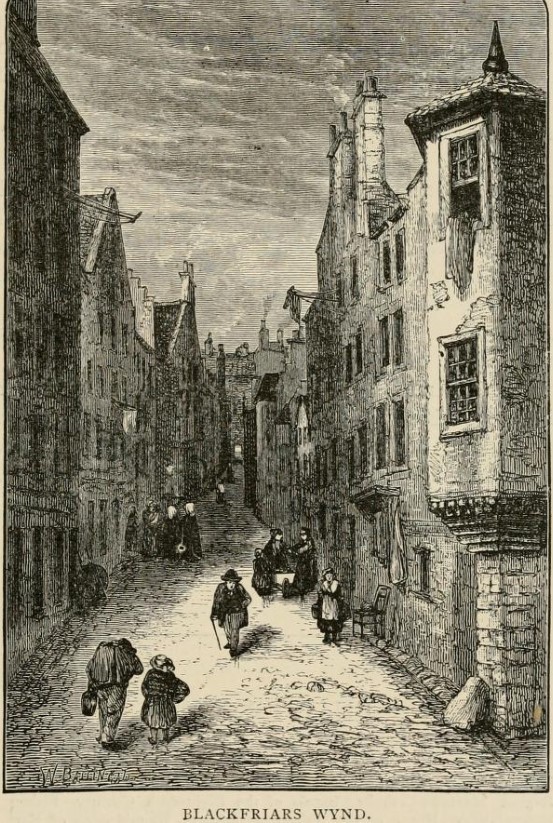
and his family lived in Edinburgh
See Note [5]. From Grant (1890)
Margaret died the following day and was buried in the family vault at Penicuik. Her son, named John after his father and forefathers, was placed in the care of an aunt, Lady Aikman of Cairnie (see §3.2). Margaret, however, was a cousin of the Duke of Queensberry, a very influential statesman, and because of the calamitous turn of events he was keen to take John under his wing and do what he could for him. John’s father-in-law, the Earl of Galloway, though perhaps less influential, was of a similar mind, and in 1703 helped to get him elected to the Scottish parliament as member for Whithorn in the south-west of Galloway. In that same year, John was appointed to the commission enquiring into the public accounts and national debt of Scotland, this time through the Duke’s influence, and was even entrusted with drawing up its report. Despite his despair at the loss of his wife, things were improving in other directions; now the Duke of Argyll was nominating him to a council of enquiry into the trade and commerce of the Scottish nation. This sort of work suited John better than the bar, and within a few years he had gained a ‘thorough acquaintance with all the Finances of Scotland, and the whole management of the Lords of the Treasury, and Exchequer’ (BJC, p. 58).
4.5 Part of the Union
When barely thirty, John Clerk was nominated by Queensberry as one of the thirty-one Scottish commissioners for negotiating the political union of Scotland and England. The two countries had joined crowns under James VI in 1603, making him James I of England, but they had retained their separate parliaments in Edinburgh and in London. Possibly thinking himself insufficient for the role, or fearing that it would end like previous attempts, in failure, he at first demurred, causing Queensberry to threaten withdrawing not only his patronage but also his friendship. It seems Queensberry’s efforts on John’s behalf were not purely altruistic, for in pressing John to accept he no doubt knew that he needed not only someone he could trust, but also someone of exceptional abilities, who would see what was going on, who would manage all the complexities, and who would keep him informed.
Clerk had then little choice but to accept the appointment and so became one of four commissioners whose duty it was to confer daily with their English counterparts. He focused on the financial aspects of the treaty and by ‘assiduous application, to the study of the momentous questions’ (Somerville, 1798, p. x) he managed to establish himself as a diligent and capable public servant. The negotiations were in the end successful and the Articles of Union were concluded on 22 July 1706. On the following day he took his place when the Commissioners presented the signed Articles to Queen Anne, filing in two by two, Scottish and English side by side. The Articles were duly passed by the Scottish Parliament on 16 January 1707 and thereafter by the English Parliament on the 6 March. Following a great procession up Edinburgh’s High Street to the Parliament House, the final acts to dissolve the Scottish Parliament were passed on 25 March (Hanham; Royal Collection Trust, 1706).
In the meantime, however, an incident that was both horrible and bizarre was unfolding at the other end of the Royal Mile. Queensberry House[7] had been left just about deserted as more or less the whole household went up to the Parliament as either participants or spectators. Alone in the house was a kitchen boy, left to turn the roast for the evening’s dinner on a spit before the kitchen fire. That is to say, he should have been alone. In a separate wing of the house, the Duke’s eldest son, an imbecile, was kept locked up, not only for his own safety but for that of the household at large; he was extremely strong and of a violent disposition. In the absence of supervision, he managed to escape from his confinement and find the kitchen. Once there, he murdered the poor kitchen boy and, according to Chambers (1980, p. 337), placed his corpse on the spit and proceded to roast it.[8]
Forhis part in bringing the negotiations to a successful conclusion, John Clerk was duly appointed as one of the five Barons of the Scottish Exchequer that was set up pursuant to the Treaty of Union. This John Clerk is frequently referred to as ‘the Baron’ simply to distinguish him from all the other John Clerks of his line, and it will be useful for us to do the same here.

He is seen here dressed in his robes as a Baron of the Exchequer.
(By Courtesy of Sir Robert Clerk of Penicuik. Photograph : Gary Doak)
4.6 Remarriage
On 15 February 1709, the Baron resumed the role of family man by remarrying. His new wife was Janet Inglis, a daughter of Sir James Inglis of Cramond and Anne Houston, of the Houston of Houston family, who bore him a further nine sons and seven daughters. Their sons were (BJC, p.2):
- James, born on 2 December 1709, eight years to the month
after his half-brother John - George, born on 31 October 1715
- Henry and Patrick, twins born on 5 October 1718
- John, born on 10 December 1728 and named after his
now deceased half-brother (BJC, p. 135 & n3) - Mathew, born on 15 March 1732
- Adam, born in May 1737.
A previous son named Henry or ‘Hary’ died aged three (BJC, p. 85) and there had also been a William who died before reaching his first birthday (BJC, p.114). Of the surviving sons, James became the 3rd Baronet (see §10.1), while George (Chapter 8) became not only George Clerk of Dumcrieff but also George Clerk Maxwell of Middlebie and, for a brief time, the 4th Baronet of Penicuik. Their younger brother John did not succeed to any family estates but nevertheless did succeed in making a name for himself as John Clerk of Eldin (see §10.4) an engraver of some distinction. Of the twins, Patrick became a lieutenant in the army and died in 1741 at the siege of Cartagena in South America, while Henry became a lieutenant in the navy and died on active service somewhere in East Indies during 1745[9]. Mathew Clerk (see §10.3) also went into the army to become an engineer and met his death in July 1758 at the Siege of Ticonderoga. Their last son, Adam, was born, much to the joy and very great surprise of the Baron and his wife Janet when she was about fifty-one years old! (BJC, p.146). Of Adam we know little, only that it appears he had once been a crew member on his uncle Hugh Clerk’s North Carolina trading ship and may have thereafter joined the navy. He died about 1757, ‘… abroad in the service of his country’.[10]
The daughters of John Clerk and Janet Inglis who survived infancy were:
- Anne, born on 4 June 1712, died unmarried in November 1755;[11]
- Elizabeth, or Betty, born on 10 August 1713. She married Robert Pringle of the Stichel family and who was later the judge Lord Edgefield (BJC, p. 145);
- Jean, or Jen, born on 5 February 1717 and married James Smollett of Bonhill, a cousin of the writer Tobias Smollett, on 17 January 1740 (BJC, p. 155);
- Johanna, or Joanna, born on 10 March 1724 and died unmarried;[12]
- Barbara, or Babie, born on 17 October 1725. She never married and in later life lived with or nearby her sister-in-law Lady Mary Clerk (see §9.1);
- Janet or Jennet, was born on 10 August 1727. She married James Carmichael of Hailes but died without issue in 1784 (BJC, p. 222).
After his remarriage, the Baron lived the life of a conventional country gentleman. While he would regularly commute on horseback to Edinburgh when the Exchequer Court was sitting, he would otherwise be engaged in developing his estates, researching antiquities or studying the classics. The family would also spend vacations either at Moffat in Dumfriesshire or at Lawers in Perthshire, where they could indulge in fishing and shooting, or taking the goat’s milk or spa water cures that were then in vogue. Almost everything that he found interesting was recorded for posterity and his own enjoyment.
4.7 The Jacobite Rising of 1715
This seemingly idyllic existence was interrupted by the Jacobite Rebellion of 1715 in support of James Francis Edward Stuart, better known today as the ‘Old Pretender’. He had been just a year old in 1689 when his father, James VII, had forfeited his crown after fleeing to Europe. The Baron would have had cause to remember that year, for it was then that he had the dreadful accident that lamed him for life. When, on 6 September 1715, the Jacobite standard had been raised by the Earl of Mar and the rebels under Brigadier Mackintosh came south from Perth to threaten Edinburgh, the city was already well prepared for the event. About 400 able-bodied citizens had been called to arms and, ever the loyal servant of his country, the Baron was amongst them. The rebels had balked at a direct assault on the city itself and instead attempted to infiltrate the Castle with an advance party of about fifty men on the night of 8 September.[13] Unfortunately for them, word of the intended assault reached Edinburgh and the garrison was on the alert.
Those of the raiding party who had managed to escape fled to the half-ruined Citadel of Leith[14], which the main Jacobite army had just taken after crossing the River Forth. Meanwhile the Duke of Argyll had been despatched to Edinburgh to take overall charge of its defences, whereupon he sacked the garrison commander for having taken the impending threat too lightly. After taking personal command, he confronted the Jacobites on 15 October at the Citadel. But when Argyll returned to the Castle to fetch some artillery (possibly a feint), the rebel army slipped away during the night (Grant, 1850, pp. 213−218; Arnot, 1779, pp. 107−108). For the Baron, therefore, it had been but a brief fling. In the meantime, back home at Penicuik, Janet Inglis awaited not only news of her husband, but the imminent birth of her son George, who was born a fortnight later (see §8.1).
As to the ‘Old Pretender’ himself, he did not set foot on Scottish soil until after the battle of Sheriffmuir[15]. He eventually landed at Peterhead in December 1715 but on failing to impress the leaders of his rebel army, he took ill and went home to France. Somewhat ironically, he departed from Montrose, the Angus town to which John Clerk of Killiehuntly had retreated in the wake of a previous Stuart failure. Back in France he fared no better, for he was shunned by his French backers, to whom he was now a mere embarrassment.
4.8 Cammo Mavisbank and Dumcrieff
After his remarriage and presumably some improvement in his finances, the Baron purchased Cammo, an estate adjacent to his father-in-law’s at Cramond.[16] Cramond lies by the east side of the River Almond where it flows into the Forth Estuary, while Cammo is a little further south. Cramond, now best known as a picturesque seaside village and the site of some significant Roman remains, was purchased by the Inglis family in 1622. They had lived in the old four-storey tower house there until about 1680 when James Inglis built the adjacent Cramond House.[17]
Cammo obviously had the advantages of being near both his new wife’s parents and the Roman site, while its distance from Edinburgh was only half of what he had to travel from Penicuik:
… by this purchess I had a very agreable retirement and abundance of Exercise in riding between Edin. and my House in the Country. (BJC, p.78)
Furthermore, the Baron would have known there was a family connection with Cammo, for the Mowbrays of Cammo were ancestors of his; Giles Mowbray, maidservant to Mary Queen of Scots, had been the grandmother of Mary Gray, his own grandmother (see §3.2 and Family Tree 1).
At Cammo, one of the first things the Baron did was to start a plantation, an activity that he pursued both there and at Penicuik:
My plantations at Pennicuik no ways hindered me from improving the Lands and Gardens of Cammo, for I did a great deal about it, all the Plantations except a few Firrs on the East side of the House having been made by me. (BJC, p. 84)
He mentions that he managed to keep on planting at Cammo and adding to his collection of antiquities even during the turbulent year 1715:
… his long residence at Cammo, and his connection with Sir John Inglis [his brother-in-law] were the means of enriching his museum with innumerable … remains … found at Cramond. (Wood, 1794)
The Penicuik and Lasswade estates having fallen to him on the death of his father in March 1722, in the following winter the new baronet, now himself Sir John Clerk, reluctantly decided to sell Cammo and return to Penicuik. He:
… resolved to build a small house at Mavisbank, under the Town of Lonhead, which my Father inclined frequently to have done, because his Coal works there … required his frequent attendance. (BJC, p. 113)
The Baron had helped his ageing father run his lucrative coal mines in the North Esk valley. Being the owners of the land, the Clerks had the right to exploit the coal seams lying beneath its surface, and one might ask whether the original John Clerk had designs on the coal rights when he bought the Penicuik estate. At any rate, it must have been a major source of income. The multitude of coal mines that were dotted all around the North Esk valley, from the industrial revolution to fairly recent times, gave rise to many of the present-day towns in the area, such as Loanhead itself. The main problem with the exploitation of the coal was getting access to the seams, but where they met the deep valley it was possible to dig into them horizontally from the steeply sloping surface. We therefore hear the Baron talk of beginning new ‘levels’ to keep his coal revenues flowing.
The years 1722 and 1723 were full of sadness for the Baron: his father had died in March 1722 and his eldest son, John, being far from well even then, died in August of a prolonged ‘hectique fever’[18] that may have ended in pneumonia. By the end of the year his brother William was also unwell with a similar condition that endured until the following April, when he too died of his illness (see §5.3).
Cammo was eventually sold in the summer of 1724 for £4,300, bringing him some £1,500 profit.
▪ . ▪ . ▪ . ▪ . ▪ . ▪ . ▪ . ▪ . ▪
Mavisbank (Historic Scotland, 1971; Glendinning et al., 1996) was built just to the north of Loanhead[19] on the sloping side of the valley of the North Esk River, which flows down from the Pentland Hills, through Penicuik, past Loanhead and thence to the Firth of Forth at Musselburgh. Based on the Baron’s own design, the building commenced in 1723 under the Baron’s regular stonemason, John Baxter (Skempton, 2002; DSA, 2014) and the supervision of the architect William Adam (1689−1748).[20] The exterior was completed in the summer of 1724, which date is carved in one of the lintels, but he did not live in the house until the early summer of 1727 (BJC, p. 132). He now carried on with the finishing touches and adding outbuildings, gardens and enclosures.
At the previously desolate moor of Loanhead nearby, he also built houses and created enclosures and an avenue. In Loanhead itself he built a Town Council house and installed timber pipes to bring in a water supply. In the midst of this he was expanding his coal workings by constructing a ‘level’ running ‘300 fathoms under ground’ (BJC, pp. 233−234).
▪ . ▪ . ▪ . ▪ . ▪ . ▪ . ▪ . ▪ . ▪
As already mentioned, the Baron was in the habit of taking a late summer vacation at Moffat,[21] where he and his family could benefit from the spas and enjoy the local shooting and fishing, just as his father had done for many years before. Being unconnected with any family there that might offer them hospitality, it was necessary to take lodgings, which at times were neither easy to find nor convenient to his needs. In ‘summer, 1727’ he therefore purchased the estate of Dumcrieff from his friend and mentor, Charles Duke of Queensberry (BJC, p. 130).[22]
Originally called Drumcreich, it was a small estate with a farm and dwelling house (BJC, pp. 249−250). Lying about one and a half miles south-east of Moffat, it had been in the possession of the Murray family until 1717 when it was sold to the younger brother of the Duke of Queensberry, then just sixteen years old. The property fell to the Duke himself in 1726 and, presumably being surplus to his needs, he sold it to the Baron at the end of that year, a little in advance of the Baron’s own recollection of events, but at any rate it was indeed the Baron’s property by 1727.
As it stood, however, the existing house at Dumcrieff was not suitable and so he and his family carried on staying at lodgings in Moffat until such time as the house could be rebuilt. In the summer of 1728, they were lodged in an old tower house called Frenchland[23] where they had the dining room and two bedrooms, but had to bathe in the kitchen because a decent tub could not be fitted through the old house’s narrow doorways. By that time the Baron had made plans for creating a park enclosed by drystane dykes, which were then relatively unknown in the region.[24] Later that year he improved the parklands by exchanging part of his land for half the adjacent acreage belonging to his neighbour, Tod of Craigieburn.[25] In August 1729, the Clerksonce again stayed at Frenchland[26] while the work continued on, and on until 1733, when a final deadline had been set for Dumcrieff to be ready for occupation by Clerks during their August vacation. Dickson, the Baron’s factor, wrote:
I hope the hous will be in order when you come … you may eather bring your coach or chaise, [if] your honour will give orders to John Black to put Doars on the barn. (Prevost, 1977)
Even so, work continued on the parks with Robert Clerk, most likely the Baron’s half-brother, acting as the factor. He wrote to the Baron a year later, on 21 September 1734, to tell him the parks would at last be finished by the end of November, but he updated that during the following week, complaining of lack of progress due to foul weather and the concomitant flooding. Even worse, there was a great deluge later that night that caused a good deal of damage round about. Robert therefore wrote to the Baron in the morning, 1 October 1734, to tell him the bad news:
Old Herbert here says the lyke flood was never seen in Moffat water in his dayes. (ibid.)
He went on to say that he would like to see the back of the place, and the only time he ever wished to see it again was from the next world! Alas, we do not know whether he first departed from Dumcrieff or this world, for this was the last of this particular episode in the Baron’s affairs.
Dumcrieff, upon which the Baron must have expended an enormous amount of time and money for the land; building and furnishing the house; and creating the amenities such as the parks, gardens, drystane enclosures and plantations, took a very long time to complete, some six or seven years. Possibly because of the expense involved, he could not have afforded to do it any faster. Nevertheless, Dumcrieff was not just a holiday home for the Baron and his family; it was to become of enormous significance to the first Clerk Maxwells.
4.9 Public Offices, Interests and Later Life
In the years following the building of Mavisbank the Baron, now entering his fifties, continued with his duties at the Exchequer[27] and the management of his own coal mines and estates as usual. Nevertheless, he took on some new public offices and still found time to broaden his personal pursuits. In 1726, his mentor the Duke of Queensberry made him one of the trustees acting in his affairs. This occasioned trips to the Duke’s family seat at Drumlanrig, which no doubt had helped sow the seeds of his idea of building himself a place near Moffat, which although not quite en route was less than twenty miles distant.
On a visit to Carlisle in 1724, the Baron had met the antiquarian William Gilpin of Scaleby Castle, ‘I had all the pleasure imaginable in his Company’, and afterwards corresponded with him (BJC, pp. xxiv, 119). Although the correspondence was cut short by Gilpin’s death at the end of that year, it is worth mentioning that his sister Dorothy married Jabez Cay who was the first Cay of Charlton Hall (see §14.1). In late 1726, the Baron formed a correspondence ‘upon Greek and Latine Literature, and particularly upon Antiquities’, which he had ever been interested in, with some like-minded English gentlemen: Roger Gale Esq., excise commissioner; Dr William Stukeley, physician turned clergyman; and the Earl of Pembroke. This resulted in his acceptance as member of the Society of Antiquaries in London, whose president was then the Earl of Hertford.[28]
In the spring of the following year he travelled to London where he visited many friends and useful contacts. One in particular, his new friend and correspondent, Roger Gale, took him to visit the Royal Society of London at Crane Court, off Fleet Street. The Baron had just shortly before visited its recently elected president, Sir Hans Sloane, a great collector, who showed him a greater ‘Treasure of Valouable Antiquities, jewels, and medals, and Gold, silver, and copper’ than he had ever seen before. But it was not until around November of 1729 when at last he was informed:
… by a letter from Roger Gale, my good English friend and constant correspondent, that I was chosen a Member of the Royal Society [of London, on 16 October]. (BJC, p. 126)
In the following year, 1727, the Baron was appointed one of the Trustees for Manufactures in Scotland,[29] a commission that had newly been set up following representations by the Baron himself, his cousin Duncan Forbes of Culloden,[30] Charles Erskine[31] and others, to strengthen provisions under the Articles of Union for boosting the economic situation in Scotland. He was a man very suitable for the position, for he was not only skilful in the law, politics and negotiation, he was also of an inquisitive mind and certainly knew a great deal about mining.
The year 1731 saw two of the Baron’s sons (see §4.6) leaving home to continue their education. For George, it was a trip no further than Penrith, to a boarding school at Lowther, while for his eldest son, James, it was a case of following in his father’s footsteps and setting off first for London and thence to Leiden, where George was to join him some five years later. George returned in 1737, but it was two more years before James came home after an extended grand tour. Like his father, he had a fascination for art, music and Europe. The Baron’s interest in antiquities and philosophy led to him becoming a founder member of the Philosophical Society of Edinburgh, of which he was one of the original co-vice-presidents.[32] He was already a Fellow of the Royal Society of London, but he now had access to a stimulating environment where he could meet with local illuminati, gentlemen such as himself, the number of whom was now swelling rapidly. Indeed, he soon presented a paper on the early languages of Britain and indulged his interest in astronomy. He noted, sometimes in great detail, comets and eclipses of the Sun, Moon and Jupiter.[33] He had wondered, as the ancients had done, whether the brilliant comet of 1744 heralded an impending calamity; indeed, Bonnie Prince Charlie had already set sail on an exploratory venture with the French marshal, Count de Saxe.
Following his son George’s rather early marriage to his cousin Dorothea in 1735, the Baron busied himself in sorting out their rather complicated affairs (see §§8.2 and 8.3). His efforts in building Dumcrieff had been partly for their benefit and when it was eventually finished he turned his attention back to Mavisbank, to put a ‘finishing hand’ to it, which he succeeded in doing by the summer of 1739. He continued to live there to be near his coal workings at Loanhead, otherwise living at his hereditary seat of Newbiggin, at Penicuik, which he eventually decided was the more fitting of the two for a baronet.
When the second Jacobite rebellion eventually came in the summer of 1745, the Baron was by then nearly seventy and too old to take up the call to arms as he had done thirty years before. On receiving the news that Bonnie Prince Charlie’s rebel army had entered Edinburgh, he quite sensibly preferred to be out of the way. Heading for England with his wife and eldest daughter, he left it to his eldest sons James and George to defend the family honour, as one might expect, from the government side. This rebellion was a much bigger affair than ‘the 1715’, with Edinburgh and its environs under rebel occupation for about six weeks, but when the rebels eventually marched south the Baron and his family headed home from the comparative safety of Durham. Once back at Newbiggin, they discovered that sixteen to twenty of the highlanders had billeted themselves there, in the course of which they had made free with his stores of hay and meal and before making off with his best horses.
Although this was to be the Baron’s last great physical upheaval, the following years saw his health decline, which he valiantly tried not to show. Nevertheless, at the Exchequer Court he was now involved in managing those estates in Scotland that had been forfeited by rebel lairds in the aftermath of the ’45. He was still able to make the journey to Dumcrieff and Drumlanrig, and even ventured north, to Perthshire, to take the goat whey near Lawers and to see the progress made in getting the ‘highlanders’ to take up linen manufacturing for a living. Walking any distance got ever more difficult, but even when he was just two years short of eighty, a great age then, he still managed to ride well. This we know because he had the misfortune to be thrown off his horse at Penicuik Bridge. Although he ended up no worse than badly bruised, the experience must have revived unpleasant memories of his boyhood accident on a horse, which had nearly killed him and left him with a permanent limp.
Still enjoying the thrill of learning something new, the Baron spent time poring over his beloved books and writing his manuscripts. Even if he was now allowing his son and heir James to do some of the work, he was still the instigator of many improvements in the village and about his estate; for example, the Terregles Tower on Knight’s Law was built when he was about seventy-five years old. Over the years he had accomplished a great number of things in and around Penicuik most of which are still there as a memorial to a man of so many talents.[34]
Ever the skilled administrator and clever manager, he made rapid progress, and he possessed energy and erudition in equal measure. In October 1755, the Scots Magazine announced his death to the nation:
Octr. 4. At his seat of Pennycuik, Sir John Clerk of Pennycuik, one of the Barons of the Exchequer. He had been Baron since the union in 1707. He is succeeded in estate, and the title of Baronet, by his eldest son, James.
His only enduring regret was his unrefined manner of speech and writing, which he always felt placed him at a considerable disadvantage to his English cousins. He consequently felt that his manuscripts were inferior; he frequently revised them, and would even forbid them to be seen except by friends and family. He earnestly desired his sons to do much better in this respect, so that they could truly become gentlemen, but a key piece of advice that he pressed on them was:
You have nothing else to depend on but your being a scholar and behaving well. (BJC, p. 138n1)
It was a motto that he himself had lived by. His wife Janet survived him by just over four years.
Notes
[1] Leiden is about twenty miles north of Rotterdam.
[2] He was Alexander Clerk (Worling, 2012), son of distantly related William Clerk (Grant, 1944, p. 37).
[3] Presumably also on the grand tour, he was then Marquess of Tavistock and later 2nd Duke of Bedford.
[4] The majority of it covered by his own borrowings, which by 1703 totalled £12,000 Scots (Hayton, 2002). In order to pay back his debt to his father, his annuity of £1,000 Scots was held back.
[5] While he was still a minor, John Clerk had been left an estate at Elphinstone and a substantial house at the head of Blackfriars Wynd in Edinburgh by Dr Henderson, his grandfather (BJC, Additional Note H, p. 246,). He sold this house only to purchase another at the opposite end of the Wynd, possibly Cardinal Beaton’s old house down by the Cowgate. However, Dr. Henderson’s house seems to have been repurchased some time thereafter:
… [about mid October 1710] I lived in my own House at the head of Blackfrier Wynd… built, anno 1552, by Thomas Hendersone… my mother’s Grandfather.
After the Baron’s death in 1755, his son Sir James Clerk ‘had a lodging in the head of Blackfriars Wynd either as proprietor or tenant’ (ibid).
[6] For example, he informs us on a later occasion ‘If I had consulted physitians they might have done me mischief …’ (BJC, marginal note on pp. 146‒47).
[7] The original house is now part of the Scottish Parliament complex (Scottish Parliament, 2024).
[8] A further tradition given by Chambers (p. 309) is that the Treaty of Union was signed in a summerhouse in the gardens of Moray House, on the south side of the Canongate a short distance from Queensberry House, or that it took place in a ‘laigh shop’ (cellar bar) further up the High Street. The only formal signing that took place, however, was when the Articles of Union were agreed in London on 22 July 1706 (see §4.5).
[9] BJC, pp. l58‒162 and 203. The Baron tells us:
Patrick had a very great genius for the Ingeneering business. … he was naturally very industrious. … [He was one of the] Aids de Camp and Chief Engineers to [Lord Cathcart] (p. 158)
… [Henry was] first Liutenant to the Earl of Noresk, who commanded a Man of War of 50 Guns … [his] skill in navigation and the mathematical sciences, wou’d have rendered him a blessing to his Relations … (p. 203)
[10] BJC, p146 n2; NRS: GD18/5321, 1751; GD18/4199, 6/1/1756; GD18/4200, 19/2/1757.
[11] NRS: GD18/5463, 26/11/1755
[12] Possibly in November 1781 (SOPR: Deaths, 685/010970/0266 Edinburgh, 27/11/1781) but it is more likely that the Johanna Clerk who died on that day was in fact her neice (see §8.6)
[13] One of the prime movers in this failed scheme was none other than the Baron’s brother-in-law, Dr William Arthur! (see §3.3 under ‘Barbara Clerk’). Needless to say, the Baron made no mention of this in his memoir. For a recent detailed account of the part Dr Arthur played see (Arthur A., 2021).
[14] It stood on Dock Street near its junction with Commercial Street, would have been out of effective range of the Castle guns. A fragment of it remains.
[15] Fought near Stirling on 13th November 1715, with both sides claiming to have won.
[16] He bought Cammo for about £2,800 by selling the lands of Elphinstone which Dr Henderson left him (BJC, p. 8n6). See also note 5 above.
[17] The tower (CANMORE: ID 50421) is assumed to have been built by the Bishops of Dunkeld (Scottish Castle Association, 2013) whereas for the house (CANMORE: ID 74420) see Wood, 1794, pp. 44‒51, etc.
[18] A fever with alternating extremes of body temperature
[19] Loanhead was then within the precincts of his estate. It lies to the west of the steep valley of the River North Esk, about half way between Edinburgh and Penicuik.
[20] Father of the rather better known classical architect Robert Adam, (Macaulay, 2004; DSA, 2014; Gifford, 1989). He was also the architect who built the Scots Mining Company house for James Stirling (see §12.4) at Leadhills. The Clerk and Adam families were brought together by the marriage of John Clerk of Eldin, the Baron’s fifth son, to Susannah, William Adam’s daughter (see §10.4).
[21] In Annandale, about fifty miles south of Edinburgh on the road to Dumfries and Calisle
[22] This section on Dumcrieff is based on Prevost, 1968. . Charles had succeeded his father, the Baron’s mentor of old, in 1711.
[23] CANMORE: ID 49725
[24] The first such dykes began appearing in the area in the early eighteenth century (gallowayglens.org, 2018)
Once a very familiar feature in many parts of the Scottish countryside, many are now dilapidated or have disappeared altogether.
[25] BJC, p. 135. Archibald and Thomas Tod at Craigieburn were apparently unconnected with the Tods of Blackhall and Hayfield with whom the Baron had business connexions. This Thomas Tod (1657‒1742) was the minister at Durisdeer, west of Moffat.
[26] While the Baron says they were at Dumcrieff, he was evidently not able to live in the unfinished house.
[27] He was also in effect acting as the Chief Baron, for the incumbent Baron Lant was hardly ever there.
[28] Algernon Seymour, later the Duke of Somerset
[29] The Board of Trustees for Fisheries, Manufactures and Improvements in Scotland was eventually set up to make grants for to encouragement economic improvement throughout the land. After 1823, its funding was instead applied to the decorative arts and the encouragement of education in the fine arts, and from 1906 the Board of Trustees for the National Galleries of Scotland took its place (NRS: NG [see under ‘Admin. History’]; Select Committee on Arts and Manufactures, 1836, pp. 77‒88). The Baron was also a member of the Honourable Society of Improvers in the Knowledge of Agriculture in Scotland, which was active from 1723 to 1745 (Maxwell of Arkland, 1743).
[30] The King’s Advocate for Scotland, he was the son of Sir David Forbes of Newhall who had married the Baron’s aunt, Catherine Clerk (see §3.2).
[31] Charles Erskine, or Areskine, of Alva (1680‒1763) was Solicitor General for Scotland 1725‒37, Lord Advocate 1737‒42, the judge Lord Tinwald from 1744 and Lord Justice Clerk from 1748. His wife Grizzel Grierson, was a descendant of Homer Maxwell of Speddoch, (see §6.3 and §6.4) and therefore distantly related to the Baron’s niece and ward, Dorothea Clerk. Erskine’s descendants were therefore potential successors to Middlebie.
[32] The Philosophical Society of Edinburgh was established in 1731 as a society for sharing medical knowledge. In 1739 it broadened its remit and became the Society for Improving Arts and Sciences, but still known alternatively as the Philosophical Society of Edinburgh, with interests covering medicine, literature, philosophy, mathematics and the sciences. The first co-vice-presidents were Sir John Clerk, the ‘Baron’, and his cousin Dr. John Clerk (see §10.7). In 1783, the Philosophical Society re-incorporated itself under royal charter as the Royal Society of Edinburgh (RSE) taking all the existing members over as its founder fellows. By then, however, the Clerk cousins were both dead (Campbell & Smellie, 1983; O’Connor & Robertson, 2004b).
[33] The comets were in 1742 and 1744. The eclipses were: of the Sun, 1715 and 1737, of which he published an account (Clerk, 1737‒8); of the moon, 1739; and Jupiter, 1751. He also attempted attempt to see mercury during the comet of 1744. (BJC, pp. xxv, 86, 150, 164, 166‒7, 227).
[34] See BJC, pp. 232‒34 and Wilson, 1891, pp. 10, 153−154
 Brilliant Lives