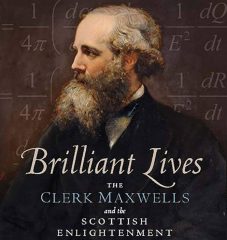
Brilliant Lives
by John W. Arthur
Second edition
Published by the author in 2024
First published in Great Britain in 2016 by
John Donald, an imprint of Birlinn Ltd
Copyright © John W. Arthur 2016, 2024
All rights Reserved.
Contents
11.1 The Weirs of Blackwood and their Cadets
11.3 The First Irving of Newton
11 From Weir to Irving
James Clerk Maxwell’s paternal grandmother was Janet Irving, daughter of George Irving of Newton. In turn, this George Irving’s maternal grandmother was Margaret Weir, brother of John Weir of Newton, so that the Clerk Maxwells are connected to the Weirs through the Irvings. However, the tale of how Newton passed from John Weir to the Irvings came to be a family legend with which James Clerk Maxwell would have been very familiar. While the story is not mentioned in Lewis Campbell’s biography, Newton is indirectly touched on concerning the journey between Edinburgh and Nether Corsock:
Coming by way of Beattock, it occupied two whole days, and some friendly entertainment, as at the Irvings of Newton … had to be secured on the way. (C&G, p. 26)
And indeed, we find Newton to be very nearly the halfway point on that journey. But it is with the story of the Weirs that we must begin the tale.
11.1 The Weirs of Blackwood and their Cadets
In olden Edinburgh there were a number of families by the name of Weir. In addition to John Weir of Newton (c.1650−c.1713), an early Weir, of grand infamy, was Major Thomas Weir (1599–1670), while a later one, Janet Irving’s great-grandfather, Dr Thomas Weir (c.1725–c.1804) ran a very interesting patent medicine business that endured through several generations of Weirs and Irvings. These three Weirs belonged to cadet branches of the Weirs of Blackwood, the Weirs of Newton, Kirkton[1] and Stonebyres respectively, all of which originated from an area around Lesmahagow, a small town in the upper Clyde valley about twenty-five miles to the south-east of Glasgow. Around the year 1400, Patrick, Bishop of Kelso (c.1392−1411) had granted part of the Church lands in the vicinity of Blackwood to Rotaldus (or Rothald) Weir, one of his baillies in Lesmahagow, in return for services rendered, which mainly consisted of carrying out ‘inquests’ on his behalf, a duty that probably ensured, by one means or another, that the Bishop got paid his rightful dues (Greenshields, 1864, pp. 83−84). Blackwood itself is a village situated just three miles to the north of Lesmahagow, while Stonebyres lies only two and a half miles to Blackwood’s east, and Kirkton is some five miles to its north-east and on the opposite bank of the river Clyde. The histories of the families therefore did not take entirely separate paths, for they lived close enough to become intermingled, very likely as a result of alternating cycles of feuding (involving murder) and reconciliation (involving marriage) that were typical of the times.
According to Irving and Murray (1864, vol. 1, p. 80), a cadet of the Weirs of Blackwood subsequently acquired property about twenty miles further to the south, in the parish of Crawford lying in the upper Clyde valley,[2] whereupon they became known as the Weirs of Newton, a small steading on the property that gave it its name. On John Clerk Maxwell’s family tree,[3] this cadet is identified as having arisen from the Weirs of Stonebyres. As to the place, Newton is a very common name simply because it means what it says, ‘new town’; there are consequently Newtons scattered here and there all over the country, both north and south of the border. Our particular Newton (Figure 11.1) was the ‘new toun’ on the east bank of the River Clyde facing its junction with the Elvan Water (Irving & Murray, 1864, vol. 1, p. 80). No town is to be seen there, nor was there ever one that we would now recognise by that word, but as already mentioned, in the ancient manner of speaking in Scotland, a ‘toun’ could simply mean a single country house. Nevertheless, not far away, and on both banks of the river, there are many signs of previous habitation where the earlier toun could have been,[4] but when Newton was actually a new town must have been a very long time ago indeed.

Newton is the solitary house seen on the right bank of the River Clyde where it is joined by the Elvan water (NLS: Public Domain Dedication (CC0))
While an estate of a few thousand acres went along with Newton, it was just part of the vast, empty moorland that forms the Upper Clyde valley. The M8 motorway now passes through the estate and indeed within a few hundred yards of the site of Newton House, but virtually all that is now left there is the name and a fragment of the buildings. It had once been the property of one William Were (alternatively spelled as Vere or Weir) who in 1512 served on an ‘assize’ (Irving & Murray, 1864, vol. 1, p. 80; Pitcairn, 1833, p. 87). His name appears centre of the bottom row:
Slaughter of the Laird of Greifton
May 31. –William Dekesoune, fon of umqll John Dekefoun, convicted of art and part of the Slaughter of George Myddilmeft of Greiftoun, committed by the faid William, John his father, and John his brother, upon forethought and culpable felony : Item, for being at the horn of the faid Slaughter.— Beheaded.
Assisa
Thomas Lewis of Menner, Ninian Paterfoun of Caverhill, John Caverhill of Foulage
Gilbert Berde of Poffo, John Elphinftoun of Hendirftoun
William Were of Newton
Thomas Wylie of Bonytoune, James Levingftoun of Girifwode, John Carmichell, Capt of Crauforde
William Were lived in the turbulent times when war with the English seemed to be the status quo and any intervening peaces were short-lived. In particular, a war against Henry VIII that started in support of the French culminated in the infamous defeat for the Scots at the Battle of Flodden,[5] which took place in the year after Were served on the assize. As already discussed in §6.1, cross-border reiving and retaliatory skirmishes were endemic, and both sides were equally culpable. The reiving flourished as far north of the border as Newton, for the Devil’s Beef Tub, to the north of Moffat, is not far distant and, as the name suggests, it was a well-known repository for stolen cattle. On the Elvan side of the Clyde there is ample evidence of ancient buchts and bastles (Ward, 2012), the former being a sort of byre or sheep pen and the latter a fortified farmhouse, heavily built with slit windows to make it easier to defend in a raid.
In the seventeenth century, the reiving gave way to a period of more widely spread political and religious strife (see §6.4) during which, in 1662, one John Weir of Newton was fined £360 Scots by the Scottish Parliament for being a Covenanter sympathiser (Woodrow & Burns, 1824, p. 272) and as we shall see, the fact that he was soon in even greater trouble had a major bearing on our story, in which the Weirs of Blackwoods also have a minor connection.[6]
11.2 From Weir to Newton
Now, as has just been mentioned, John Weir of Newton had been accused of being involved with the Covenanter cause, and it is a matter of record that he was indicted for treason in one of the infamous trials that took place between the years 1682 and 1686. A dramatic story is recounted by George Vere Irving of Newton, of how his great-grandfather, George Irving, came to inherit the estate of Newton from this John Weir as a result of his trial (Irving & Murray, 1864, vol. 1, pp. 80−81; Irving, 1907, pp. 3−4). Vere Irving called the story a family tradition, but we will now examine it to see how close to the truth it might have been.
John Weir of Newton’s sister, Margaret, was married to a Scottish court official by the name of James Irving.[7] It was a common family name in places both to the north and south of Edinburgh. There were two families of Irvings in the staunchly royalist south, namely the Irvings of Bonshaw and the Irvings of Hoddom, which were to be found in and around Dumfriesshire. This indeed is where one might have expected a connection with the Clerk Maxwells to have originated. In the opposite direction, the main clan was Irving of Drum, whose seat is Drum Castle about ten miles east of Aberdeen (Boyd, 1908). The Irvings generally seemed to have royalist leanings, in particular the Irvings of Drum were staunchly royalist, and it was to that family that James Irving was connected.[8]
Since his appointment in 1683, James Irving had been Macer to the Privy Council, which at that time was effectively the highest court in the land, for it had taken to intervening in the usual judicial procedures whenever it happened to be in the King’s interest. The Mace was the symbol of the monarch’s authority (as it still is in Parliament today) and the Macer was the senior court usher, amongst whose duties it was to carry the Mace before the procession of Privy Councillors as they filed into Council. James Irving is also recorded as having been Secretary to Alexander Stuart, 5th Earl of Moray,who not only was a strong supporter of James VII but had taken part in suppressing the Covenanters. There is no way that James Irving could have held such a position had he not been trusted by the Earl as being, heart-and-soul, loyal to the Crown, and therefore an anti-Covenanter. How, therefore, he came to marry the sister of a prominent Covenanter we do not know. Margaret’s testament,[9] however, informs us that she had been married before, to John Balmaine (died c. 1679), a Baillie in the Canongate,[10] but of him there is little to report. It seems there were no children and so on his death she inherited his moveable estate. Now, it has been said that James Irving married Margaret Weir about 1684, in the April of which year he was granted the movable property of ‘John Balman in Doning’ (Irving, 1807, p. 4), who had been outlawed. Perhaps the similarity of the two names is just a coincidence, but if so it is a curious one.[11]
Let us return now to George Vere Irving’s family story of how the Irvings came into possession of Newton. During his trial before the Privy Council, Margaret Weir, now Mrs Irving, was said to have gained entry to the courtroom, whereupon she proceeded to plead vehemently for clemency on her brother’s behalf. This she may have contrived to do with or without the connivance of her husband the Macer for, as his wife, she would have been able to get into the courts armed with some suitable excuse. Being heavily pregnant at the time, that may not have been difficult, and for the same reason the judges may have tolerated her interruption. Her impassioned plea found its mark with them and a pardon was duly granted. A crucial part of the story, however, was that in gratitude for this providential escape from the gallows, John Weir declared ‘be it lad or lass’ he would leave his property, then comprising mainly the estate of Newton in the upper Clyde valley, to his sister’s child. Vere Irving goes on to say that the Lord Chancellor himself was so affected by these entreaties[12] that it was he who had relented, exclaiming ‘Take away the woman, and make out the pardon!’
Vere Irving cites David Hume’s account of Weir’s trial (Hume, 1796, pp. 144–5) as supporting evidence for his story, but the Weir in that trial was actually a different one, namely William Weir of Blackwood[13] who was tried in 1682−83, as recounted and described in detail in Cobbett’s Complete Collection of State Trials (1811, pp. 1022−54). By offering only ‘Weir’ as the name, Hume clearly left the door open to confusion exactly which Weir he was referring to. Blackwood was condemned to death by beheading, but after having at least one request for clemency turned down, as Hume later put it, a ‘reprieve was with some difficulty procured’. Since Vere Irving chose to use this very same quotation from Hume’s account, it is clear that it was a case of mistaken identity.
Our John Weir of Newton did stand trial for treason, along with twenty-one others, in a separate, later trial.[14] Weir, as we may surmise, was not amongst the accused that were eventually convicted; the principal charges against him were that he had been part of the rebel conspiracy, or at least had helped to conceal it, and more specifically he had sent a man to join the battle of Bothwell Bridge. To this, his defence was that he had sent his brother-in-law there, but not to join the battle; he had simply asked him to recover a horse stolen by the rebels. After an ordeal lasting more than two years, during part of which he had been held in Dumbarton Castle, he was finally acquitted on 18 February 1686 on the orders of the Privy Council, to which, of course, his brother-in-law James Irving was Macer. But it did not happen just as in the story, for the trials of the rebels went on from month to month, in fits and starts, sometimes in front of the criminal court, in the case of usual trial business, and sometimes in front of the Privy Council. Although Weir had managed successfully to petition the Privy Council on the grounds that the witnesses for the prosecution were tainted inasmuch as they had uttered ‘threats and capital enmities’ against him, such a procedure did not happen instantly even then. Neither is there any mention in the records of a woman having been present at any stage in the proceedings. Walter Scott’s edition of Fountainhall’s commentary, however, includes the suggestion that Weir may have got off by bribing the Lord Chancellor himself:
John Weir of Newtown, (who was an arrant Whigg rogue,) [i.e. a manifest rebel sympathiser] the dyet [was] deserted against him before the Justiciarie, for which, no doubt, he paid the Chancellor. (Fountainhall & Scott, 1822, pp. 163‒4)
The Lord Chancellor at that time was James Drummond, Earl of Perth, a staunch royalist and prominent Roman Catholic who would have had no natural sympathy for a Covenanter, even an innocent one. If emotional pleading cut no ice with him, then perhaps some other form of inducement was indeed involved.
The Scottish Privy Council was a body hand-appointed by the King for the specific purpose of ensuring that his absolute will was done in Scotland; they were therefore the country’s de facto governors. The royalist view was that all authority came from the King, so that his Privy Council had the final word even in judicial matters. The opposing view was that the Scottish ‘Lords of Justiciary’ were a sovereign body, and so in Fountainhall’s account it is ironic that Weir was appealing over the head of his own trial judges to the Privy Councillors, who would have ordinarily been even more ready to see him hanged! But things were not that simple, for some of the sitting judges were also Privy Councillors, and on occasion the Lord Chancellor himself sat in court as the chief judge. The trials of the rebels went on from month to month in fits and starts, sometimes in front of the criminal court in the case of usual trial business and sometimes in front of the Privy Council when it came to special matters such as the presenting of petitions.
If the judges, prosecutors and Privy Councillors had been chosen for their antipathy to the rebel cause, the juries were often little better. In the case against John Cochran of Waterside, out of a jury of fifteen men, thirteen were from the nobility; the jury protested to the court that it was not properly composed, as it should have been, of Cochran’s peers, that is to say commoners (Cobbett, 1811, p. 1002). Overcoming the odds in these cases would demand the use of cunning, the calling in of favours, and even blackmail or bribery, which was perhaps more acceptable then than now. The inference is that, one way or another, Weir did manage to ‘persuade’ the Privy Council that the prosecution witnesses had ‘minæa et inimicitiæ capitales’ against him or in plain speech, they ‘had it in for him’, and so they let him go:
18 Februarij 1686, poft meridiem.–At Privy Counfell, John Weir of Newton’s petition is confidered ; and, in regard the Articles of Parliament had praecognofced his objections of minæa et inimicitiæ capitales, vented by the witneffes, viz. Hamilton of Gilkerfcleuch, Symonton, and Bailzie of Litlegill’s brother, and found them proven, they fet him at liberty ; and ordained the Lords of Jufticiary (tho’ some alleged this was to impofe upon the Justices, who were a fovereign Court,) to defert the dyet fimpliciter againft him. The Hy-Treasurer and his party oppofed this ; but loft it. (Fountainhall, 1848, p. 709)
The irony here was that the witnesses against Weir would have simply been saying exactly what the Privy Council wanted them to. One cannot help but think that having a brother-in-law as Macer to the Privy Council must have given John Weir some sort of advantage when it came to planting the seeds of his escape from the gallows. It is here that the promise of an inheritance for James Irving’s son-to-be would most effectively have been put to work.
Despite Weir’s release in February 1686, he was before the courts again in 1687, this time accused of extorting taxes on behalf of the rebels (Fountainhall, 1848, p. 813). Although he was found guilty, he was let off with a mere fine (500 merks, about £25 Sterling, or roughly £4,000 in present-day terms). But again Fountainhall seemed to think that this was more than just luck, for he alluded to Cato’s observation about certain Roman Censors having ‘passed delinquents for money’, and he pressed home the point by stating that such practices were ‘as true of our times as of theirs’.
The persecution of the Covenanters waned soon thereafter and effectively ended in 1689 after the vengeful James VII took flight and sequestered himself and his court at St Germain in France. The English Parliament had finally managed to oust him by appealing to William and Mary of Orange to come and take the Crown. The new monarchs were sympathetic to the protestant cause and so, having come through the worst of it, John Weir managed to survive until about 1714, the year that George Irving inherited his estate of Newton.
11.3 The First Irving of Newton
Irrespective of whether there is any truth to the story of Margaret Weir’s pleading on her brother’s behalf, John Weir was certainly involved in the marriage contract, dated 29 October and 2 November 1711, between his sister’s son, George Irving, and Sarah Weir, the daughter of Dr Thomas Weir and Bethia Blackwood (see §13.0). While he did subsequently make this nephew his heir,[15] there is no way of knowing whether it was actually George who was being carried by his mother at about the end of 1685; the best we can say is that George would have been the eldest surviving male child. Margaret Weir died in 1695 and James Irving in 1698 (Paton, 1902) and so George was an orphan by the age of about twelve. He was his mother’s next of kin[8] and probably her only surviving child. As John Weir made George his heir, it would have been only natural for him to have become one of his tutors on the death of his macer father in 1698, and under the circumstances, he and his wife Jean[16] may even have raised George as one of their own, a situation that could well have led to him being named as his uncle’s heir regardless of whatever had taken place in front of the Privy Council.
The sasine giving George possession of Newton was recorded on 6 January 1714 (Irving, 1907, p. 4), and so we must assume that John Weir had died towards the end of 1713 or very early 1714. The record of his marriage to Sarah Weir (Paton, 1908, p. 279) states:
[Irvine,] George, writer in the N. W. p.; Sarah Weir, d. of late
Thomas W., apothecary, burgess, in S.E. p.
4 Nov. 1711, m.
What we know of George Irving, or Irvine as the spelling had become, is as follows. As already mentioned, his mother and father were Margaret Weir and James Irving. We may guess from the story of James Weir of Newton’s trial that George would have been born about 1686. Since he was admitted as a notary public in July 1708 (Finlay, 2012) he must then have been above the age of twenty-one and was therefore born no later than July 1687, so the dates are indeed consistent. The same source informs us that, having had hopes of getting a position with the Privy Council dashed by the abolition of that body, he found employment with the Town Council in Edinburgh as a clerk making out burgess tickets. Later, he was set to work for the committee dealing with the Parliamentary tax on ale, and by and by he showed himself to be sufficiently competent and reliable that he was made its secretary, even being sent to London on one occasion to negotiate on the town’s behalf. By 1720, he was allowed the privilege of becoming a Writer to His Majesty’s Signet, and his entry (Writers to the Signet, 1890) verifies that he was indeed by then George Irving of Newton:
IRVING, GEORGE, of Newton. 8th February 1720.
Apprentice to Alexander Home. – Son of James Irving, Usher of the Privy Council. Died 19th June 1742. Mar. 1711, Sarah, daughter of Thomas Weir, Surgeon in Edinburgh. Clerk to the City of Edinburgh.
This is also of help in the identification of Dr Thomas Weir, for the terms apothecary and surgeon were then mutually consistent, as the roles were frequently combined under ‘apothecary surgeon’. For George Irving, promotion then seems to have followed promotion and eventually in September 1728 he was made joint Town Clerk, a position which he eventually held in his own right from 1736 until his death in 1742. Another gleaning from Finlay is that from 1712 he had a pew in Lady Yester’s church, which seems always to have been a Presbyterian charge (Hunter, 1864). If his father, James the Macer, had followed the religious leanings of his master the Earl of Moray, of which there can be little doubt, George leaned in the opposite direction, towards his mother’s family. He was his mother’s next of kin and probably her only child [8]. As John Weir made George his heir, it would have been only natural for him to have become one of his tutors on the death of the Macer in 1698, and under the circumstances, he and his wife Jean may even have raised George as one of their own.
George Irving and Sarah Weir had three sons that we know of: Robert, George and Thomas. Robert was the first to inherit Newton, on the death of his father in 1742, but he died in 1748 and it then passed to his younger brother, George, who was served heir in July of that year.[17] Thomas, the youngest, became a doctor and served with the army in Lisburn in Ireland. He inherited a lucrative medical business from his grandfather, Dr Thomas Weir, the story of which features in Chapter 1313. They also had a daughter, Sarah, who did not marry.[18]
An interesting footnote to the story of George Irving WS is prompted by the very late date of his mother’s testament,1718,[9] for she died around the New Year of 1695. The answer lies in the astuteness of George himself as the up-and-coming lawyer. He seems to have discovered a debt dating from 1658 that was owed by Archibald Earl of Argyll (1629–1685) to his mother’s first husband, John Balmaine. As Balmaine’s widow, Margaret Weir inherited both his debts and any monies that were owed to him, and since George, her son, was now her next of kin, sixty years later he was able to claim that the unpaid debt was now owed to him! [19]
▪ . ▪ . ▪ . ▪ . ▪ . ▪ . ▪ . ▪ . ▪
George Vere Irving acknowledged that his version of John Weir’s acquittal amounted to a ‘family tradition’, but there is also a postscript to John Weir’s acquittal that adds weight to the account of his trial given above. Four years later, when the political tide had turned, John Weir revisited the basis of his defence in a subsequent petition to Parliament. While during his trial he may not have been able to prove that John Hamilton of Gilkerscleugh and others had given false information against him, at least he did manage to persuade the court that their evidence was tainted by malice. The substance of this petition was that John Hamilton of Gilkerscleugh had maliciously accused him of having furnished horses to some of the rebels, whereas it will be recalled that Weir had said that the horses had actually been stolen by the rebels and that he had merely sent his brother-in-law to retrieve them. Now he was suing Hamilton for damages in respect of his financial losses during the years he had been kept in prison. The petition asserted: [20]
… by Gilkerfcleugh’s falfe and malitious information he was brought in hazard of his life, being accufed of treafon, and was damnified in his estate to a great fum; and therefore craved reparation of his loffes…
Parliament referred his petition to the Court Commission for Fines and Forfeitures who, upon hearing the evidence from witnesses on both sides, accepted that not only had Hamilton given a deposition accusing Weir, he had also bribed others to give testimony against him, presumably the aforementioned ‘Symington, and Bailzie of Litlegill’s brother’(Fountainhall, 1848, p. 709). What is interesting here is clearly the authorities now seemed to be favouring those that had been against James VII, and consequently deemed to have been in favour of the new order under William and Mary. Nowhere did it say in Weir’s petition that Hamilton had actually borne false witness against him, only that his purpose in giving information against him was malicious. Anything Weir had told Hamilton about his activities on behalf of the rebels had been just between the two of them; there had been no witnesses, and therefore Hamilton had been under no obligation to tell the authorities. Naturally, this stood the law as it had been under James VII completely on its head. It had been the case then that if a man did not give up such knowledge to the legal authorities he would be guilty of treason, and the Crown had gone a long way to try to enforce this edict.
Following the Commissioners ruling, Weir was told that Hamilton should pay him 3500 merks compensation[21], but unfortunately Hamilton died before the case came up. Hamilton’s son and heir, James, was a child at the time, and so Weir probably felt that Hamilton had once again abused him, this time by inconveniently dying before he got his money. Either deliberately or by mischance, James Hamilton was not served heir in due time after his father’s death, and so, when he was old enough, it became his turn to petition Parliament. In 1706, he asked to be allowed to be served heir to his father on the grounds of negligence on the part of his tutors and curators. When his petition was subsequently allowed in one of the last acts of the Scottish Parliament,[22] Weir took his chance to sue him as heir to his father’s debt, to which young Hamilton’s defence was that he did not have to answer in law for the crimes of his father. The case came before the Court of Session in 1710 and ended with the Lord’s ruling against Hamilton on the basis that his father had not simply committed a crime, he had also incurred civil damages on Weir.
11.4 Weir of Kirkton
Our story about the Weirs would be incomplete without some details of Major Thomas Weir (1599‒1670), who was one of the Weirs of Kirkton. The particulars of his later life are now well known, for he was burned at the stake for witchcraft in 1670, whereas his sister (Isabel, Grizel or Jean, depending on the source) was merely hanged for complicity in his evildoing.[23] In the aftermath of the executions, the ever-amplified stories of Weir’s evil powers spread, only to be surpassed by rumours that his house, in the upper leg of Edinburgh’s West Bow, being haunted.[24] All that they were guilty of was nothing more than disturbing their neighbours.
The major was a Weir of Kirkton, descended from the Weirs of Stonebyres who in turn were descended and intertwined with the Weirs of Blackwood. Likewise, James Clerk Maxwell’s maternal grandmother, Janet Irving, was the great-granddaughter of Margaret Weir of the Weirs of Newton, also a cadet of the Weirs of Blackwood. Happily, the author has found no evidence that suggests that the Weirs of Kirkton were related to Weirs of Newton in any close degree. Going back three generations, Major Thomas Weir’s antecedents were:
Great-grandfather: James Weir of Blackwood m. Eupham Hamilton
Grandfather : William Weir of Stonebyres m. Elizabeth Hamilton
Father: Thomas Weir of Kirkton m. Jean Somerville
Finally, it is worth mentioning that James Irving the Macer married Margaret Weir within at most fifteen years of the scandal of Major Weir and his sister. The story would hardly have been forgotten by then, for Major Weir’s house was still regarded as a place accursed. It is therefore clear that had Margaret Weir been anything other than distantly connected with the Major, James surely would have had second thoughts about marrying into a family tainted with witchcraft. The same would apply to her previous marriage to John Balmain. On the other hand, if some connection through the Stonebyres family did exist, it is certain that the last people to advertise the fact would have been the Weirs of Newton!
▪ . ▪ . ▪ . ▪ . ▪ . ▪ . ▪ . ▪ . ▪
As we have seen, The Irvings and the Weirs were not only connected through the marriage of James Irving and Margaret Weir, they were connected again in the next generation through the marriage in 1711 of George Irving and Sarah Weir. We do not as yet know whether Sarah’s father, Dr Thomas Weir of the Weirs of Blackwood, was related to George’s mother and uncle, who belonged to the Weirs of Stonebyres, a sept of the Weirs of Blackwood. It seems plausible, but even so, any connection may have been distant.
As to the Irving side, it turns out that contemporaneously with James Irving the Macer, there was a Dr Thomas Irving in Edinburgh, for between 1693 and 1696 he buried three children in Greyfriars kirkyard (Paton, 1902). Thomas was a name carried on down the Irving of Newton family. Were James and Thomas related?
It is sometimes the case that such things are purely coincidental, but coincidences do happen. Two cases came to court on the same day on 21 July 1687. One was brought by Thomas Steill against Dr Thomas Weir, George Irving’s father-in-law, of whom we shall hear later, while the other was the case brought by the Crown against John Weir, his uncle, for extortion on behalf of the rebels (see §11.2). There was no connection whatsoever between these two cases, and so there could be no reason other than coincidence for them coming to court on exactly the same day.
Notes
[1] This was Kirkton in South Lanark, a different Kirkton from the one at Kilmahoe, Dumfriesshire, that was part of the Middlebie entail. It was overbuilt in the twentieth century as a result of the urban sprawl of Carluke (CANMORE: Kirkton House, ID 46710).
[2] One could be forgiven for failing to comprehend that the river at Newton and the River Clyde that flows through Glasgow are actually the same river. The mighty River Clyde is fed by tributaries that flow down the Lowther Hills in the Southern Uplands of Scotland, one of which, the Elvan Water, meets the Clyde at Elvanfoot, on the opposite bank to which lies Newton. Before reaching Glasgow, the river flows through the county town of Lanark and from thence it passes between the industrial towns of Motherwell and Wishaw. The Clyde is to Glasgow what the Thames is to London. It issues into the Firth of Clyde, which provides sheltered access to the Atlantic for any size of ship, and practically any number of them. It was therefore, along with Liverpool and Bristol, one of the principal gateways for trade with North America and the West Indies. While the merchants of Glasgow became rich by the trade in tobacco, cotton and sugar, emigrants from the Highlands sailed in droves from the Broomielaw, its riverbank port, to populate the USA and Canada. Others found work in the docks and shipyards of Clydeside, and thereby they enabled trade with the Empire to burgeon by turning out vast numbers of the greatest ships in the world, hence the expression ‘Clyde built’.
[3] DGA: RGD56/13
[4] See, for example sites marked on the OS map for the area around Elvanfoot on CANMORE.
[5] The battle of Flodden Field on 9 September 1513 was a heavy defeat indeed for the Scots. King James IV was slaughtered along with perhaps a third of his army and many of his nobility, the ‘Flower of Scotland’. The grievous loss is now associated with the haunting lament by Jean Elliot (1727–1805), ‘Floo’ers o’ the Forest’, amongst the sentiments of which are:
The Floo’ers of the Forest are a' wede awa...
The pride o' oor land lie cauld in the clay.
The solo bagpipe melody (pibroch) to which it is set is now traditionally played as a lament for the fallen, a purpose for which it seems to be so aptly fitted. Another version by Alison Cockburn (1712–1794), has a different theme (Wikipedia, 2014).
[6] We are here concerned with the Weirs of Blackwood so named from the village of Blackwood near Lesmahagow, which was their home. But somewhat confusingly, there was also a separate family by the name of Blackwood from Ayr, much further to the west. While no specific evidence has been found for a connection, given that in a later part of our story there was a marriage between a Blackwood and a Weir, it seems likely.
[7] There were at that time, and even now, various other spellings of the name Irving including Ervine, Erwin Irvine, Irvin, Irveing, Irwin, Irwing and Urwin. Our Edinburgh family usually spelled their name as Irving, but there was a period about the late eighteenth century when it seemed to be the fashion to spell it as Irvine.
[8] Irving (1907, p. 3); DGA: RGD56/13, Clerk Maxwell Family Tree. There appears to be no evidence of direct descent, rather, James Irving was part of the household of Irving of Drum (Irving, 2020).
[9] SWT: Margaret Weir, CC8/8/87, 18/6/1718
[10] SWT: Johne Balmain, CC8/8/76, 25/2/1679; Grant, 1898; Armet, 1951)
[11] While Balmain and Balman are to all intents and purposes are the same surname, one is described as a being a ‘Baillie in the Canongate’ while the other is designated as ‘Balman of Doning’. This suggests that they were not the same person. Nevertheless, if the two were sufficiently closely related so that after his horning Balman’s property could have been claimed by Balmain the Baillie, it is then possible that James Irving would have been able to claim the property in right of his wife, who was the Baillie’s widow and executrix.
Other snippets about James Irving the Macer are as follows. As procurator of deceased John Preston he resigned the patronage of the parish of Lasswade in favour of Sir John Clerk, the 1st Baronet of Penicuik (NRS: GD18/628 24/7/1696). He and his wife Margaret Weir owned a tenement in the Canongate (NRS: RH9/4/84, 1696). Just before his death he resigned ‘the eight merkland of Monyhagen and Keirmein and the £10 land of Auchindrein with the mill thereof’ in favour of Hugh Muir of Auchindrain (NRS: GD86/783 , 28/1/1698).
[12] The Lord Chancellor, rather than the lord President, was the actual head of the Privy Council.
[13] This William Weir also went by the surname of his stepfather, that is to say, Lawrie or Lowrie. For whatever reason, he was also known as Robert Blackwood.
[14] We have an account of its lengthy progress from Fountainhall (1848, pp. 465, 529, 559, 568, 600, 709) and Brown (2007−13) and for example, within RPS: 1685/4/1‒1685/4/76.
[15] George Irving may not have been the actual child that Margaret Weir was expecting at the time of her brother’s petition, for by the time John Weir formalised his promise that he would inherit Newton, George was about twenty-six years of age and an older brother may not have survived. Also, we cannot be sure he whether he actually uttered the his words ‘be it a lad or be it a lass’, and so George may have had an older sister. James Irving and his wife had buried at least one child, a ‘haflin’ or half-grown child (Paton, 1902), that could have been born around 1685. Whatever the case, George would have been the eldest surviving male child. Margaret died in 1695 and James in 1698 (Paton, 1902) and so George had already been orphaned by the age of about twelve. It is possible he could have been brought up thereafter by his uncle John, a situation that that could well have led to him being named as his uncle’s heir regardless of whatever had taken place in front of the Privy Council.
[16] Her name is given in NRS: GD120/178, 1687
[17] Irving, 1(907) states that George inherited directly from his father, but in (SPWT, Testament of George Irvine of Newtoun WS, CC8/8/106, 11/8/1742) we find George as executor but ‘Robert Irvine of Newton’ as cautioner. If George was served heir to Newton in 1748, it must have been as heir to his brother.
[18] DGA: GGD56/13, Disposition by Sarah Irving, 25/10/1783.
[19] The debt would have passed down to the Earl’s grandson, Archibald 2nd Duke of Argyll, to settle. The Earl was executed in 1685 for his part in the Monmouth rebellion against James VII while his son, the 1st Duke of Argyll, had died in 1703.
[20] RPS: M1690/4/43, 19/7/1690
[21] RPS: M1693/4/29, 15/6/1693
[22] RPS: A1706/10/48, 21/3/1707
[23] The punishments meted out by Scottish justice were then very cruel, but compared with those of many other European countries they were often tempered with a touch of humanity. In the case of burning at the stake, the victim was normally strangled to death before being committed to the flames. Unfortunately, the same concern did not apply to the accused before their trial; when it came to extracting a confession, various excruciating forms of torture were approved for effecting the desired result.
[24] Chambers, 1980, pp. 31‒35; Grant, c. 1887, pp. 310‒14, vol.2; Arnot, 1812, pp. 403‒04.
The West Bow was a crooked street that zig-zagged steeply down the southern slope of the Lawnmarket to the east end of the Grassmarket. It was the last walk of many a felon on their way from the Tolbooth jail in the High Street down to the Grassmarket gibbet. In the nineteenth century, its upper section was diverted to join George IV Bridge via a new section of road named Victoria Street. Although part of the old West Bow was built over by a row of tenements in order to form the north side of the new street, a stairway was created through one of the buildings to allow pedestrian access between the lower and upper parts of the old West Bow that they now divided.
[25] DGA: RGD56/13, 19th C.
[26] A separate connection between Major Thomas Weir and the Clerk Maxwells is possible through the Hamilton line, for it will be recalled that John Clerk Maxwell’s draft family tree shows him to be a direct descendent of James Hamilton, 2nd Earl of Arran, whose great-great-granddaughter, Anne Hamilton, was the grandmother of Janet Inglis, Baron Sir John Clerk of Penicuik’s second wife. Now, it has been suggested in some quarters that Elizabeth Hamilton, the aforementioned wife of William Weir of Stonebyres and grandmother of Major Weir, was the illegitimate half-sister of the Earl, which if it were true would imply the existence of a fairly direct connection, but we have found no corroborating evidence for the claim. First of all, it would be improbable on the grounds that the Earls of Arran were amongst the upper echelons of the Scottish nobility, whereas the Weirs of Stonebyres were commoners. Secondly, it is known that the Earl’s half-sister Elizabeth (b. 1522) in fact married Robert, Master of Sempill (1522–1569). They were contracted to marry in 1543 and she was mentioned as being his wife in treasury papers up to 1548. Unless the marriage was dissolved by some means that left her free to remarry, it could not have been possible for her to have subsequently married William Weir of Stonebyres. If such a thing had occurred, it would surely have been sufficiently unusual to have been mentioned somewhere.
Robert Master of Sempill (or Semple) was the son of the 3rd Lord Sempill, but he predeceased his father leaving his own son to succeed as the 4th Lord. Elizabeth Hamilton was his first wife, but the marriage was without issue. He later married Barbara Preston who bore his heir, Robert, in 1567. See Paul (1909, vol 4. p. 365; vol.7, p. 543) and Stedall (2012–15).
 Brilliant Lives