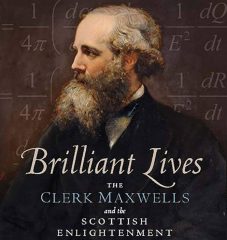
Brilliant Lives
By John W. Arthur
Second edition
Published by the author in 2024
First published in Great Britain in 2016 by
John Donald, an imprint of Birlinn Ltd
Copyright © John W. Arthur 2016, 2024
All rights reserved.
Contents
5…… William Clerk and Agnes Maxwell
5.3 Making the Maxwell Connection
5 William Clerk and Agnes Maxwell
The 1st Baronet of Penicuik had three sons by his first marriage. The first was his heir, John, whose story we have just recounted; the second was Henry, a favourite brother of John’s who took to the sea and died unmarried; the third was William, born on 12 July 1681 and named after his great-grandfather. Although the direct line of the Clerk succession passed him by, it was William who played the pivotal role in our story by marrying Agnes, a daughter of one of the many minor Maxwell lairds with properties in and around Dumfries, for it was through this marriage that the Clerk Maxwell line was begun.
Although from his portrait painted in the early 1700’s (Plate 5.1) William looked very much like his elder brother John, they were altogether different characters. William was less inclined to apply himself and rather more inclined to be wayward. In fact, it seems his father had his difficulties bringing William to heel and even wished him to sign a bond for his good behaviour.[1] He wanted William to prepare for life in the same manner as his older brother, and so he was first put to Glasgow University, where his best efforts were such that he was expelled for having an affair with a servant, Janet Steinstone (Stevenson), with whom he fathered a son, Henry Clerk.[2]
William was consequently sent away to Leiden just before his nineteenth birthday to continue his studies there, but he was back in Edinburgh again within a couple of years. In all probability things were such that his father would never have contemplated letting him go on any grand tour, and could have prevented it by denying him the letters of introduction that he would have needed.
5.1 Clerk and Ramsay
Despite his wayward tendencies, by early 1704 William managed to qualify as an advocate (Grant, 1944, p. 37). By no means does this imply a complete reform on his part, for he was ever the spendthrift[3] and his restless spirit earned him an apt nickname:
From his liking to visit, and shift about, from house to house; among his companions, he got the name of “Wandering Willie” (Ramsay, 1808, p. 640n)
The footnote goes on:
When at New Hall House, he slept in one of the garret rooms, adjoining to those of Allan Ramsay, and Mr Tytler.[4]
Until 1714, Newhall near Carlops belonged to Sir David Forbes[5], who was William’s uncle by marriage on his mother’s side (see §3.2), and after that date it passed to his son John (1683−1735) who, like his cousin William, was an advocate. The Allan Ramsay being referred to here was the well-known early Scottish poet[6] and friend of the Baron and his family. He and William Clerk were friends, possibly from as early as about 1710. Feckless though he may have been, William was not untalented; he drew, composed songs and wrote poems, such as Letter in verse from Mr William Clerk, Advocate to Dr Alexander Pennecuik of New Hall, May 1714 (Ramsay, 1808, pp. 640−641). William, Ramsay and Dr Pennecuik had something in common; their fondness for wandering the environs of Penicuik, no doubt often ending up in each other’s company, either at Newhall or at one of the many local ‘howffs’.[7]

There is a very similar portrait of the Baron by John Medina, painted about the same time. The portrait of William, however, is catalogued as being by John Aikman, which, given the similarities, would seems to be a mistake. In addition, although William Aikman had a son John, he would have been far too young to do such a work.
(By courtesy of Sir Robert Clerk of Penicuik)
When he was about fourteen, the young Allan Ramsay had been sent by his stepfather to Edinburgh, some fifty miles distant, to learn a trade. The reason was simple enough: the rural economic conditions of the time were poor and Ramsay would have to be able to fend for himself in the city. Indeed, his older brother Robert had been sent off on the same journey five years earlier. In 1704, after having been accepted as an apprentice wigmaker in Edinburgh, Allan Ramsay became close friends with William Clerk in spite of their social backgrounds being entirely different. This was not unusual; for in the Scottish society of the time there was a much smaller gap between the landed gentry and those that worked for a living: a laird such as the Baron might manage a coal mine and a country lad like Ramsay might become a scholar. In addition, there were some common factors: Ramsay’s father had been a mining manager at Leadhills, and William and John Clerk were both keen on poetry, something the young Ramsay was showing a talent for.
But how did William Clerk and Allan Ramsay first become acquainted? We cannot say but, like William, Ramsay seems to have been fond of wandering and Newhall may have been a social nucleus that attracted them both. This is evident from Ramsay’s poetic works, for his pastoral comedy, The Gentle Shepherd (Ramsay, 1808), is set at Habbie’s Howe, a noted beauty spot on the Newhall estate. Their acquaintance may well have begun with nothing more than a chance encounter at some howff or other, for they were both fond of ale.[8]
As Ramsay was a wigmaker, their acquaintance could also have been occasioned in an entirely different way, by William, the advocate, coming to have his wig dressed at Ramsay’s shop near Edinburgh’s law courts. It is, moreover, possible that they could both have been members of one of the many Edinburgh clubs that were so popular at the time.
5.2 The Easy Club
Allan Ramsay became one of the early members of the Easy Club in 1712, when his career as a poet was only just beginning (Ramsay & Robertson, c. 1886, p. xxxii). The club initially comprised just eight ‘young’ men, all allegedly unmarried and in or about their twenties; on the face of it, it seems to have been just the sort of social and literary enterprise that both Allan Ramsay and William Clerk would have readily joined in with. The club’s stated literary objective was to emulate English literary ideas and values; for example, the members would read and discuss Addison’s Spectator. They even chose English literary pseudonyms, of which more shortly. The description Easy referred to a main tenet of the club, that its members should be ‘easy’ in each other’s company, in particular, differences of either a religious or political nature were to be strictly out of bounds.
The use of pseudonyms suggests that the members did have certain reputations that they needed to put aside. It would have allowed them to forget who they were for a while and so be able to enjoy the company of their fellow enthusiasts without falling into a quarrel. An alternative view, of course, is that they used pseudonyms to allow themselves the freedom to express certain opinions that they could not give voice to in their own name. The description of themselves as being ‘unmarried, and in or about their twenties’ (Rogers, 1884, p. 358), seems so far from the mark as to suggest there was indeed some element of intentional obfuscation: Archibald Pitcairne was nearly sixty; Thomas Ruddiman was nearly forty; and James Ross, Allan Ramsay’s father-in-law, could hardly have been in his twenties.
But if they were trying to be obscure, what was the reason? The year 1712 was a time of rising Jacobite sentiment, and even if an uprising was not actually imminent, talk of one was beginning to circulate. Some of the Easy Club’s members were staunch Jacobites.[9] Moreover, there was an entirely separate current of nationalistic sentiment; those involved wanted the clock turned back to before the Union of 1707. Of course, there were those that saw a Jacobite rising as a good solution to both of these issues. For example, members such as Archibald Pitcairne and Thomas Ruddiman were not only Jacobite sympathisers but had been involved in disputes over it. Pitcairne was particularly disputatious and had even been suspended from the Royal College of Physicians of Edinburgh for pushing his opinions too far (Henderson, 1896). Hepburn of Keith was also a staunch Jacobite, and was so well-known for it that, on the outbreak of the 1715 uprising, troops were immediately sent to arrest him with the unfortunate result that Hepburn’s son became the first casualty of the conflict. Another, John Fergus,[10] was a staunch nationalist, for his rantings on the subject were recorded in the club’s minutes (Andrews, 2002, p. 2) and he alone refused to take an English pseudonym, taking instead the name of George Buchanan from the outset. The problem for the nationalists was that they were taken for Jacobites irrespective of who they thought should be the rightful monarch.
If men such as these did ever leave their factions at the club door, it did not last long and the club’s sentiments began to swing more overtly towards nationalism. Indeed, all of the original English pseudonyms were soon replaced by Scottish ones. Ramsay, who had styled himself as Isaac Bickerstaffe[11], switched to ‘Gavin Douglas’, the sixteenth-century Bishop of Dunkeld who had been a poet.
Ramsay became a burgess of the city in 1710 by right of being by this time a master of his trade. Nevertheless, he would not have found it easy to join a club of select gentlemen. Furthermore, as an early member he must have already been in very good standing with at least one of the other members for whom the question of status was not a problem. It is said that the person in question was a lawyer called James Ross (Smeaton, 1896, pp. 46−47). his future father-in-law. Ross was well enough off but did not belong to the upper echelons of his profession. Nevertheless, he cultivated friends at all levels in society and his house in Blair’s Close off Castlehill[12] (Smeaton, 1896, p. 10) was a focal point for Edinburgh’s literati. But, as the story of Ramsay’s wooing of Ross’s ward Christian Ross[13] suggests, Ramsay was both persistent and persuasive (Ramsay & Robertson, c. 1886) so that in the end Ross allowed the marriage. While he may have been reasonably impressed by Ramsay’s prospects as a master wigmaker, he was probably susceptible to the fact that Ramsay’s literary potential could eventually serve to boost his own standing amongst those that attended his soirees. At any rate, he vouched for Ramsay at the Easy Club and persuaded him to produce his earliest known poem as his introductory address, in effect launching the aspiring young poet’s literary career.
While Allan Ramsay’s membership of the Easy Club is well established, the social writer Rev. Charles Rogers (1884, pp. 356−358) has it that the Baron, William’s brother, was also a member, in fact its secretary. However, if any of the Clerk brothers was involved with the Easy Club, it was far more likely to be William. The true identity is obscured by incomplete knowledge of the real names behind the pseudonyms of each of the (approximately) twelve members. Even the accuracy of those identities that are supposed to be known is in doubt, for at least two have been disputed (Martin, 1931, p. 26; Gibson, 1927). We therefore cannot be certain, we can only argue that it would have been uncharacteristic of the well-regulated unionist Baron, while it would have been more typical of his self-indulgent brother William to join in the nationalistic banter of the Easy Club.
From what we know of John Clerk, he would have been disinclined even to appear to depart from the establishment line; he did Queensberry’s bidding and had duly taken a prominent part in the negotiation of the Union; and he also came out for King George in the Jacobite rising of 1715. If neither Jacobite nor nationalist, he would have been quick to distance himself from the Easy Club at the first whiff of any such leanings. Nevertheless, Rogers does state that he was the Secretary, and that it was he who took the pseudonym George Buchanan.
In 1713, Ramsay wrote an elegy on the death of the disputatious Jacobite, Dr Pitcairne. Although it does not appear in any of Ramsay’s own publications or later collections, it was read to the Easy Club and printed by them for circulation, making it Ramsay’s first published work. It opens with a couplet originating from Gavin Douglas’ Aeneid:[14]
Some yonder bene for ready gold in hand,
Sold and betrayed their native realm and land.               (Pittock, 2006, p. 154)
This, and the nationalistic tenor of the poem in general, is unmistakeable, and indeed it is the reason that Ramsay never published it in his own collections. ‘George Buchanan’, however, wrote a response in praise of Ramsay’s elegy that, by reflecting these very lines, could not conceivably have come from John Clerk:
And then at last by whom [their darling liberty] was basely sold
For the dire thirst and love of English gold.          (Rogers, 1884, p. 368)
If so, he would only have been damning himself.
Although Smeaton (1896), who saw the original club minutes, was able to identify about half of the members, John Clerk was not amongst them. Nor does Andrews (2002) mention any Clerk, rather he proposes that George Buchanan was actually the name taken by John Fergus. But even if Rogers was wrong in some respects, it is curious how he came to assert that John Clerk was a member.[15] But if there is any grain of truth in Roger’s assertion, it could well be the case that he had been thinking of another clerk with poetic inclinations, William, who was a friend of Ramsay’s, a fellow poet and of a similar age.[16]
Furthermore, Ramsay went on in the poem to point out that none of the Easy Club’s members had tainted themselves in such a manner (Pittock, 2006, pp. 154−156); he could not, in all seriousness, have said that of John Clerk, whose position as a Baron of the Exchequer and a little monetary ‘compensation’ had been his reward for the part he played in bringing about the Union. At any rate, Ramsay did not publish the poem and, by the time the uprising was actually imminent, he no doubt realised the real danger that these politically imprudent verses posed – anything that carried the slightest whiff of disloyalty of any sort would have been seen as seditious. The other members no doubt began to see things in pretty much the same light and so the club was soon disbanded.
Despite being on the opposite side of the fence from the Baron as far as the ‘Union’ was concerned, Ramsay became a firm friend of the Clerk family as a whole. Grant, however, (BJC, p. 229 n1), found cause to remark that, good friend and frequent visitor to Penicuik House though Allan Ramsay was, he is mentioned only once in the Baron’s memoir. On the other hand, in the same note we are also told that the Baron had a portrait of Ramsay.[17] Painted by his cousin William Aikman (see §3.2) in 1722, It was inscribed on the back with a comic verse extolling both poet and painter and bearing the line ‘By Aikman’s hand is Ramsay’s snout …’; it is signed by the Baron himself and dated 5 May 1723.[18] It is therefore likely that the Baron commissioned the portrait but, either way, it signifies that by then there was a strong friendship between him and the poet.
Other evidence of the friendship of Allan Ramsay is to be found in his poem ‘To Sir John Clerk: On the Death of his Son John’, in 1722. The Baron in addition helped Ramsay’s son, also called Allan, when he was trying to establish himself as a portrait painter in Edinburgh. He also advised the young artist on the design of a house that he was building for his father, the ‘Goose-Pie’ that still looks down on the New Town from its vantage point on the north side of Castlehill. Further, he helped him get introductions to the artistic community in Italy (Ingamells, 2004). In turn, Ramsay the poet wrote a poem for the Baron’s second son, James, shortly before the Baron’s death, and there is more besides, including letters written in familiar terms to the Baron’s son George, and the obelisk on the Penicuik estate raised in 1759 to the memory of the poet.
5.3 Making the Maxwell Connection
While it is known that William Clerk married the heiress Agnes Maxwell (C&G, p.17; BJC, p. 114), he had previous designs of marriage to at least two other women. The first was Henrietta Porteous (1678?−1762) of Hawkshaw[19] which lies in the Tweed valley close by the principal route from Edinburgh to Moffat. While William was known for wandering, Hawkshaw was some distance from Penicuik; but it did lie only ten miles north of Moffat, a place frequented by members of the Clerk family in the late summer months (see §4.8), at least as early as 1706 (BJC, p. 63). Since William’s return from Leiden was about 1702 and Henrietta married Michael Anderson of Tushielaw in April 1706,[20] it seems the affair would have taken place sometime during 1703−05. However, his father would not give his permission for the match, perhaps because Henrietta’s family had a certain reputation owing to a remarkable atrocity that occurred during the civil war of 1641−50 (Pennecuik, 1815, p. 244n) in which sixteen of Cromwell’s horsemen were captured and slaughtered in cold blood by a Porteous laird. If that was not enough to put off Sir John Clerk, the lands of Hawkshaw had been put up as surety against debts (Buchan & Paton, 1925, vol. 3, pp. 381−415). On William’s side, he had a record of irresponsible behaviour and as yet could have had no great income. It would have therefore been clear in his father’s mind that William needed some considerable time to prove himself to be ready for marriage.
Henrietta was widowed in 1719 but by this time William had moved on in his search for a wife. He secondly pursued Helen Smollett, daughter of Sir James Smollett of Bonhill, grandfather of the author Tobias Smollett. Sir James was a director of the bank of Scotland and so Helen could have proved a very good catch indeed. The match, having doubtless been scotched by both sets of parents,[21] in an interesting twist to the story William’s niece Jean Clerk was to marry Helen’s nephew, the advocate James Smollett of Bonhill.[22]
William’s eye soon afterwards alighted on Agnes Maxwell (Plate 11), daughter of John Maxwell of Middlebie In the county of Dumfriesshire (now Dumfries and Galloway).[23] Dumfries was and is an ancient royal burgh, the principal town in the county of the same name. As such, it was home to all the main markets, courts and kirks for miles around. It was also the most important town between Edinburgh (or for that matter Glasgow) and Carlisle. Lying about seventeen miles east of Dumfries itself, the village of Middlebie is some considerable distance from Penicuik, in fact nearly seventy miles. It may be that William came about Middlebie or Dumfries on one of his wanderings, or equally well, Agnes could have gone to Moffat for pretty much the same reasons that the Clerks did, for the spas, or she may even have been visiting family in Edinburgh.

(By courtesy of Sir Robert Clerk of Penicuik)
What we know for certain, however, is that in September 1718 William wrote a letter to his beloved ‘A’, begging her to accept his proposal of marriage.[24] He could not come to see her because his father was desperately ill, which was at least true,[25] and he recalled to her that when he had last seen her at Dumfries, his father had horses sent to Moffat to bring him back in all haste. Nevertheless, he had found the time to spare for a visit with one of ‘A’s aunts. Poetically, he signed himself ‘Damon’. We do not know the reply, but in January of 1719 he wrote again, this time with a song, extolling the virtues of his ‘Celia’.[26]
When Celia gracefully walks through the plain,
she’s admir’d by each shepherd, adored by each swain.
If he were being true to Agnes, then she was his Celia. But how do we know for sure? For the answer we must turn to literature of the time, in which the Celia of the song, and the Damonof the previous letter, are the archetypal characters of pastoral poetry, for example, as employed by George Farquhar (1677?−1707) in Thus Damon knocked at Celia’s door (Farquhar, 1700). The same names were still current when Ramsay chose them for the principal characters in The Morning Interview (Ramsay, 1719−22).[27] They would have been understood by almost everyone of that era and therefore it required no great leap of imagination for William, the country lad, and Agnes, his true love, to see themselves as the Damon and Celia in his song.
By the time of the next letter,[28] the couple were married and expecting their first child. William wrote it from his father’s house at Penicuik, where it seems that Agnes was not welcome. He was asking her to be patient and reassured her that in time things would sort themselves out. This certainly suggests that William had married Agnes against his father’s wishes, and his reasons were no doubt much the same as before. We may guess that the marriage had taken place sometime after September 1718, for his letter from that time shows him to be still in the process of wooing Agnes. No record of the marriage has been discovered in the old parish records on Scotland’s People, but the same is true for many Clerk marriages. There is a record, however, of the birth of their only child, a daughter Dorothea, who was born in Edinburgh on 28 August 1720.[29]
In 1722 we find William writing to Agnes on two further occasions when he was at Penicuik house and she at Castlehill,[30] which is therefore most likely to be where they both lived in Edinburgh. The later of the two letters is dated 9 March 1722, when he had been attending the wedding of his sister Mary and the Rev. Alexander Moncrieff of Culfargie[31] minister at Abernethy. William mentions that he needed to stay on because of his father’s poor health, and indeed Sir John, having been unwell for a couple of days, died peacefully the very next night (§3.3). Note again, that Agnes was not with him at Penicuik.
The Baron’s youngest son William, aged one, took ill in November 1722 and died in the early days of January 1723, to be followed by his two-year-old sister Mary, who died in March. The Baron’s wife was then also very ill and ‘was reduced to a meer shadow’. It therefore seems that some serious illness was doing the rounds of the Clerk family, for William Clerk himself had been ill since at least December 1722. From about February 1723 he was being medicated on a regular basis with such things as ‘pectoral pills’, ‘anti-febrile decoctions’, ‘spirit of hartshorn’ (ammonia solution) and laudanum.[32] On 5 April, several things were tried, the very last of which was for Agnes herself, ‘2 ounces of the spirit of wine and camphire’ to fortify her in her grief; clearly, William had died that very day. Aged forty-one,[33] he left behind a widow who was still in her early twenties, and Dorothea[34] the only child of their marriage and just over two and a half years old.
From the funeral bill[35] we learn that William was buried at Penicuik on 12 April 1723. The funeral procession was no mean affair, for the journey from Edinburgh required five vehicles, including two mourning coaches and two ordinary coaches, each drawn by six horses!
William left a number of debts, most of which Agnes had to settle.[36] Gentlemen’s bills often went for years without being paid, as so aptly described in some of Allan Ramsay’s poems,[37] and William was no exception. His personal bills and bonds dating back as far as March 1720 went unsettled, and to these were added his medical bills and funeral expenses. Having sold William’s horse and books to raise some money, Agnes was left with a balance of nearly £100 to pay off.[38] This she may have been able to do with the help of the man she was later to marry, of whom we will hear later, in Chapter 7.
William was the Baron’s only surviving full brother, but in his memoirs (p. 114) the most he could say of him was that he had been ‘an advocate’! As to his sister-in-law Agnes Clerk and his niece Dorothea, he says little more than that he and Agnes became joint tutors of the child (ibid., n1). Nevertheless, Dorothea Clerk was in due course to become central to the Baron’s plans.
Notes
[1] NRS: GD18/5253, 1703‒24
[2] NRS: GD18/5522, 15/9/1699 and GD18/5237, 1700‒08
[3] NRS: GD18/2315, 1711
[4] Probably Mr Alexander Tytler, writer in Edinburgh. His son William Tytler of Woodhouselea (b.1711), who was a Jacobite sympathiser, wrote an acclaimed defence of Mary Queen of Scots. Newhall and Woodhouselee are both within a five mile radius of Penicuik.
[5] See Chapter 3, note 4
[6] The poet and topographer Dr Alexander Pennicuik (1652‒1722) lived at Romanno Bridge, some distance from his old family seat of New Hall which had passed into hands of the Forbes family. Despite the age difference, he and William Clerk were good friends and eventually Allan Ramsay joined their company. The howff at Cowies’ mill was near Macbiehill.
[7] The poet and topographer Dr Alexander Pennicuik (1652‒1722) lived at Romanno Bridge, some distance from his old family seat of New Hall which had passed into hands of the Forbes family. Despite the age difference, he and William Clerk were good friends and eventually Allan Ramsay joined their company. The howff at Cowies’ mill was near Macbiehill.
[8] The inn at Carlops may be named after Allan Ramsay, but it was not established until the late eighteenth century (Hanson, 2009, 2013). Until recently, however, there was an old inn called Habbie’s Howe (Canmore, ID50165) at Nine-Mile-Burn, about a mile north of Carlops, notwithstanding the fact that the actual Habbie’s Howe was on the other side of the present road and close to Newhall.
[9] In 1712 Queen Anne was on the throne and the Act of Settlement of 1701 meant that she would be the last Stuart monarch; instead she would be succeeded by her second cousin George, Elector of Hanover. He did indeed become George I in 1714, the eve of the Jacobite uprising. The Jacobites, however, maintained that Anne’s brother, James Stuart, son of the James VII who had fled to France in 1689 was the true King. The Jacobites toasted James as ‘the King over the water’, but to those to who wanted to move on, he was merely the Old Pretender (father of Bonnie Prince Charlie, the Young Pretender).
[10] Unlikely to have been the Irishman Dr. John Fergus, who was born c.1700 and was Dublin based.
[11] A pseudonym also used by Jonathan Swift and Richard Steele
[12] See the glossary entry ‘Royal Mile’
[13] Christian Ross (1683‒1743) was the orphaned daughter of Robert Ross, possibly the brother of her ward James Ross.
[14] Ramsay’s lines were apparently adapted from a passage in Gavin Douglas translation of the Aeneid (Taylor, 2006, pp. Book VI, Canto LXXXIII),’There stands the traitor, who his country sold … for a bribe of gold.’ It was this Douglas whose name Ramsay chose to take as his club alias.
Burns employed Ramsay’s wording in the form ‘We’re bought and sold for English gold’ in his poem Such a Parcel of Rogues in a Nation that was written in much safer times.
[15] He based his evidence on the love poem ‘Harmonious Pipe’ attributed to the Baron (BJC, p. xxii) and supposedly submitted to the Easy Club. If it had appeared at the Easy Club, it would have been more likely to have ridiculed him.
[16] Henry Clerk, born in 1678, was ‘bred to sea’ and is therefore an unlikely candidate and their half-brothers would have been too young. William was about thirty to Ramsay’s twenty-six when the club opened
[17] National Galleries of Scotland, available online at
https://www.nationalgalleries.org/art-and-artists/3526
[18] The date may have some significance, for it was a month to the day after William’s death.
[19] Hawkshaw, or Hackshaw, now lies beneath the Fruid reservoir, formed in 1963 by flooding the narrow glen that carries the Fruid Water.
[20] SOPR: Marriages, 774/00 0010 0068
[21] NRS: GD18/5294, ?/12/1717
[22] BJC, p. 155. He was a cousin of Tobias Smollet (Herbert, 1870, pp. 9‒11).
[23] On the B725 two miles northeast of Ecclefechan (see Figure 2.1)
[24] NRS: GD1/1432/1.7, 15/9/1718
[25] In late August 1718, Sir John Clerk had caught a serious infection on his back. Necrotised tissue had to be repeatedly excised resulting in the wound getting so very large his life was feared for (MBJC, pp. 97‒98 and note).
[26] NRS: GD1/1432/1.6, 22/1/1719
[27] Ramsay clearly influenced Jonathan Swift, whose The Lady’s Dressing Room (1910) of 1730 is an even more satirical take The Morning Interview of 1721. While the characters are Strephon and Celia rather than Damon and Celia, the parallels are abundantly clear.
[28] GD1/1432/1.9, 5/12/1720
[29] FamilySearch.org, ID2:17NJNG4. No record appears to exist on Scotland’s People, but the record cited ties in with the only other available first‒hand mentions of her age or year of birth. Firstly, the Baron himself (BJC, p. 134) tells us ‘In March 1728 [when her mother died]… The girle was about 7 or 8 years of Age’ and in John Clerk Maxwell’s draft family tree (DGA: RGD56/13, 19thC) the year 1720 is pencilled in against her name.
[30] He rented a house from James Wright (DGA: GGD56/21, List of Debts Paid by Mrs Clerk). Castlehill is same small area of the town where James Ross of the Easy Club lived.
[31] By this marriage Mary Clerk became the sister‒in‒law of David Moncrieff, great‒great‒grandfather of the Rev William Scott Moncrieff (1804‒1857) who was for some time the minister at St Mungo’s in Penicuik (Seton, 1890), (Wilson, 1891, p. 93). In 1841 he married Mary Irving (1811‒1886), a second cousin of James Clerk Maxwell.
[32] (GGD56/21, Accompt the Deceased Mr William Clark advocat, 1723)
[33] In his memoirs Sir John Clerk says forty, but the earlier notes give William’s exact date of birth as 12/7/1681.
[34] It appears that in the days before her father’s death she may also have been unwell, for she received several of the doctor’s prescriptions.
[35] GGD56/21, Accompt to the funeral of Mr William Clerk advocate to Wm Baillie, 1723)
[36] NRS: GGD/56/21. A List of Debts Payed by my Wife for her Deceased Husband Mr William Clerk, c. 1725.
[37] See, for example, his complaints about debtors in ‘To John Wardlaw’ and ‘To James Clerk of Pennycuik’ (Ramsay & Robertson, c. 1886, pp. 249−255).
[38] There is no record of a testament on Scotland’s People. It seems strange that Agnes was left to clear off William Clerk’s debts, but this she did over a period of time between June 1723 and September 1724 (GGD56/‒, List of Debts Paid by Mrs Clerk), (GGGD56/21, Vouchers, 1723‒4).
 Brilliant Lives