Brilliant Lives
by John W. Arthur
Second edition
Published by the author in 2024
First published in Great Britain in 2016 by
John Donald, an imprint of Birlinn Ltd
Copyright © John W. Arthur 2016, 2024
All rights reserved.
Contents
2 James Clerk Maxwell’s Life
and Contribution to Science
You will sometimes hear it said that James Clerk Maxwell is one of the greatest physicists that ever lived. For many people this will be a surprise, for in comparison with Isaac Newton, Albert Einstein and Stephen Hawking, he is practically unknown amongst the general public. This is most keenly demonstrated by an anecdote related by R. V. Jones (1973, p. 67) [1], who was some years ago the Professor of Natural Philosophy at Aberdeen, where a century before Maxwell himself had been the professor (see §2.4). Professor Jones had been told the story of an advertisement that had been placed some years before in the Aberdeen Press and Journal, by a solicitor seeking information on the whereabouts of a certain James Clerk Maxwell. The solicitor dealt with the funds of the local Music Hall, which happened to pay out a small annual dividend to its subscribers, one of whom had been Maxwell. Unfortunately, Maxwell’s share of the distribution was now being returned as undeliverable. While it was bad enough that the solicitor had been unaware that James Clerk Maxwell was ‘the most famous man to walk the streets of Aberdeen’, his letters to Maxwell at the University were being returned marked ‘NOT KNOWN’ !
2.1 Behold the Child
Most of what we know about James Clerk Maxwell is to be found in his original biography[2] by Lewis Campbell (see §16.1), a lifelong friend, and William Garnett, who worked alongside Maxwell at the Cavendish Laboratory, first as his demonstrator and then as a lecturer. Although he was born at 14 India Street in Edinburgh (Plate 2.1) and wanted for nothing there, his parents’ lives centred on John Clerk Maxwell’s ‘family seat’ at Nether Corsock a piece of some rough farmland set in a remote area nearly twenty miles west of the county town of Dumfries (Figure 2.1). Nether Corsock was part of the estate that John had inherited from his paternal grandmother, Lady Dorothea Clerk, or Clerk Maxwell of Middlebie. The rest of his estate consisted of a few farms scattered about nearby, and some properties in and near the town of Dumfries, but the farms and properties at Middlebie were long gone by the time he inherited it, sold off in a public roup to pay off his grandfather’s debts. After their marriage, John Clerk Maxwell and his wife Frances resolved to become country gentlefolk, alternating between living at Nether Corsock from spring to autumn and overwintering in Edinburgh beside their friends and family. For the well-to-do this was in any case the general pattern of life; in the Clerk Maxwell’s case the only difference was that John’s business focus was no longer in Edinburgh. The journey back and forth, nearly 100 miles over rough roads and tracks, took two entire days by horse and carriage. Such a journey was not to be undertaken on a whim, but for a definite purpose. Life at Nether Corsock, however, was not ready made for them. They had first to turn rough pasture into a viable farm, and they had no more than a gardener’s cottage to live in. A proper house had to be designed and built, a project that John Clerk Maxwell would have entirely relished, for as a boy he had often dreamed of such things.

For Nether Corsock, see Glenlair.
Amidst all this, in the summer of 1829 Frances fell pregnant. By the time their child Elizabeth was born, they were back in Edinburgh for the winter. Sadly, the child died shortly after birth, and the bereft parents, having married a little late in life, must have wondered if they would ever be lucky enough to have another. Happily, within the space of a year Frances was pregnant again, but since the building of a new two-storey house at Nether Corsock to John’s own design[3] was still then only just about to be started, they decided to stay on in Edinburgh. It seems natural that a man in John Clerk Maxwell’s position would have insisted on his wife staying put in Edinburgh where she could be looked after by nearby family, and the best of doctors. Nothing would be spared, no risks taken. On the other hand, he would have had business to carry on with at Nether Corsock; farmhands and workmen to supervise; and rents to gather in. In the ways of these times, a man decided for himself what had to be done; Frances had to stay and he would just go and get on with things. In any case, what practical use could he be to Frances until it was near the time for the child to be born?
In due course, Frances was safely delivered of a son whom they named James after his paternal grandfather (Family Tree 2) as was then the custom for a firstborn son. Captain James Clerk had died many years before while his son John Clerk was just a child of three; the reason why John came to have a different surname from his father will become clearer later on.
By the time James was two years old and thriving, his parents felt that they could return to Nether Corsock and make it their permanent base. The town house at 14 India Street was rented out and they were never to live there again. The earliest demonstration we have of young James definitely at his new country home is a letter from his parents to Frances’ sister Jane back in Edinburgh:
To Miss CAY, 6 Great Stuart Street, Edinburgh.
Corsock, 25th April 1834.Master James is in great go … He is a very happy man, and has improved much since the weather got moderate; he has great work with doors, locks, keys, etc., and ‘Show me how it doos’ is never out of his mouth. He also investigates the hidden course of streams and bell-wires, the way the water gets from the pond through the wall and … down a drain into [the] Water Orr … As to the bells, they will not rust; he stands sentry in the kitchen, and Mag runs thro’ the house ringing them all by turns, or he rings, and sends Bessy to see and shout to let him know, and he drags papa all over to show him the holes where the wires go through. (C&G, p. 27)
Fortunately, we have an image of James in infancy, with his mother, in their portrait by William Dyce (Plate 2.2), the story of which we will arrive at later. James’ cousin, Jemima Wedderburn, later Mrs Blackburn, was to tell Lewis Campbell (C&G, p. 28) that throughout his childhood his constant question was, ‘What’s the go o’ that? What does it do?’ and he would drill on in this vein until he got an answer that satisfied him. There was not always such an answer to be had, for he could not be satisfied by a mere form of words. His nurse recalled to Campbell (C&G, pp. 30−31) that, having been questioned by James in this manner about the colour of some pebbles he had collected on a walk together, she had answered, ‘That (sand) stone is red; this (whin) stone is blue.’ ‘But how d’ye know it’s blue?’, he retorted.
From Campbell’s own recollection (C&G, p. 28) we hear that James’ earliest memory was of lying on the grass to the front of the house at Nether Corsock ‘looking at the sun, and wondering’. These are Campbell’s italics, for he particularly wanted to impress upon the reader this aspect of James’ character. There would be hardly anything, it seems, that he did not wonder about, and amid all the other opportunities for indulging in some form of play or excitement, he would come to rest, and pause, and simply wonder.
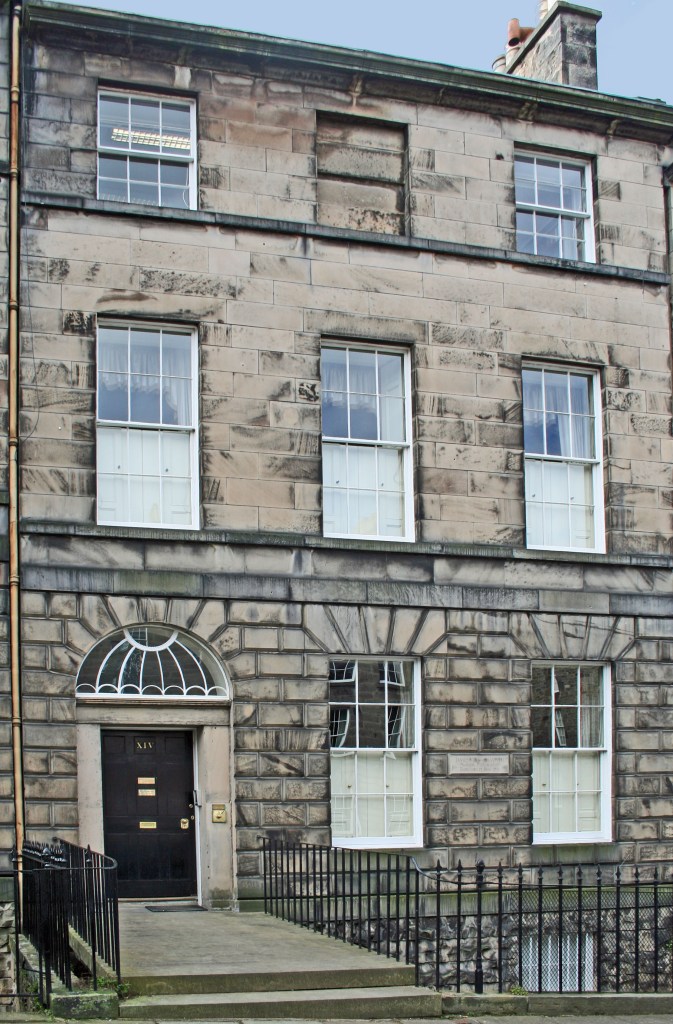
This category-A listed building has changed little since it was built in 1820. The false window on the top floor makes it a little different from some of the other houses in the street.
As well as having a seemingly endless appetite for enquiry, the young boy also had a keen ear for music and a prodigious, highly active memory:
His knowledge of Scripture, from his earliest boyhood, was extraordinarily extensive and minute; and he could give chapter and verse for almost any quotation from the Psalms … These things … occupied his imagination, and sank deeper than anybody knew. (C&G, p. 32)
In most other respects, James was a normal, happy boy. Although born of the landed gentry, his sensible parents did not keep him apart. Nor, as an only child, did they treat him as being overly precious. If there was any local parish school that he could have gone to, however, he did not attend; he was taught by his mother. But there was no haughty separation between masters and servants; in all other things he mixed in with the local boys, for the most part sons of his father’s tenants and workers, taking part in their play and speaking their broad Gallowegian brogue . He had no fear of getting his hands dirty, for he had learned that ‘country dirt’ was ‘clean dirt’ (C&G, p. 34). He rambled in field and wood, climbed trees, took a washtub as a craft to be sailed in the duck-pond, hunted frogs and insects, and by the age of ten he could ride a pony. He was by then in every way a thorough-going country boy.
The single unhappy event that overtook his childhood was the illness and eventual death of his mother. By the time of his eighth birthday it must have been evident that all was not well with her, and in due course she was diagnosed with stomach cancer from which, all efforts to save her having failed, she eventually died at Nether Corsock in December 1839. James must have been all too aware of her suffering, for on being told that his mother was now dead he had declared ‘Oh, I’m so glad! Now she’ll have no more pain’ (C&G, p. 32). Nevertheless, the loss of his mother at such a tender age took its toll and naturally enough disorientated him:
… his activities were apt for the time to take odd shapes … bright and full of innocence as they were … produced an effect of eccentricity on superficial observers … (C&G, pp. 45−46)
A different side of James’ character was to come to the fore in the days that followed, when his father brought in a young, inexperienced tutor to carry on with his education. The two did not hit it off, but whereas it seems that James had hitherto been a fairly rational and obedient boy, now he rebelled. The tutor had somewhat surprisingly found James to be slow at learning, and resorted to employing the sort of rough discipline by which he himself had probably been forced to learn his subjects. James, having been used to the gentle encouragement of his mother, may well have taken it into his head that he was not going to co-operate with such an unworthy interloper. Learning had been part of his daily diet of interesting things that were offered, accepted and taken on board, and now he was not going to buckle down and take it as though it were being thrust at him like some disgusting swill that he must consume or suffer the consequences:
Meanwhile the boy was getting to be more venturesome, and needed to be not driven, but led … his power of provocation must have been … ‘prodigious’. (C&G, p. 41)

Finished by Dyce at Glenlair in the late summer of 1835 when James was aged four.
Photo by Birmingham Museums Trust, licensed under CC0
The tutor’s response was brutal; James was ‘smitten on the head with a ruler’ and had his ‘ears pulled till they bled’. In the tutor’s defence, the maxim then was ‘spare the rod and spoil the child’, and so his methods were not quite so outrageous as they seem today. Nevertheless, James did not run to his father telling tales; he bore it all like a man and soldiered on. This gives us an early indication to another side of the boy’s character, which he was to retain until his last breath; he could patiently endure anything, even suffering.[4] Had not Christ suffered, and his own mother too? James would have learned from his father the traits of the Scottish Presbyterian character; one must be stoical and endure some pain in life, one must be brave and not complain but carry on? One day, however, James decided he had had enough. Whether he ran off from his lesson or would not come in for it, we cannot tell, but we have the scene in Figure 2.2 (C&G, p. 42). We see him in his washtub in the middle of the duck pond, with his tutor struggling to bring him to shore using a rake for a boathook. The standoff has been going on for some time, it seems, for already his father and Aunt Isabella are on the scene awaiting the eventual denouement. His cousin Jemima, the artist who made this record in the late summer or early autumn of 1841, stands on the left; two local lads who possibly shared James’ lessons, watch from the far bank. Only the tutor, however, seems at all perturbed!

the young James and his tutor
Although he did not get to know James until shortly after this episode, according to Campbell his torment at the hands of his tutor, both physical and mental, left him with ‘a certain hesitation of manner and obliquity of reply’, aggravating his slight oddity of character and, undoubtedly, the distress he suffered due to the loss of his mother.
2.2 Edinburgh Academy
On the prompting and advice of his sister-in-law Jane Cay, after the duck pond incident John Clerk Maxwell accepted that his son would be better off going to a proper school. He now recognised that James would need more than the sort of rough and ready education that was to be had anywhere nearby. The loss of his mother was part of the problem, and so it was decided that James should not go to a boarding school; he should go to school in Edinburgh, at the new Edinburgh Academy (Plate 2.3), which was within five minutes’ walk from the care of his two aunts, Jane Cay and Isabella Wedderburn. The former lived in a substantial flat at 6 Great Stuart Street while the latter had a town-house of considerable grandeur at 31 Heriot Row which had been John Clerk Maxwell’s own home before his marriage (Plate 2.4 and Plate 2.5 respectively). There was space enough there for James to have his own room and he would want for nothing; he would have the company of his cousin Jemima and a younger cousin Colin Mackenzie. He would have school-friends in the nearby houses and he could visit his aunt Jane whenever he liked; his father would come up on his usual visits to Edinburgh. And so it was decided.
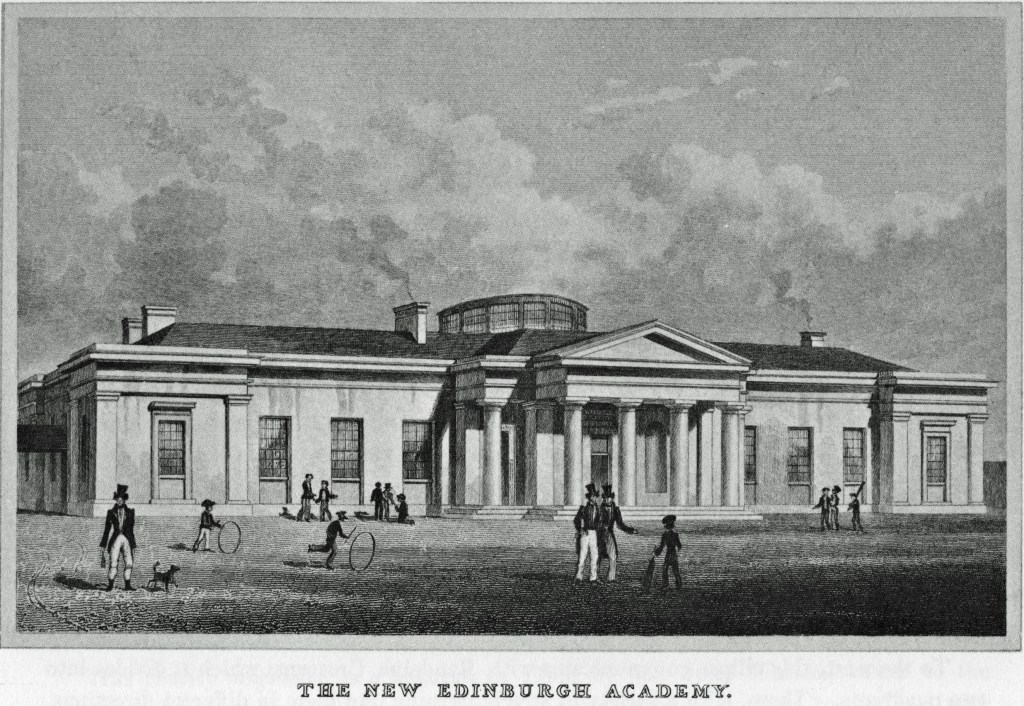
The school, founded by Lord Cockburn, opened in 1824 about 17 years before James Clerk Maxwell’s first attendance there. Note the unusual oval cupola atop the roof, which James would have seen every day.
That October, Isabella and Jemima travelled down by carriage to Glenlair, as the recently expanded estate and house at Nether Corsock had now become known (Figure 2.3),[5] and there they stayed a few weeks before commencing the return journey, the top of the coach laden with the trunks carrying all that father and son would need during their sojourn in Edinburgh, and to equip James for school (Wedderburn, c. 1841).

Aunt Isabella’s eventual home, 25 Ainslie Place
6 Great Stuart Street is the door on the far left while 25 Ainslie Place is just round the corner on the right. Notice that the dummy windows to the left of the corner help maintain the regularity of the frontage.
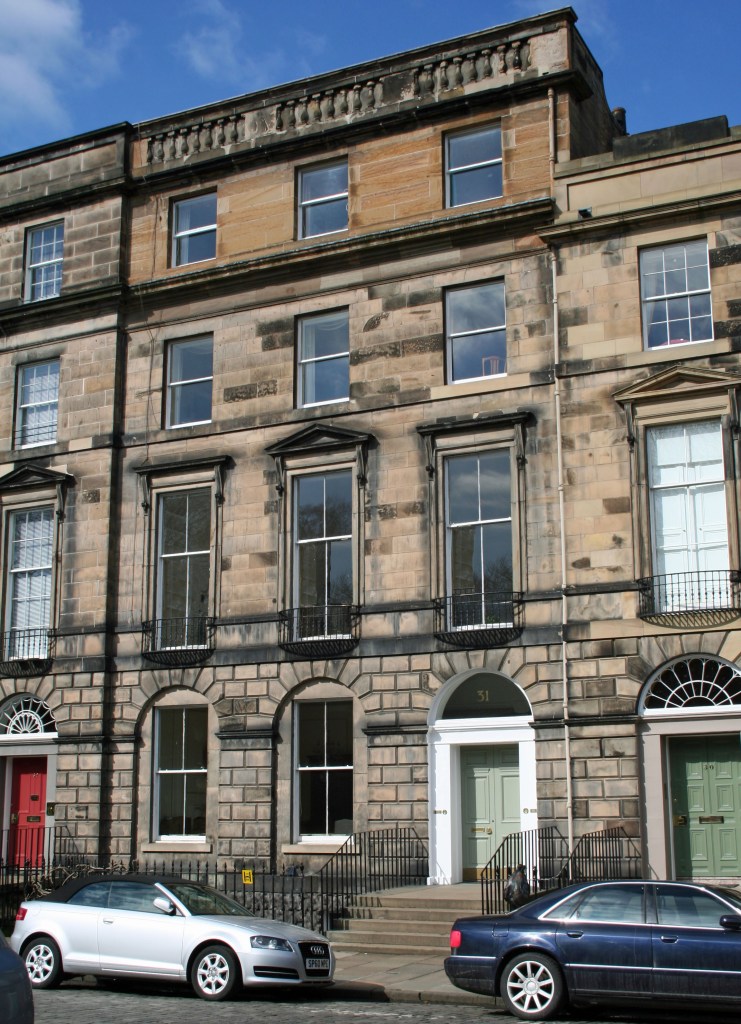
Numbers 30 (far left) and 31 (centre) are the centrepieces of the west side of Heriot Row, being the only houses there that were eventually allowed a third floor above ground level.
James’ first encounter with his new school-mates at Edinburgh Academy was not a happy one. Having joined late in the term, he was not one of the crowd, rather an intruder to be examined and found wanting. If his father and aunts had had the foresight to dress him like any other schoolboy, he might have got away with it, but his plain rustic garb, such as we see in Plate 2.6, was inappropriate in the new setting.

The tunic, and the square-toed shoes fastened with buckles rather than laces, the frilly collar, are all as mentioned by Campbell in C&G.
By courtesy of the Cavendish Laboratory
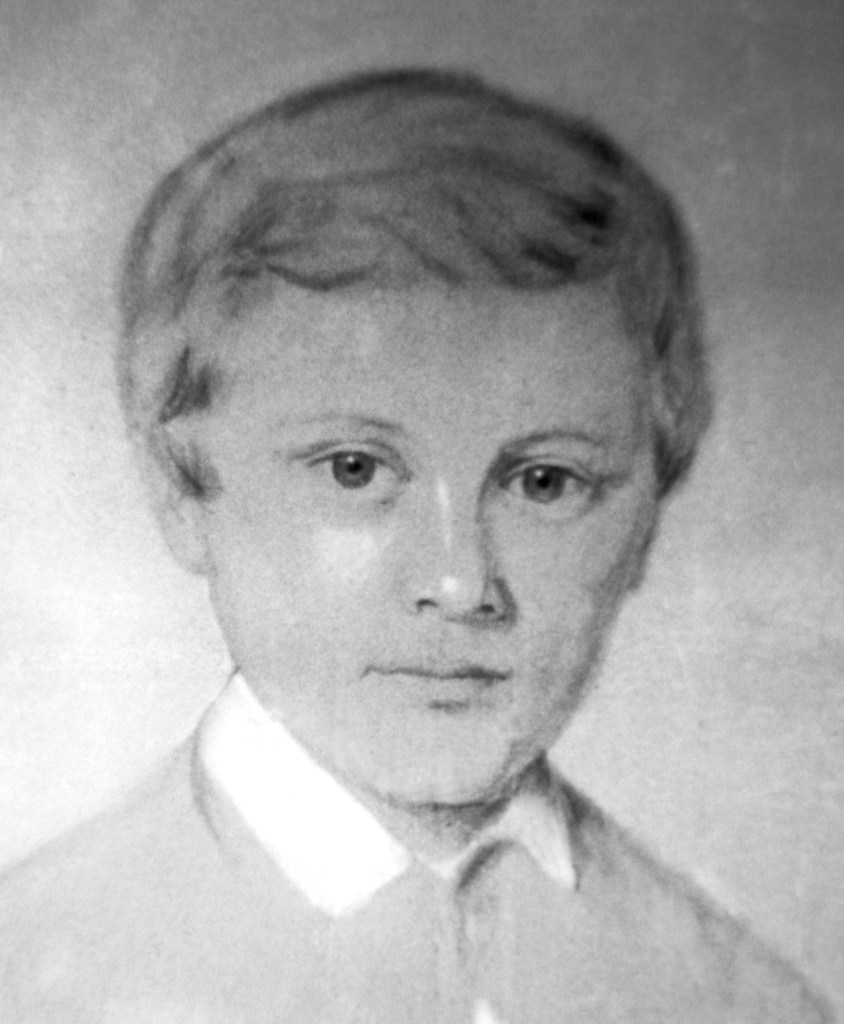
This may well be the picture he referred to as having been done by ‘Mrs Tis’, possibly his Aunt Isabella, who sometimes sketched and painted with Jemima. Whoever the artist was, they were close enough to the family to comment disparagingly on John Clerk Maxwell’s grammar.
By courtesy of the James Clerk Maxwell Foundation
His oddness of manner and Gallowegian brogue only served to confirm first impressions: here was a misfit. Children make few allowances in their judgements, and boys will be boys; the nickname ‘Daftie’[6] was handed out to the new lad and the earliest opportunity was taken to show him that he did not fit in. James returned home that afternoon with his clothes bearing full testimony to the treatment he had received in the schoolyard. Nevertheless, according to Campbell he ‘was not in the least inwardly perturbed by all this, nor bore any one the slightest malice’ (C&G, p. 50). One can only wonder on whose side Campbell had been during James’ rough initiation.
It took some time for James to adjust to his new school setting. Even if discipline was more humane and not always directed at himself, his experience under his tutor must have made it difficult for him to accept the dull repetition of learning by rote, while outside the classroom he:
… seldom took part in any games … preferred wandering alone … sometimes doing queer gymnastics on the few trees that were left [in the schoolyard] … his heart was at Glenlair, … (C&G, p. 51)
His hesitancy became more pronounced. He was also frequently absent from school because of childhood illnesses, and when he did attend there were always classmates who would take the opportunity to discomfit him, with the inevitable upshot that his performance in class was not what it might have been. In Campbell’s analogy, he was a ‘cygnet amongst goslings’ (C&G, p. 50). A portrait of James drawn about this time is shown in Plate 2.7.
Thanks to the extensive library at ‘Old 31’, as he now called his new home, James managed to engross himself in the works of Swift and Dryden, and later Hobbes and Butler[7], some of which would have proved difficult reading even for an adult. When his father was in town, they would go for Saturday afternoon walks ‘always learning something new, and winning ideas for imagination to feed upon’ (C&G, p. 52). On one such occasion he was taken ‘to see electro-magnetic machines’, for the latest scientific and technical advances had long been of interest to not only his father but also his uncle, John Cay, Sheriff of Linlithgow. John Cay lived just doors away from James at 11 Heriot Row, and he had been the good friend of John Clerk Maxwell since their days together at the old High School.They were the same age, had studied the law together and had qualified as advocates at more or less the same time.[8] Their common interests led to them becoming Fellows of the RSE in 1821; at that time the requirements for election were not so demanding, the main requisites were being a gentleman of good reputation with a genuine interest in science or the arts, for which they were both amply qualified. John Cay was to take part in similar excursions with his nephew, for example, to visit William Nicol,[9] who at a later date sent James the gift of a polarising prism.
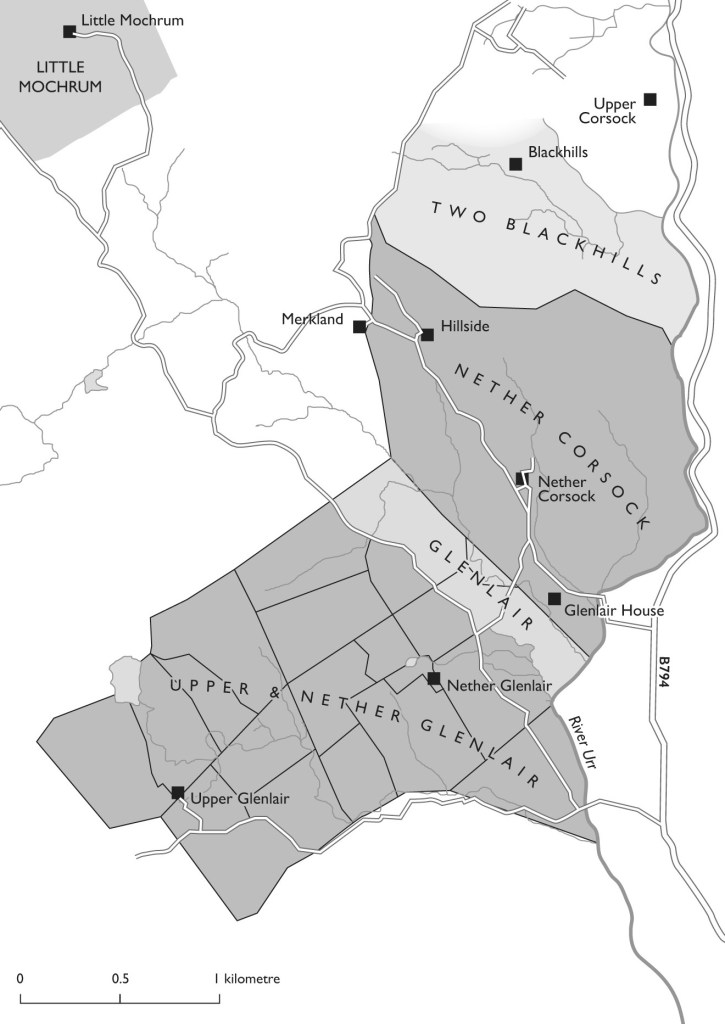
See Figure 2.1 for the general location. Nether Corsock, Over and Nether Blackhills, and Little Mochrum were all part of the estate under the Middlebie entail. Glenlair, together with Upper and Nether Glenlair, were brought into the estate later, in 1839, when John Clerk Maxwell purchased them to make a single estate with the mansion house that he built in 1831 as ‘Nether Corsock’ at its centre. Only from 1839 onwards was this house and estate referred to as Glenlair, whereafter the name Nether Corsock became attached to the steading a little to its north.
Synthesized from DGA: GGD56/1, ‘Plan of Nether Corsock’ by John Gillon, 1806; GGD56/26, ‘Undated Pencil Plan of Glenlair’, 19th C. ; GGD56/13, ‘Glenlair Plan for Entailing’, c. 1839, and other maps of the area.
When his father was not in Edinburgh to divert him, James wrote regularly. But he did not simply observe the customary pleasantries; he took it as an opportunity to let his mind take a creative turn for the benefit of his father’s enjoyment. For example, by:
… concocting the wildest absurdities, inventing a kind of cypher to communicate some airy nothing, illuminating his letters … and adding sketches of school life … drawing complicated patterns … (C&G, p. 53)
Campbell saw this as significant,
… marking the early and spontaneous development of ‘the habit of constructing a mental representation of every problem’, which was in some degree an hereditary proclivity. (ibid.)
By and by, James managed to settle into his new situation and slowly began to progress. By his second year he had managed to get into the top twenty per cent of his class of some seventy boys.[10]His hesitancy, however, still seemed to be something of a problem in Latin and Arithmetic,[11]but by age twelve he could show himself to be top of the class in English and Scripture Biography. In addition, he had managed to prove himself in the schoolyard. A classmate later recounted for Campbell’s book:
On one occasion I remember he turned with tremendous vigour, with a kind of demonic force, on his tormentors. I think he was let alone after that and gradually won the respect even of the most thoughtless of his schoolfellows. (C&G, p. 55‒56)
It was shortly afterwards that James and Lewis Campbell became close friends. Campbell had been in the class since it began, under Mr Carmichael as master, with the intake of 1840. Though James had joined the following year, it was not until about 1843 that their friendship started, and it became all the closer when Campbell’s mother remarried and moved into number 27 Heriot Row, practically next door to James:
We always walked home together, and the talk was incessant, chiefly on Maxwell’s side. Some new train of ideas would generally begin just when we reached my mother’s door. He would stand there holding the door handle, half in, half out, while, ‘Much like a press of people at a door, thronged his inventions’, till voices from within complained of the cold draught. (C&G, p. 68)
James had already done some dabbling in geometry on his own, for shortly after his thirteenth birthday, he mentioned in a letter to his father, ‘I have made a tetrahedron, a dodecahedron, and two other hedrons [sic], whose names I don’t know.’ Amazingly, he had not then had any formal lessons in geometry. When work seriously began on the subject in year five (1844‒45), however, it began to awaken his interest significantly:
Our common ground in those days was simple geometry … but whatever outward rivalry there might be, his companions felt no doubt as to his vast superiority from the first. He seemed to be in the heart of the subject when they were only at the boundary. (C&G, p. 69)
James turned fourteen during the last weeks of that school year, by which time he had had nearly four full years at the Academy; in terms of his steady progress and growing friendships, he seemed completely settled there. When in due course he got the results of the customary end of term examinations, he was able to write proudly to his Aunt Jane, who seems to have been out of town:
I have got the 11th prize for Scholarship, the 1st for English, the prize for English verses, and the Mathematical Medal. [12] (C&G, p. 71)
If winning the Mathematical Medal gives more than ample evidence of progress and branching out, his first prize in English showed he had lost none of his abilities in that direction. The work he submitted was a poem, ‘The gude Schyr James Dowglas’ written in the style of an ancient ballad with language drawn from Barbour’s Bruce. He had researched his topic in several books including Scott’s Marmion, which he was evidently so well acquainted with that he had to stop himself from falling completely into its style and language when he was writing his poem. Throughout his life, Maxwell would turn to poetry to express his thoughts, or simply for a piece of fun, and a number of his verses were recorded by his friend (C&G, pp. 577‒651).[13]
Peter Guthrie Tait (see §16.2) belonged to the class below Maxwell and Campbell but was of much the same age. He was already keen on mathematics and took note of Maxwell having won the school medal; in this way he was drawn into Campbell and Maxwell’s friendship. All three had an awakening intellect that became the basis of a lasting kinship, while their drive to succeed created the most harmonious of rivalries. If Tait tended to excel in Mathematics and Campbell in the Classics, then Maxwell tended to fit squarely in between. The autumn term of 1845 would no doubt have seen Maxwell giving Tait a bit of coaching, enjoying expanding on what he himself had learned. From 1844 on, Tait kept a note-book[14] for the purpose of jotting down what they generally referred to as ‘props’, that is to say, propositions consisting of conjectures, definitions, constructions and proofs. The signature ‘J C Maxwell’ is to be found under an entry in the notebook headed ‘Propositions on the Conical Pendulum’ and dated 25 May 1847, but the writing on the page, including the signature, appears to be in Tait’s hand.[15] This is evident when it is compared with another entry ‘On the Imaginary Roots of Negative Quantities by the Right Reverend Bishop Terrot’[16] signed and dated 27 May by ‘P G Tait’. Another entry signed by Tait has, on the opposite side of the page, ‘J G dedit’ (gave it), while yet another has ‘J G fecit’ (did it); we may presume ‘J G’ to be James Gloag his mathematics master. It seems likely, therefore, that while Tait would copy out things he found of interest, he attributed them conscientiously. The entry on the conical pendulum turns out to have been the solution to a ‘prop’ that Tait had given to Maxwell, which Tait then transcribed into his notebook and dutifully attributed to Maxwell.
Later on Tait and Maxwell would produce their own separate manuscripts on some topic of current interest to add to the collection. Two contributions by Maxwell, ‘Ovals’ and ‘Meloid and Apioid’, are reproduced in C&G, pp. 91−104; some sheets of the original in Maxwell’s own hand are now displayed at the museum at 14 India Street. Another, identified as being in Tait’s handwriting, consists of a few pages of propositions on the ellipse.[17] There may have been an element of competition as well as co-operation in this, with one challenging the other to solve a problem. Tait challenged Maxwell to find the cross-section of a torus (a ring) taken in a plane tangent to its inside surface, but Maxwell found the answer. In turn he gave Tait a highly convoluted question about a heavy body rolling on a curve with the ‘horizontal component of the force, by which it is actuated … to vary as the nth power of the perpendicular upon the axis’ (C&G, p. 116). Little wonder that Tait demurred.
His awakening in mathematics and subsequent rapid success no doubt helped James to appreciate all the better the technical aspects of the latest ideas and inventions. His father must also have taken serious note for, when back in Edinburgh during the winter of 1845−46, he redoubled his interest in attending meetings of the RSE and the Royal Society of Arts,[18] this time taking James along with him. Campbell recalled:
And so it happened that early in his fifteenth year the boy dipped his feet in the current of scientific inquiry … he had always something new to tell … in February 1846, he called my attention to the glacier-markings on the rocks, and discoursed volubly on this subject, which was then quite recent, and known to comparatively few.[19] (C&G, p. 73)
Through the Royal Society of Arts he came across the work of David Ramsay Hay, who at the time was listed as being a ‘decorative painter to the Queen’ (EPD, 1846) and had published not only a volume on the theory of architectural designs but also a reference book of colours:
Such ideas had a natural fascination for Clerk Maxwell, and he often discoursed on ‘egg-and-dart’, ‘Greek pattern’, ‘ogive’ … One of the problems in this department of applied science was how to draw a perfect oval; and … [at age fourteen he] became eager to find a true practical solution of this. (C&G, p.74)
In mentioning a perfect oval here, Campbell means one that is truly egg-shaped rather than merely elliptical. James must have seen various forms of decorative ovals, as well as the gamut of decorative stucco embellishments that went with them, on many a ceiling in the fine houses of the New Town. His own school had a prominent oval cupola perched atop the building, and even St Andrew’s Church, seen in Plate 2.8, where he sat in contemplation on many a Sunday morning, was designed in a grand oval. Edinburgh had taken this classical theme to its heart.
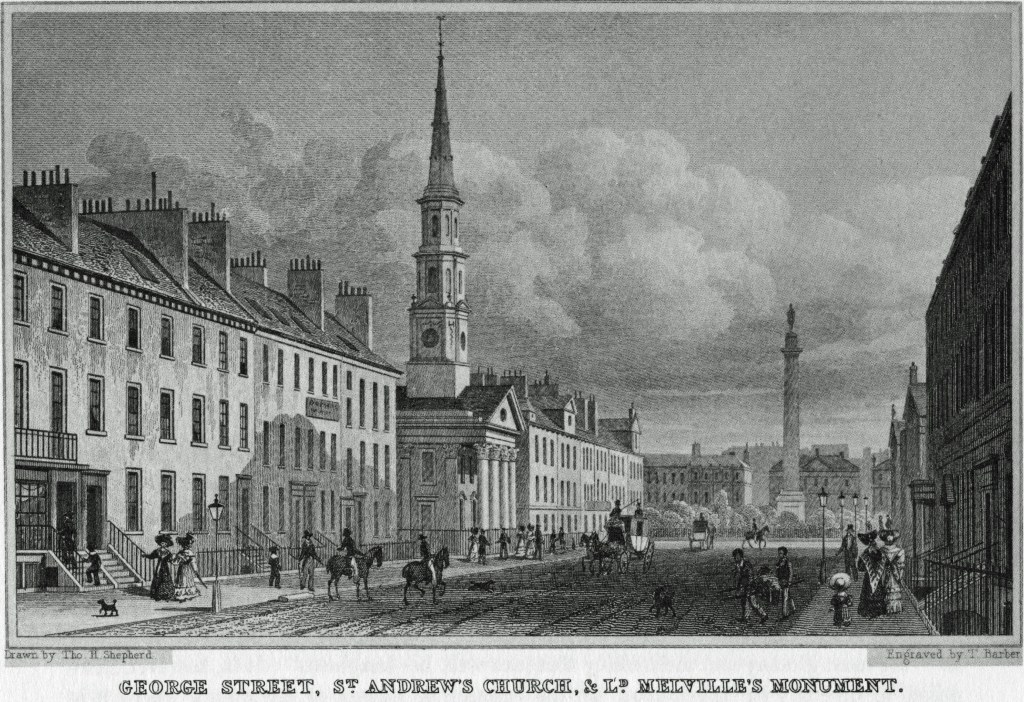
Before they flitted to 11 Heriot Row, Robert Hodshon Cay and his family lived at 2 George Street, the far house on the right side of the street, just before St Andrew Square. The gable-end of the house faced onto the street (follow up from the right-hand lobe of the hat of the lady on the extreme right). Many such buildings have since been replaced, and so the character of the street is now quite different. St Andrew’s Church (now St Andrew and St George’s) was where John Clerk Maxwell would take his son James to the morning service when visiting Edinburgh.
Sometime in late 1845, James must have started looking into this seriously. He may have got what he could on the subjects out of books and from the mathematics teacher, Mr Gloag, who seems to have been the sort of amenable master who would have encouraged such an enquiry. By the following February James had experimented with various ideas for generating his ovals geometrically. It is well known that one can draw an ellipse with the aid of a loop of thread placed over two pins stuck into a sheet of drawing paper. An ellipse will be traced out as shown in Figure A1.1 of Appendix 1 by placing the pencil-point within the loop and pulling it outwards as far away from the pins as it will reach. The shape of the ellipse is varied by changing the length of the loop and by moving the pins further apart or closer together. James worked out an ingenious variation of this method which is shown in Figure A1.2, This he wrote up in a manuscript of the sort that he and Tait were beginning to put together as part of their joint effort on props. To whose attention it first came is not clear, but it would hardly be surprising if it were not Mr Gloag. Perhaps he mentioned to John Clerk Maxwell that it was no mere reinvention of something that was already known; or perhaps it was Mr Hay, who although he was by no means a mathematician, probably knew of every practical method for constructing ovals. In the event, John Clerk Maxwell’s confidence in James’ abilities was such that, in February 1846, he took it to James David Forbes,[20] Professor of Natural Philosophy at Edinburgh University, for an opinion.
Not only did John Clerk Maxwell know Forbes through the meetings of the RSE (he had probably given the talk on glaciers that James had swallowed up whole), Forbes was a relative[21] and so he could ask his honest opinion without fear of any embarrassment in the event of disappointment. It may well have been this way, for he did not take James’ prop directly to the Professor of Mathematics, Philip Kelland, whom he would also have known through the RSE. Forbes indeed seemed to think there was something in it, and it was he who showed it to Kelland for an opinion, and Kelland duly concurred. Forbes wrote back within little over a week of first seeing James’ actual paper:
3 Park Place, 11th March 1846.
MY DEAR SIR ‒ I am glad to find to-day, from Professor Kelland, that his opinion of your son’s paper agrees with mine; namely, that it is most ingenious, most creditable to him … I think that the simplicity and elegance of the method would entitle it to be brought before the Royal Society. ‒ Believe me, my dear Sir, yours truly,
JAMES D. FORBES (C&G, p. 75)
On 6 April 1846, Professor Forbes duly presented the paper on James’ behalf to a meeting of the RSE under the following heading:
On the Description of Oval Curves, and those having a plurality of Foci. By Mr. CLERK MAXWELL, junior, with Remarks by Professor FORBES. Communicated by Professor FORBES. (C&G, p. 6)
And in due course it was published (Maxwell, 1851)[22] in the same journal that had featured such ground-breaking articles as James Hutton’s ‘Theory of the Earth’ (1788).
John Clerk Maxwell must have been an exceedingly proud man, but there is no indication that it went to James’ head in any material way; on the contrary, it would have had the beneficial effect of consolidating the initial boost to his self-confidence from winning the previous year’s mathematical medal, and it also strengthened his mathematical affinity with Tait. What seems surprising, however, is that Campbell makes no mention whatsoever of any reaction from the Academy; perhaps they considered it a distraction for James, who was not to repeat his previous success when it came to that year’s mathematical prize. All the while, he and Tait continued producing props for their little mathematical club. It is Tait who telss us what James contributed:
‘The Conical Pendulum’, ‘Descartes’ Ovals’, ‘Meloid and Apioid’ and ‘Trifocal Curves’. All are drawn up in strict geometrical form, and divided into consecutive propositions. (C&G, p. 86)
Since these were written during the course of 1846 and early 1847, it may have been that his paper on oval curves started out as an early attempt to produce such a contribution. What a start!
By the time he had reached the age of fifteen, James had blossomed. He had demonstrated a talent for geometry, a subject that requires a different kind of thought from mere words and numbers; points, lines and curves have to be visualised, and relationships have to be explored by logic and construction rather than by mechanical grinding at facts and formulae. Latin, Greek and English verse might amuse him, but geometry enthralled him. He now made rapid progress in mathematics in general and was to take the final year prize. Given his maturity of mind, even at fifteen he must be regarded as being quite the young man, no longer a mere boy. Considering also his success at the RSE, he must have commanded a degree of respect even from his elders. His father’s encouragement, which had been growing since his mathematical medal, must have been even further amplified. Nevertheless, during the late summer of 1846, on the occasion that Campbell made his first visit to Glenlair, we find the pair just being boys, relaxing and enjoying the countryside with few thoughts about geometry and schoolwork.
When they returned to school that autumn for their final year, James’ health was not at its best and he missed many days. But this could not have kept him back from his scholarly interests in general and geometry in particular, for it must have been during this phase that he was pursuing extensions to his work on ovals that developed into contributions to his and Tait’s mathematical props. Campbell relates that he was now also becoming interested in physical phenomena, rather than just abstract mathematical ideas:
He was certainly more than ever interested in science. The two subjects which most engaged his attention were magnetism and the polarisation of light. He was fond of showing ‘Newton’s rings’, the chromatic effect produced by pressing lenses together, and of watching the changing hues on soap bubbles … working with Iceland spar, and twisting his head about to see ‘Haidinger’s Brushes’ [23] in the blue sky with his naked eye. (C&G, p. 84)
This was begun even before he visited William Nicol, who was now approaching eighty, in the spring of 1847. Nicol was a fellow of the RSE and would already have known that James had made something of a mark there in the previous year, and when they met he would have found that James was no one-day wonder. From what we know of James thus far, his knowledge and enthusiasm for the subject must have been obvious to Nicol. His subsequent gift of a polarising prism was perhaps the gesture of an elderly man, one who had made his own mark long time since, doing his little bit to help a rising genius find his way.
According to Campbell, the visit to Nicol:
… added a new and important stimulus to his interest … the phenomena of complementary colours came first, then the composition of white light, then the mixture of colours (not of pigments), then polarisation and the dark lines in the spectrum, then colour-blindness, the yellow spot on the retina, etc. (C&G, p. 84n)
As if that were not enough, shortly after his visit to Nicol, his father took him to a cutler’s shop to choose magnets[24] suitable for experimenting with, an activity that he was still pursuing during his autumn vacation at Glenlair. On that occasion, however, John Clerk Maxwell was taking steel to the local smiddy[25] to be made into magnets for his son. It appears that James was eager to get his magnets because a few days later he and Robert Campbell (brother of Lewis) haunted the smiddy until they got them.
2.3 Undergraduate at Edinburgh
John Clerk Maxwell had by that summer of 1847 arranged for James to start at Edinburgh University in the following November:
In deciding not to continue his [son’s] classical training, he appears to have been chiefly guided by some disparaging accounts of the condition of the Greek and Latin classes in comparison with those of Logic, Mathematics, and Natural Philosophy. (C&G, p.90)
Perhaps this is what he gave out to people when they asked him what James was going to be doing by way of preparing for some profession, which was at that time held to be essential even for the sons of the landed gentry. Could he imagine James as a lawyer or a minister of religion? He had the intellect and the learning, but not the personality, and speechifying was not a strong point. A banker? What interest had he or James shown in making money for its own sake? A doctor, perhaps? That would bring demands that made it more of a vocation than a profession. Being a university professor would suit James in intellect, interest and status, and the long vacations were useful if you had a country estate to look after. Furthermore, would he not have recalled his own situation forty years earlier when he studied the law and became an advocate, only to find that, like his grandfather George Clerk Maxwell before him, he had neither the heart nor aptitude for it? In the event he had decided that James must follow the trajectory along which he was already hurtling.
At the age of sixteen, James duly entered what is now called Old College on Edinburgh’s South Bridge (Plate 2.9), enrolling in mathematics, natural philosophy and logic under, respectively, Professors Philip Kelland, James Forbes and Sir William Hamilton.[26] He was sufficiently advanced in his mathematics to be allowed to enter not the first class, but the second.
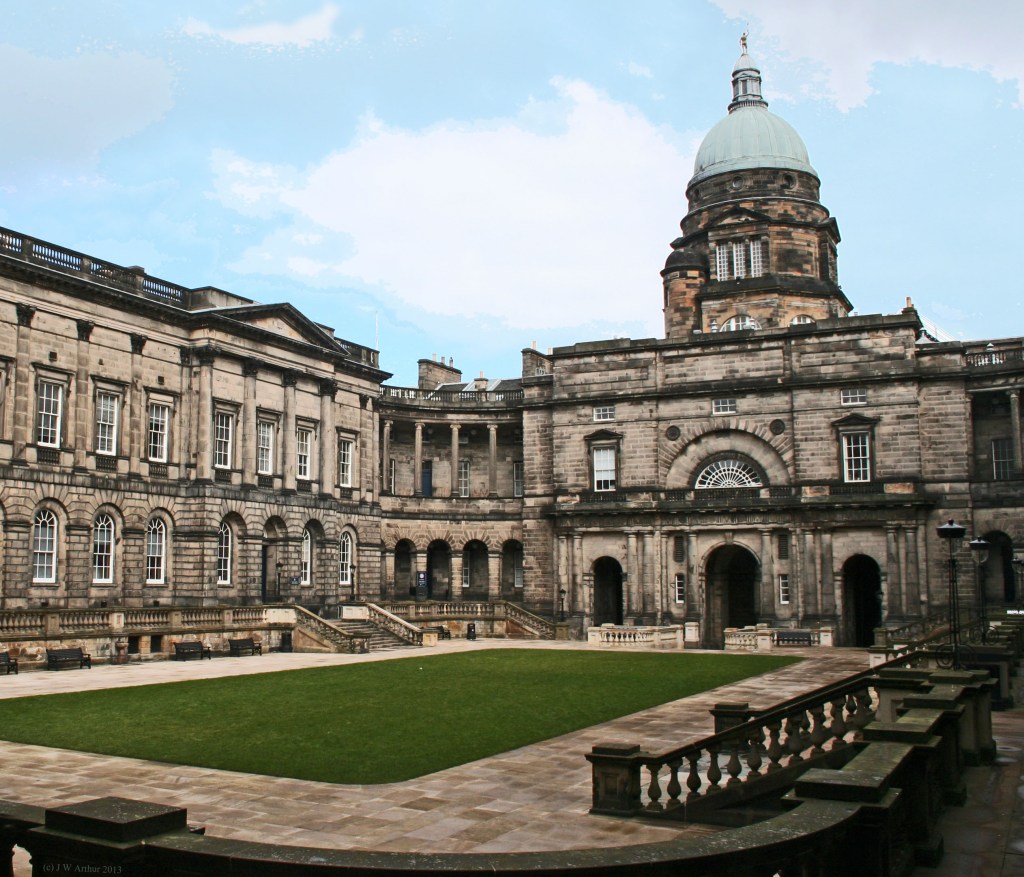
Plate 2.9 : Old College, University of Edinburgh
James Clerk Maxwell attended Professor Forbes’ natural philosophy classes here. The lecture theatre and equipment store were located on the upper level, by the three upper floor windows on the far left of the picture. In Maxwell’s last year at the college, Forbes allowed him the use of the facilities there so that he could do his own experiments. A plaque commemorating Maxwell was erected on the facing side of the quadrangle in November 2015.
By the following summer vacation, James had found his niche and was by now hooked on science, as his letters to Campbell on two consecutive days, 5 and 6 July 1848 clearly demonstrate. We give an extract here to give some idea of the flood of things that were going on, all orchestrated in his mind and the whole put into experimental practice under his own inclination and efforts:
I have regularly set up shop now above the wash-house at the gate, in a garret. I have an old door set on two barrels, and two chairs, of which one is safe, and a skylight above, which will slide up and down. On the door (or table), there is a lot of bowls, jugs, plates, jam pigs, etc., containing water, salt, soda, sulphuric acid, blue vitriol, plumbago ore; also broken glass, iron, and copper wire, copper and zinc plate, bees’ wax, sealing wax, clay, rosin, charcoal, a lens, a Smee’s Galvanic apparatus …
With regard to electro-magnetism, you may tell Bob that I have not begun the machine he speaks of, being occupied with better plans, one of which is rather down cast, however, because the machine when tried went a bit and stuck …
July 6. To-day I have set on to the coppering of the jam pig [Figure 2.4] which I polished yesterday.
I bathe regularly every day when dry, and try aquatic experiments. I first made a survey of the pool, and took soundings and marked rocky places well … also tried experiments on sound under water, which is very distinct, and I can understand how fishes can be stunned by knocking a stone.
We sometimes get a rope, which I take hold of at one end, and … when the water is up, there is sufficient current to keep me up like a kite …
I have made regular figures of 14, 26, 32, 38, 62, and 102 sides of cardboard.
A Latest intelligence – Electric Telegraph [the problematic electromagnetic machine?]. This is going so as to make a compass spin very much. I must go to see my pig, as it is an hour and half since I left it; so, sir, am your afft. friend,
JAMES CLERK MAXWELL. (C&G, p. 118‒120)
Two months later, while still at Glenlair, he revealed that on top of all this, not to mention his diversions with work in the fields, classical reading, time spent in the garden and walking the dogs, he has found time to work on even more ‘props’:
Then I do props, chiefly on rolling curves, on which subject I have got a great problem divided into Orders, Genera, Species, Varieties, etc.
One curve rolls on another, and with a particular point traces out a third curve on the plane of the first, then the problem is :– Order I. Given any two of these curves, to find the third [and so it goes on]. (C&G, p. 121)
His experimental work now consisted of making bits of unannealed glass of various shapes so that he could examine the pattern of internal stresses within the glass by viewing it with polarised light through a ‘crossed’ polarising prism, for example, his Nicol prism.[27]
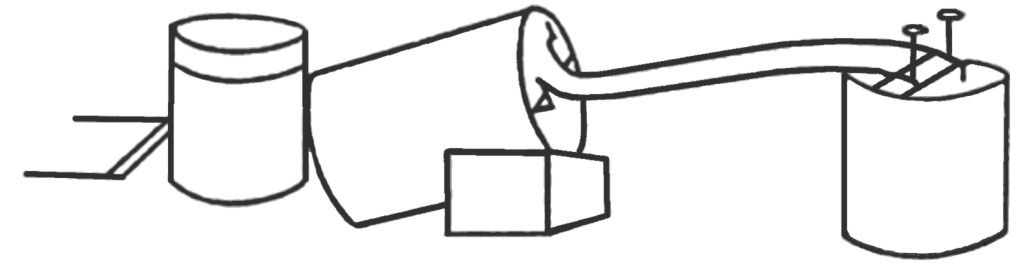
Figure 2.4 : Maxwell’s homemade experiment for electroplating a ‘pig’
“I have stuck in the wires better than ever, and it is going on at a great rate …” (C&G, p. 119)
That long summer vacation at Glenlair had been an amazing time of discovery and development. He returned to university in November and entered his second year of study. He kept his ‘props’ on rolling curves going on the side before eventually submitting the final draft to Professor Kelland for his opinion, for by this time they knew each other well enough and James was confident enough in his own abilities to do so. Kelland communicated the paper ‘The Theory of Rolling Curves’ (Maxwell, 1849)[28] to the RSE in February 1849, three years after James’ first paper was read there. Having, it seems, sated himself with curves, he then chose a topic that involved both mathematics and physics, the theory of elastic equilibrium in solids, a subject which perhaps occurred to him while peering at bits of unannealed glass and moulded jelly through crossed polarisers.
He started writing this up in March 1850 (C&G, p. 127) and gave it to Professor Forbes, who then put it before the RSE for consideration. The mathematical content was such that they in turn put it out to Professor Kelland for an opinion, and by May James heard back from Forbes that Kelland had read the paper thoroughly and recommended it for publication. But he also warned James that Kelland had complained about ‘the great obscurity of several parts, owing to the abrupt transitions and want of distinction between what is assumed and what is proved’ (C&G, p. 138). He stressed in no uncertain terms that James had to clarify many such parts before the work could go to print. Nevertheless, he had no doubt that James would be able to do so, for the revised manuscript was to be in Professor Kelland’s hands in less than a week! The paper was read shortly thereafter, but it did not appear in print for another three years (Maxwell, 1853).[29] The paper is indeed a tour de force of mathematical physics for someone not quite nineteen years of age.
While one can understand his rapid progress with basic experimental physics through learning, enthusiasm and ingenuity, this reveals something deeper, the penetrating power of his analytical mind, visualising the purely abstract stresses and strains and rendering them into three-dimensional differential equations. Nevertheless, it also shows another side that is hardly surprising in one so gifted; in the written word he occasionally found it difficult to express himself sufficiently clearly for even the most capable of readers to be able to follow him.[30] His Treatise on Electricity and Magnetism (1873a) left Heinrich Hertz so flummoxed that he gave up on it and worked out Maxwell’s electromagnetic theory from the beginning. In his book Electric Waves (1893) Hertz commented:
Many a man has thrown himself with zeal into the study of Maxwell’s work, and … has nevertheless been compelled to abandon hope of forming for himself a consistent conception of Maxwell’s ideas. I have fared no better myself. (p. 20)
Again, the incompleteness of form referred to renders it more difficult to apply Maxwell’s theory to special cases. (p. 196)
On entering his third year at Edinburgh University, Maxwell had completed all the mathematics, natural philosophy and logic that the syllabus offered. He therefore decided to take up moral philosophy under Professor John Wilson[31], chemistry under Professor Gregory, who took the theoretical part, and Professor Kemp, who took the practical work. In addition, he studied German and hung around Professor Forbes’ natural philosophy class where he did not formally attend lectures but was afforded the liberty of using the experimental apparatus for his own investigations. These classes may have proved useful, but other than working on his own prop about elastic solids, he was to some extent marking time. There would have been little point in doing a further year just so that he might receive his degree, and so a decision about his immediate future had become pressing by the summer of 1850.
2.4 Cambridge
There was talk once more about James becoming an advocate. Family and friends were also asking John Clerk Maxwell about his intentions for James and offering their opinions, but it appears that it was well into the autumn before he was at last listening to their advice. In James’ own words:
He had wished me to be an advocate; but I never attended law classes, as by that time it had already become apparent that my tastes lay in another direction. Moreover, he looked up greatly to James Forbes, and desired that I should be like him. (C&G pp. 420−21)
… the existence of exclusively scientific men, and in particular of Professor Forbes, convinced my father and myself that a profession was not necessary to a useful life. (Hilts, 1975, p. 59)
He therefore finally accepted that James should go to Cambridge to undergo the rigours of the degree course there, in other words, to set his sights high and aim for the top. The system was that able students would be chosen and coached for the most exacting of final examinations, the mathematical ‘tripos’. To get that far required a tremendous amount of effort on the part of both student and coach.
Tait, having got enough from just one year at Edinburgh University, was by then already at Peterhouse College embarking on the course. James D. Forbes voiced a strong preference for Trinity (C&G, pp. 132, 146), but John Clerk Maxwell, having received many more recommendations for Peterhouse, at length made the decision to send his only son there, some three hundred miles away from home. Now, this would be nothing remarkable today, and most fathers would not hesitate to send their only son to Cambridge if they could afford it. But at that time sickness and death were ever stalking close by, and so it must have been hard for him, now at the age of sixty, to accept that he would not only see much less of James, but might be seeing him for the last time. The mitigating factors were, however, that travel by train was now well established so that Cambridge could be reached from Glenlair within about twenty-four hours; letters travelled just as quickly; and there was even the telegraph for use in an emergency. Not only was Tait already there, a friend and relative called Charles Mackenzie[32] was a lecturer in Caius College.
In October of 1850, James Clerk Maxwell duly enrolled at Cambridge, in St Peter’s House of Peterhouse College. Robert Campbell, brother of Lewis, had also enrolled, but at Trinity College. Having achieved so much at Edinburgh, James’ first year amongst the freshmen offered him barely enough to hold his attention, and there were the usual distractions of student life. While he did not allow the casual behaviour and occasional merriment of his fellow students to blow him off course, he decided at the end of first year to transfer to the college that Professor Forbes had recommended for him, Trinity.
James, having impressed his tutor William Hopkins, was duly invited to take on the mathematical tripos with Hopkins himself as coach. Hopkins had coached the likes of George Stokes, Arthur Cayley and Phillip Kelland, all of whom became Senior Wranglers,[33] and also the future Lord Kelvin, who by comparison merely managed to make second Wrangler. All four were also Smith’s prizemen, a major accolade for Hopkins. Peter Guthrie Tait was already under Hopkins’ wing and acquitted himself admirably by becoming Senior Wrangler and Smith’s prizeman at the end of 1852. The coaching primarily consisted of ‘mugging up’ on typical examination questions from past papers and the like; obscure strategies and techniques that went beyond the bounds of normal practical methods had to be learned, and the work was both difficult and laborious. James, however, seems to have bent only partially to Hopkins’ coaching methods, for according to Campbell:
… the pupil to a great extent took his own way, and it may safely be said that no high wrangler of recent years ever entered the Senate House more imperfectly trained … But by sheer strength of intellect … he obtained the position of Second Wrangler, and … equal with the Senior Wrangler in the higher ordeal of the Smith’s Prizes. (C&G, pp. 134)
The examination was in January 1854, just a few months after James had suffered a long bout of illness described as a sort of brain-fever (C&G, p. 170). It was put down to the strain of his studies, but it could simply have been a virus. Luckily it came in a break between terms but it left him so weakened that he had to be ‘careful not to read inordinately hard’ in the run up to the final examinations (C&G, p. 171). Nevertheless, if he had been seriously interested in becoming senior wrangler and had focused on doing so by following Hopkins’ coaching more assiduously, he may well have achieved it. But his reluctance to buckle down to it seems to recall the brief spell of rebellion against his tutor in his boyhood. James would have accepted what he did achieve as success enough, as would his father, as would everyone else including his old Professors, Forbes and Kelland. Tait and the Campbell brothers would have been equally pleased for him, and the difference between senior and second wrangler would have been of no account between Tait and himself.
The important thing was what Maxwell was underneath it all, with his personal traits of self-direction and deeply philosophical enquiry; his pursuance of his own ideas and ‘props’; and his insight into mathematical and physical problems. He could not, and would not, have learning drummed into him at the hands of any coach. He had the qualities of genius; and were not his perceived faults, such as Forbes’ complaint about his ‘obscurity’ and ‘abrupt transitions’, evidence of the same inasmuch as they were simply great leaps of insight? Were his spells of distraction not just episodes of absorption in some ‘prop’ or other, as his aunt Jane described it (C&G, p. 105)? Even his faltering speech could be put down to a simple failure to find the words adequate to express the ideas in his mind that were not formed from words, but from abstractions. When put on the spot to say his lesson at the Academy it may have simply been a case of nerves, but the problem stayed with him for a long time thereafter. On the other hand, when he was a student we find people saying he could speak eloquently and profoundly on any subject, and yet we find others who described him as saying little, but to the point. Surely, it very much depended on the circumstances, whether he was comfortable with the situation or whether he felt flustered, as the following example in a letter to Lewis Campbell in February 1857, clearly shows:
Up to the present time I have not even been tempted to mystify anyone [by what I say]. I am glad B‒‒ [34] is not here; he would have ruined me. I once met him. I was as much astonished as he was at the chaotic statements I began to make. But as far as I can learn I have not been misunderstood in anything, and no one has heard a single oracle[35] from my lips (C&G, pp. 265−266)
Another example was when he stood up at a meeting of the British Association for the Advancement of Science (the ‘BA’) held in Edinburgh in 1850 to challenge a point made by Sir David Brewster (C&G, p. 144n1), who had a fair reputation for cruelly demolishing any theory that did not agree with his own. Professor William Swan[36] later recalled the scene:
His utterance then, most likely, would be somewhat spasmodic in character, as it continued to be in later times, his words coming in sudden gushes with notable pauses between; and I can well remember the half-puzzled, half-anxious, and perhaps somewhat incredulous air, with which the president and officers of the section, along with the more conspicuous members who had chosen ‘the chief seats’ facing the general audience, at first gazed on the raw looking young man who, in broken accents, was addressing them … But, at all events, he manfully stuck to his text; nor did he sit down before he had gained the respectful attention of his hearers, and had succeeded, as it seemed, in saying all he meant to say. (C&G, p. 489)
These recollections of Campbell say much about James’ character, and how he managed to overcome the difficulty he found in speaking under pressure. They may give some clue as to why in later life he was always cautious and measured in what he said, and rarely if ever drew the limelight upon himself.
As soon as his final examinations were over, James was free to revert to his old way of doing things, whereupon he immersed himself in projects that had long interested him and were no doubt constantly brewing in the back of his mind. His mathematical paper ‘On the Transformation of Surfaces by Bending’ (Maxwell, 1856b)[37] may well have followed directly from his earlier analysis of elastic bodies, helped by the lectures of Professor Stokes. It was presented to the Cambridge Philosophical Society just two months later, in March 1854. He also began investigating how to reproduce mixtures of coloured light in a meaningful quantitative way, picking up on the ideas he had taken from Forbes’ demonstrations with a spinning top, which he had doubtless repeated himself. Perhaps out of curiosity, he made himself a rudimentary ophthalmoscope:[38]
To Miss CAY.
Trin. Coll., Whitsun. Eve, 1854.I have made an instrument for seeing into the eye through the pupil … and I can see a large part of the back of the eye quite distinctly with the image of the candle on it … Dogs’ eyes are very beautiful behind, a copper-coloured ground, with glorious bright patches and networks of blue, yellow, and green, with blood-vessels great and small. (C&G, p. 208)
About the same time however, he discovered something which made an interesting and challenging examination problem (Maxwell, 1854)[39]. The idea, suggested to him by the structure of a fish’s eye, was a spherical lens[40] which was more refractive (bent light more) at the centre than at the surface. Maxwell showed that if the variation in refractive power took a certain form, then a point of light on the surface of the lens would produce a perfect image of itself at a point diametrically opposite. That is to say, the lens could focus an object at point-blank range. At the time his idea was more abstract than practical[41] but it gives a clear example of how he was able to think ‘outside the box’. This, however, was only part of what he was thinking about at the time, for he went on to carry out a general mathematical analysis of optical instruments to see what was needed to make a perfect image (Maxwell, 1858)[42].
2.5 Maxwell, the ‘Natural’ Natural Philosopher
Little more needs to be said about the origin and route by which James Clerk Maxwell came to be a physicist, and a great one at that. But we must not forget that he had other sides to his character and intellect. He not only thought about things, he thought about them very deeply, at least until he could get ‘the particular go of it’ in his own mind’s eye. The lectures he received at Edinburgh in Professor Sir William Hamilton’s Logic and Metaphysics classes had stimulated this tendency, for Hamilton was a compelling lecturer on these subjects and James was very much enthralled by them, taking more notes here than in his other classes. At the end of his first year, or perhaps a little later, as an exercise he set for himself, he wrote an essay ‘On the Properties of Matter’. The manner in which this essay came to light shows how much it had impressed Sir William, for it was discovered some years later when he was too ill to continue giving his classes; Professor Baynes, who had been appointed to assist Sir William, found it tucked away in a private drawer in the old man’s desk (C&G,pp. 109).
In order to do it justice, Campbell gives the essay in full (C&G,pp. 109−113). On the age-old problem concerning the nature of a vacuum, Maxwell argued the following:
If we say it is an accident, those who deny a vacuum challenge us to define it, and say that length, breadth and thickness belong exclusively to matter.
This is not true, for they belong also to geometric figures, which are forms of thought and not of matter; therefore the atomists maintain that empty space is an accident, and has not only a possible but a real existence, and that there is more space empty than full. (C&G, p. 110)
This gives some idea of him mentally reaching out as far as he could possibly go to address, if not actually answer, the basic questions that are central to the understanding of physics, that is to say, natural philosophy. Later, on his appointment to the chair of Natural Philosophy at Marischal College, Maxwell chose to make this the theme of his inaugural lecture, given on 3 November 1856.[43]
2.6 A Scottish Professorship
During the winter of 1854, John Clerk Maxwell took ill while in Edinburgh[44] and James returned from Cambridge to be by his side at 18 India Street,[45] which was now where John’s widowed sister Isabella had set up residence; ‘Old 31’ had presumably become too big for her once her children had grown up and, apart from her son George, moved on. Isabella did not keep the best of health herself, but she would have made sure that her brother had plenty of care and attention; even so, James stayed four months and looked after him personally (Riddel, 1930, p. 28‒29). For much of the time he seems to have had little opportunity for anything else, but as soon as his father was on the mend he got back to work. It was during this period that he wrote his first short piece on colour vision, ‘Experiments on Colour Vision as Perceived by the Eye’ dated 4 January 1855.[46] For this he used a simple spinning top and three discs of coloured paper, each slit along a radius so that they could be interleaved to show any proportions of the three colour he wished, before they were spun by means of the top. In fact, he was photographed about this time with just such a top (Plate 2.10). Such was the popular interest in this that J. Bryson, the local optician, took to selling the spinning top and coloured papers for the amusement of his clientele. Maxwell’s conclusion regarding colour vision is accurate, but to the man in the street it sounds like something only a mathematician could come up with:
… the difference between Colour-Blind and ordinary vision is, that colour to the former is a function of two independent variables, but to an ordinary eye, of three. (WDN1, p. 124)
In this paper, he also introduced the now well-known colour triangle diagram showing how to compose any colour from three primaries. This exploited the fact that changing the intensity of a given colour of light does not affect the colour itself, so that one of the three variables involved can be eliminated by choosing it to be the brightness, making it possible to draw a colour composition diagram in two dimensions rather than three.
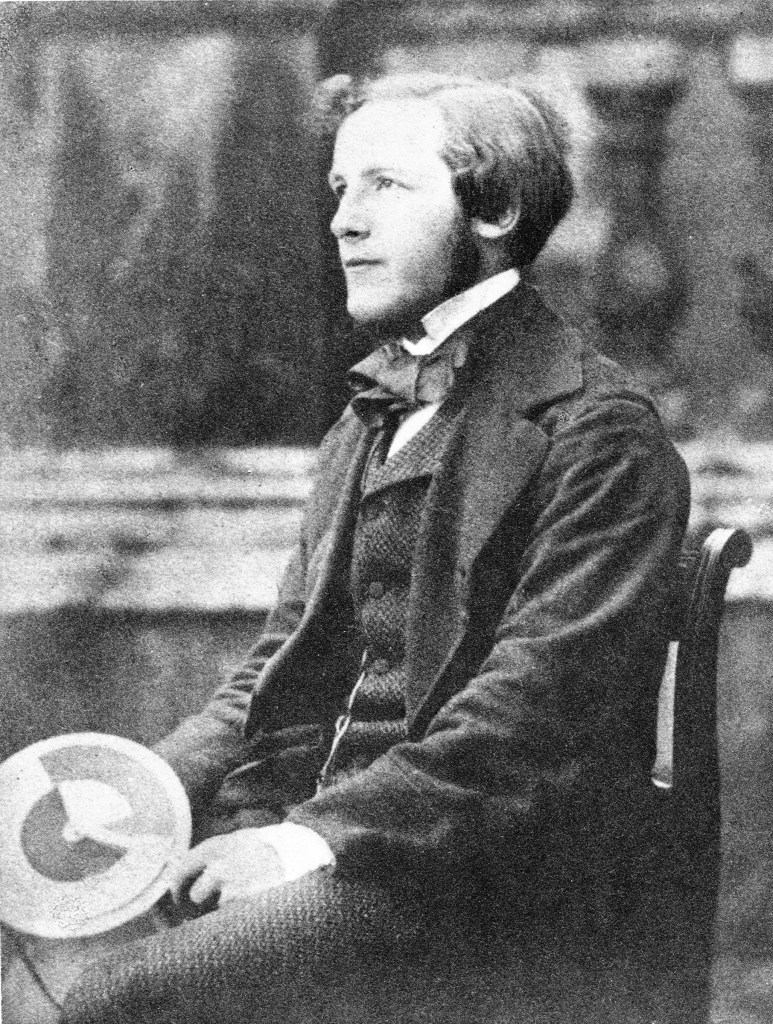
Plate 2.10 : James Clerk Maxwell at about 24 years of age holding a colour top
Here we can see the mutton chops that were a precursor to James growing a full beard. His hair is already receding a little, but the little tuft sticking up at the front seems to be a throwback to the ringlets seen falling down his brow in Dyce’s portrait of him as a child in the arms of his mother. By courtesy of the Master and Fellows of Trinity College, University of Cambridge
‘Experiments on Colour, as Perceived by the Eye, with Remarks on Colour-Blindness’ (Maxwell, 1855)[47] was subsequently presented to the RSE just two months later by his old Chemistry Professor, Dr Gregory. In this paper he described several ways of synthesising colour (he had clearly been busy reading up all the information he could on the subject) including his ‘colour box’,[48] his first attempt at which had been in August 1852, doubtless at Glenlair. At this early stage of his academic career Maxwell was making significant headway simply by studying what interested him; he seems to have had a sixth sense for anything that might be significant. It will come as no surprise, therefore, that another gem or two may be found in that article. First, we point out the pearl:
This result of mixing blue and yellow [light to make a ‘pinkish tint’] was, I believe, not previously known. It directly contradicted the received theory of colours, and seemed to be at variance with the fact, that the same blue and yellow paint, when ground together, do make green. (WDN1, p. 146)
Maxwell was therefore one of the first to point out that the mixing of coloured light was not the same as the mixing of pigments (Plate 2.11), because the former is an additive process and the latter subtractive one.[49] But even before he got that far, he had revealed what we must now recognise as a diamond:
This theory of colour may be illustrated by a supposed case taken from the art of photography … Let a plate of red glass be placed before the camera, and an impression taken. The positive of this will be transparent wherever the red light has been abundant in the landscape, and opaque where it has been wanting. Let it now be put in a magic lantern, along with the red glass, and a red picture will be thrown on the screen. Let this operation be repeated with a green and a violet glass, and, by means of three magic lanterns, let the three images be superimposed on the screen. The colour of any point on the screen will then depend on that of the corresponding point of the landscape; and, by properly adjusting the intensities of the lights, &c., a complete copy of the landscape, as far as visible colour is concerned, will be thrown on the screen. (WDN1, p.136)
(a)  | (b) |
| Plate 2.11 : James Clerk Maxwell’s Theory of Three Primary Colours (a) Mixing three primary colours using light. All three colours of light are present where the three circles overlap; they add add to make white. Where only two circles overlap only two colours of light mix, forming yellow, magenta and cyan. (b) Mixing primary colours with pigments. Pigments absorb incident light, so that yellow paint absorbs blue light, red paint absorbs green and blue, while green paint absorbs red and blue. A mix of all three paints absorbs all three primary colours of light, resulting in black rather than white. | |
He had simply, off the top of his head, invented colour photography, and never thought to patent it! The first public demonstration took place at a lecture ‘On the Theory of Three Primary Colours’ (Maxwell, 1861)[50] given at the Royal Institution in London on 17 May 1861. The subject he used was a tartan ribbon tied into a rosette, (Plate 2.12(a)). In truth, Maxwell’s focus at the time was on developing an accurate theory of colour vision, the valuable outcome being his contribution to the understanding of colour blindness.
In October 1855, Maxwell was accepted as a Fellow of Trinity College, that is to say he would teach and give lectures, a position which could have been the basis of a lifelong academic career had he wished to pursue it. As an undergraduate he had followed Faraday’s experimental researches on electricity and magnetism, and had also taken note of W. Thomson’s assertion that there was a close analogy between electrostatics and thermostatics; in conjunction with his mathematical work on elastic deformations, this led him to his first essay in the field of electromagnetics, ‘On Faraday’s Lines of Force’ (Maxwell, 1864 [sic]),[51] a considerable body of work that was read to the Cambridge Philosophical Society in four parts, beginning December 1855. The following February, James Forbes nominated him for fellowship of the RSE despite the fact that he was still only twenty-four years of age.
By this time James was very well settled in Cambridge and had developed a small coterie of close friends; college life being what it is, he felt the loss keenly when any of them had to leave for the sake of following their chosen careers. The only disadvantage was that the academic year was longer than the Scottish one, which had given him the best part of six months in the summer to spend at Glenlair. Nevertheless, he would have been well aware that his father’s health had been failing since his long illness in Edinburgh over the previous winter. As well as being nearly sixty-five years old and somewhat overweight, as we have seen, John Clerk Maxwell was not a well man. There may have been some apprehension between him and James that he was nearing his end.
No doubt wishing to leave James some reminder of himself, he finally had his portrait painted (see Plate 1.1) from which Stoddart engraved the likeness of him that Campbell used in his book . Furthermore, he wished James to be closer to home. As James himself put it:
He much wished me to have a Scottish Professorship, that I might have the long vacation free for living at home. (C&G, p. 421)
 (a) |  (b) |
Having put the idea forward in 1855, it was not until 1861, when at King’s in London, that he got round to demonstrating it in public at the Royal Institution in London. It was the first ever photographically produced colour image. The image was not produced as photographic print on paper until 1961 (Evans).
(Public domain via Wikimedia Commons)
Plate 2.12(b) : Enlargement of part of the image as displayed on modern TV screen
A TV screen is made up of a large array of tiny ‘pixels’ (picture elements). It can be seen here that each pixel is more or less square in shape and comprises three vertical bars, one red, one green, and one blue, the brightness of which can be individually controlled. At normal magnifications the eye cannot resolve the individual coloured bars and so it sees only the average of the colours they emit. The three separate red, green and blue images formed by the bars therefore correspond exactly to the concept invented by Maxwell some 170 years ago!
It perhaps came naturally to a dutiful son like James, who had become so close to his father since the death of his mother, and likewise his father to him, that when the chair of Natural Philosophy at Marischal College in Aberdeen was advertised, he put his name forward. His father did his bit to solicit suitable references, but sensing that he should once again be by the old man’s side, James came home to Glenlair just days before his father passed away, on 3 April 1856. Sadly, John Clerk Maxwell did not see his fondest wish come true. On his father’s death, James became the new laird and a man of independent means. He already had the Maxwell name and so the only change under the old entail was that he was now ‘Clerk Maxwell of Middlebie’.[52]
James was duly awarded the post just a few weeks after his father’s death. In his inaugural lecture, given to his first class in the presence of the assembled dignitaries of the College, Maxwell discussed at length his own concepts of natural philosophy and physics, but it must be said that he did not draw a distinct line between them.[53] At almost the same time, following his nomination by James Forbes, he was elected as a fellow of the RSE; it was another plaudit to his son that his father did not live to see. Maxwell took up his chair at Marischal College that November[54] already in the knowledge that discussions had been ongoing regarding its merger with its neighbour and competitor, the King’s College. Had it not been for the rancour between those who had been appointed to negotiate the merger, it could have already been under way. Even although his duties were for the most part fairly routine, as indeed they had been at Cambridge, he did take his teaching seriously. Described as having his fair share of ‘misfortunes of the blackboard’ (Lamb, 1931), his insights and asides appealed to his more gifted students. While a good deal of teaching and preparation time was involved, he still had time for his own researches, continuing with colour vision and electromagnetics and now also embarking on the molecular theory of gases, the dynamical top and completing the theory of optical instruments.
As if this were not enough, he had already taken up the challenge of the 1857 Adams Prize Essay, to find an explanation for the rings of Saturn: were they solid, liquid, rubble, or something else entirely? After a good deal of effort on Maxwell’s part, his essay ‘On the Stability of the Motion of Saturn’s Rings’ (Maxwell, 1859)[55] was read on 19 April 1858. It took the prize by showing that the rubble theory was the only one that was stable. Other competitors for the prize seemed to find the problem simply too much for them, and the Astronomer Royal, Sir George Airy, regarded Maxwell’s achievement as one of the most remarkable results of mathematical physics that he had ever seen (WDN1, p. xv ).
If the theory of Saturn’s rings was Maxwell’s first truly great work, his second was only two years in the coming. ‘On the Dynamical Theory of Gases’ (Maxwell, 1860c) was read at the Meeting of the BA[56] at Aberdeen on 21 September 1859 and subsequently published in full as ‘Illustrations of the Dynamical Theory of Gases’ (Maxwell, 1860a)[57]. Maxwell subscribed to atomic theory, which he later made the topic of a poem poking fun at the president’s address to the BA of 1874, of which the following gives the tenor:
How freely he [God] scatters his atoms before the beginning of years;
How he clothes them with force as a garment, those small incompressible spheres!
… Like spherical small British Asses in infinitesimal state …
First, then, let us honour the atom, so lively, so wise, and so small;
The atomists next let us praise, Epicurus, Lucretius, and all.              (C&G, pp. 639‒640)
While it was hard to conceive of tiny atoms making up tangible materials like solids, the idea that gases consisted of a cloud of atoms had been mooted by Daniel Bernoulli as early as 1738 in his book Hydrodynamica[58]. We can call them atoms or molecules, it does not matter which, but the underlying theory is usually referred to as the molecular theory of gases. The idea is that in a container filled with a gas, the tiny molecular constituents fly around with considerable velocity. They frequently collide with the walls of the container and the cumulative effect of these collisions acts as a pressure, somewhat like in a hailstorm when a barrage of little icy ‘ball bearings’ loudly drums on a roof. While the average velocity of the molecules depends on the temperature of the gas, Maxwell was the first to show that the molecules do not all have the same velocity, rather they have a statistical distribution of velocities, which he duly calculated (WDN1, pp. 380−381). This distribution now bears his name, along with that of Ludwig Boltzmann, who followed up on his ground-breaking work.
There were other important revelations in Maxwell’s 1860 paper that helped not only to develop molecular theory but to give it sufficient prominence to get others interested; in addition to Boltzmann, Lord Rayleigh was also impressed by it (Jones, 1973, p. 65−66) and Sir James Jeans referred to much of Maxwell’s original work in his celebrated ‘The Dynamical Theory of Gases’ (1904), which even the title recalls. Maxwell’s other publications during his time at Aberdeen are perhaps overshadowed by these masterpieces on the molecular theory of gases which, as we shall see, could hardly have been appreciated by either his fellow academics or the City Council.
It was in association with the Aberdeen instrument makers Smith and Ramage (Maxwell, 1860b) that Maxwell produced:
- the final version of his colour mixing box;
- his fully adjustable version of the dynamical top, a copy of which was provided to his old teacher and mentor back at Edinburgh, James Forbes;
- a mechanical model of the behaviour of the rings of Saturn.
- The model of Saturn’s Rings had been conceived in December of 1857 (C&G p. 295) and was demonstrated to some acclaim at a lecture given at the RSE (Maxwell, 1857‒62) in which he summarised the conclusions of his prize essay.
. ▪ . ▪ . ▪ . ▪ . ▪ . ▪ . ▪ .
The principal at Marischal was the Reverend Daniel Dewar, with whom Maxwell forged a friendship that brought him in contact with Dewar’s daughter, Katherine who, although seven years his senior, was not yet spoken for. Maxwell was invited to stay with the Dewars when they were on their annual vacation near Dunoon in the September of 1857, which must have afforded ample opportunity for Katherine and him to get acquainted. Perhaps Daniel Dewar and his wife had hoped as much in extending the invitation. The following February, James and Katherine were engaged and the wedding took place at Aberdeen in June 1858, whereafter the couple lived with the Dewars at 18 Victoria Street (Jones, 1973, p. 64).
Maxwell seems to have been very happy in his choice of wife, but it was not well received by his family back in Edinburgh. This may well be due to the fact that he did not consult the senior family members beforehand or, if he did, he was going against their advice. John Clerk Maxwell had perhaps thought that the task of seeking a wife for his son could wait until after he had his professorship, but of course it was now too late. Maxwell’s aunts Isabella and Jane would have naturally spent some time thinking about such things, and would even have pressed John to do the same, but in the event they were taken by surprise when James simply announced his engagement out of the blue:
18th February 1858
DEAR AUNT [Jane,] This comes to tell you that I am going to have a wife … So there is the state of the case. I settled the matter with her [mother], and the rest of them are all conformable … I hope someday to make you better acquainted … For the present you must just take what I say on trust. So good-bye. Your affectionate nephew. (C&G, p. 303)
By what he says elsewhere in the letter, Aunt Isabella, his uncle John Cay and Sir George Clerk, the most senior figure on his father’s side of the family, effectively received carbon copies of the same. They may therefore have been just as surprised, and perhaps Aunt Isabella and Sir George would have been offended that he had not seen fit to consult them, for James should have been thinking about the future of Middlebie, and potentially of Penicuik. James’ choice lacked any sort of alliance with a comparable family. Genteel as the Dewars may have been, Daniel Dewar was not landed gentry;[59] he had no estate of his own and had to go to his son-in-law’s when it came to summer vacation! For Sir George, the news would have been unwelcome indeed, and he may even have gone so far as to put a shot over the young man’s bows.
The issue was that, theoretically at least, James, or any children that he might eventually have, could at some time end up being successors to, or having an interest in, the Penicuik estate; Sir George did by then have grown-up sons and grandsons of his own, but it may be that he was just as upset because James hadn’t even considered the wider possibilities. On top of that, there were other legal matters that could be affected, for example, debts owed by John Clerk Maxwell’s estate to Sir George. At any rate, on 3 March Sir George served James with a ‘summons declarator’,[60] a fairly prompt riposte considering James had written to announce his engagement barely a fortnight before. The pretext was that improvements had been made over the years to the Penicuik estate, for which John Clerk Maxwell had had some sort of legal or financial liability. It was all spelled out in detail in the summons, amounting to a total of £6,777 11s 1½d, [61] an enormous sum at the time, probably thirty times a typical professorial salary.
This information has only recently come to light and what happened in consequence is not yet known. Both the timing of it, and the fact that it ever took place, seems to reveal the gut reaction of a man of the old school, who simply saw James’ behaviour as unacceptable. When James was a boy he had often visited Penicuik House, especially in the Christmas holidays, but whereas there are frequent mentions of various uncles and cousins within his mother’s and aunt Isabella’s branches of his family, the only mention of Sir George in Campbell and Garnett’s biography occurs when James wrote to inform him of his father’s death (C&G, p. 254).
There is also scant reference to Katherine Dewar in Campbell and Garnett, which Jemima Wedderburn put down to Campbell’s hands being tied because it was Katherine who had requested him to write it. From their childhood together at ‘Old 31’ and happy days ‘tubbing’ at Glenlair, Jemima knew James so well that she could have been his sister; of his marriage, she was to say bluntly in her own memoir:
This did not give much satisfaction to his friends and relations. The lady was neither pretty, nor healthy, nor agreeable, but much enamoured of him … and he being of very tender disposition married her out of gratitude. Her mind afterwards became unsettled but he was always most kind to her, and put up with it all. She alienated him from his friends and was of a suspicious and jealous nature … [after his death, she] published a life of him written by the Revd. Lewis Campbell … Of course, under these circumstances the history of his married life could not be entered into. (Fairley, 1988, p. 107)
Nevertheless, Campbell did manage to slip into the concluding remarks of his biography:
Mrs. Wedderburn [Aunt Isabella], who had had the care of him during so much of his early life, said on the occasion of his marriage, “James has lived hitherto at the gate of heaven” (C&G, p. 426)
Where she supposed that he may have ‘lived’ thereafter is left for the reader to imagine.
In consequence of his marriage, Maxwell was no longer able to retain his fellowship at Trinity but, being sufficiently well regarded, he was thereafter made an honorary fellow. In the two years that followed his marriage, the process of college amalgamation at Aberdeen progressed at last under the hand of a Royal Commission. Since for every two professors of a given subject there would now be only one, the general decision of the commissioners was that the elder man would retire on a pension. This would give the younger man a chance to have a career, give the older man a chance to live out his days in comfort and, by dying the sooner, save on the total expense. There was only one exception; in Maxwell’s case, it was the younger man was given the boot (Jones, 1973, p. 66). This has created much speculation that it was the result of him being an inferior lecturer. But according to Niven:
On the contrary, if we may judge from the number of voluntary students attending his classes in his last College session, he would seem to have been as popular as a professor as he was personally estimable. (WDN1, p. xv)
Another possible reason given by Jones is that Mrs Maxwell interfered because she wanted her husband to be quit of Aberdeen, but this only came as hearsay, originally through Peter Guthrie Tait’s wife. It may simply be that, given the affront Katherine must have felt at her husband losing his job to the senior man, she would have preferred people to think that it was they who wanted to get away from the place. But if Maxwell was not a bad teacher, why did the commissioners make the anomalous decision to sack him rather than the older King’s College man, Professor David Thomson?
First, the pension was not a consideration for they actually paid him an annuity equal to his average income (Flood, et al., 2014, p. 42). Second, if Maxwell had been interviewed at any stage by the commissioners, his quietness and old ‘hesitancy’ may have resulted in a less than favourable impression. On the other hand, Thomson was robust, well known, influential in the pro-amalgamation campaign and somewhat devious, ‘earning himself the soubriquet crafty Thomson’ (Reid, 2012)[62]. Finally, and perhaps equally relevant, could have been the matter of Maxwell’s entirely contrasting character: mild, self-effacing, and perhaps too considerate of others for his own good; it is conceivable that he could have offered to go to save the older man! After all, he had independent means, whereas Thomson, who was seventeen years his senior and had a family, may have faced hardship if he lost the post. Indeed, when he had originally applied for the chair at Marischal at Aberdeen, Maxwell had received a request for a reference from another candidate, who happens to have been the William Swan, the attendee at the BA meeting of 1850 who witnessed Maxwell struggling to put a question to David Brewster. Rather than demurring, Maxwell granted his request (C&G, p. 252). Interestingly, the fact that Swan asked the comparatively junior Maxwell for a ‘good opinion’ would seem to indicate that Maxwell had already established a considerable reputation for himself.
Since Maxwell knew Professor James Forbes very well, he may also have been aware that Forbes was set to become Principal of the United College of St Andrews and the post at Edinburgh would soon be vacant. Edinburgh was a post that would have suited him very well, for the city was a real centre of learning and of learned men, and he would be back amongst his family and old friends. Katherine and he would be able to live there quite comfortably through the winter at 14 India Street, which he now owned, for it would be only a matter of giving notice to the current tenant. With the progress of railways, Glenlair was now only a few hours distant[63]. But it was not to be, for his good friend and rival Peter Guthrie Tait, who had been in Ireland, also took his chance at the chair, and it was he who got it. The Edinburgh Courant commented on the chair being awarded to Tait as follows:
… there is another quality which is desirable in a Professor in a University like ours and that is the power of oral exposition proceeding on the supposition of imperfect knowledge or even total ignorance on the part of pupils. (O’Connor & Robertson, 2003)
The implication is that Maxwell was not able to lecture to his students at a sufficiently simple level. His reputation for lofty research seems to have gone against him.
2.7 King’s College, London
After failing to get the post at Edinburgh, Maxwell subsequently applied for the chair of natural philosophy and astronomy at King’s College in London. There were pros and cons, of course. On the one hand he could be nearer other great men of science, especially Faraday, and the possibility of a social life in London may have appealed to Katherine. On the other hand, the academic year was somewhat longer, and it was 300 miles from Glenlair; even so, the journey from London to Glenlair by train could now be done in a day. The chair became his and the couple moved to 8 Palace Gardens Terrace, Kensington,[64] which afforded Maxwell a sizable garret in which to carry out his own experiments. His current version of the colour mixing box was now eight feet long, and so he would have needed ample room! The college was four miles away, but it could be reached by a pretty route, by foot or horse, through parks and along the riverbank.
Things could have taken an altogether different turn, however, for just before the move Maxwell came down with smallpox, which he attributed to visiting the Rood Fair at Dumfries to buy Katherine a horse (C&G, p. 319). The Rood Fair was traditionally held on the last Wednesday of September, and it was soon thereafter that he came down with this dangerous disease that claimed one life in three. He afterwards attributed his survival to Katherine’s constant care and devotion, for it was she who nursed him exclusively for fear that any of the servants might catch the disease.
Maxwell gave his inaugural lecture at King’s in October 1860 (Maxwell, 1979; Harman, vol. 1, p. 183). Once settled there, he was asked to join the BA committee for standardising the unit of electrical resistance later designated as the Ohm. While this would seem low-level stuff now, it was then quite fundamental. The experiments took place during 1862 and 1863 at King’s College under the general direction of William Thomson, who had become a close friend of Maxwell’s. Thomson was knighted for his efforts in 1866 and later became Lord Kelvin, but at this juncture he was simply Professor Thomson, the incumbent of the chair of natural philosophy at Glasgow University since 1846. Like Maxwell, he had been coached by Hopkins at Cambridge, becoming a senior wrangler. There had been connections between the two since about 1850, for in 1849 Maxwell’s cousin Jemima had married Hugh Blackburn, Professor of Mathematics at Glasgow, a lifelong friend of Thomson’s who had taken the vacant chair at Glasgow on the death of Thomson’s father. Although Thomson was seven years Maxwell’s senior, they became close, and Maxwell and his father had often spent a winter holiday in Glasgow, sometimes as guests of the Thomsons, and sometimes as guests of the Blackburns.
The work on the standard Ohm brought Maxwell back in touch with Fleeming Jenkin[65] and afforded him the chance to meet Faraday. In 1861 he was elected a fellow of the Royal Society of London, which gave him an even greater degree of contact with the most important scientists of the day, and there were also frequent meetings at the Royal Institution.
In his next great paper on electromagnetic theory ‘On Physical Lines of Force’ (Maxwell, 1861‒62)[66] he used the description ‘physical’ in the title in a sense meaning something like ‘tangible’. His attempt to find a rationale for electromagnetic forces in terms of an analogy with a mechanical model in the form of an array of ‘molecular vortices’ may have been encouraged by his friend Sir William Thomson who was very much in favour of this sort of explanation.[67] This paper, published in five separate parts between March 1861 and February 1862, revealed for the very first time all the essential equations of electromagnetic theory; from these he was able to deduce the existence of electromagnetic waves, and further, that light is an electromagnetic wave. His critics, however, found his mechanical analogy of molecular vortices too much. The mathematician Cecil Monro, wrote to him:
The coincidence between the observed velocity of light and your calculated velocity of a transverse vibration in your medium seems a brilliant result. But I must say I think a few such results are wanted before you can get people to think that, every time an electric current is produced, a little file of particles is squeezed along between rows of wheels. (C&G, p. 329)
The critics could not see that his intention in introducing a mechanical model was nothing more than an analogy, a mere stepping stone towards trying to nderstand what was really going on. The paper, by its timing, had clearly been on the brew in Maxwell’s mind during his last days at Aberdeen, for he had presented the first part of the paper in December of that year, 1860. However, he was probably still correcting proofs for the final parts when he went off again on a new tack, for in December 1861 he wrote to another of his Cambridge friends, H. E. Droop:
… I am trying to form an exact mathematical expression for all that is known about electro-magnetism without the aid of hypothesis. (C&G, p. 330)
He had therefore already abandoned his mechanical vortex model and was now postulating in its stead the concept that electrical charges, currents and magnetic dipoles pervade matter and space alike with electromagnetic fields governed by equations. While these equations and the conclusions to be drawn from them were little different from those of his previous paper, the key point is that it was an entirely different approach. The eventual paper, ‘A Dynamical Theory of the Electromagnetic Field’ (Maxwell, 1865)[68] was first read in the December of 1864 and although it proved far more acceptable and added to his growing reputation, in a sense the outcome was academic. He would not live to see the full consequence of his achievement, for that was to take more than twenty years to come to fruition.
On 8 February 1866, not long before leaving King’s, Maxwell was awarded the honour of giving the Royal Society of London’s Bakerian Lecture. His chosen subject was ‘On the Viscosity or Internal Friction of Air and Other Gases’ (Maxwell, 1866a)[69]. This was followed by a major work ‘On the Dynamical Theory of Gases’ (Maxwell, 1867b)[70] that built on his earlier work at Aberdeen, One of Maxwell’s important and memorable contributions to this theory is a paradox that he dreamt up, now called Maxwell’s Demon. He first described it to Peter Guthrie Tait in a letter of 11 December 1867. Maxwell mentioned no demons as such, rather ‘a very neat and light-fingered being’; it was actually Kelvin who later dubbed it a ‘demon’. Maxwell imagined the ‘demon’ operating a shutter between two sealed compartments both filled with the same gas. It was the demon’s task to allow molecules through the shutter according to whether they were moving slower or faster than average. Now, the molecules in a cold gas move slower than those in a hot gas, and therefore by instructing the demon to let all the slower molecules into one chamber and all the faster ones into the other, in a manner analogous to sorting out white and black sheep at a gate, he could end up with one chamber full of hot gas and the other full of cold, which means that it would be possible to get both heating and cooling for free. But we all know that in practice it requires work to do this, otherwise the demon would provide us with a free source of energy. Even in theory, this result appears to be a paradox. Maxwell’s point, however, was to demonstrate that the results of a molecular gas theory are entirely statistical, and as such their physical interpretation has to be properly qualified.[71]
According to Niven, it was:
… the mental strain involved in the production of so much valuable work, combined with the duties of his professorship … [for] nine months of the year … (WDN1, p. xvi)
that led him to resign his chair and retire to Glenlair. For one who knew him so well, Campbell makes little comment on the matter. In contrast, he takes up time with Katherine’s devotion to her husband during his two major illnesses of that period, and so it is fair to ask whether Katherine was part of the reason. But if this was the case, Maxwell would have been the last person to divulge it.
Certainly, Maxwell’s abilities as a lecturer have come under scrutiny over the years. Firstly there was speculation that he had not been a good lecturer at Aberdeen, and then there was the reportage as to why Tait had been preferred over him for the chair at Edinburgh. As to King’s, Hearnshaw (1929, pp. 247‒48) informs us that an assistant lecturer had to be appointed in October 1863 to help Maxwell control his unruly students, but this was to little avail and he was effectively sacked in February 1865, with his post being awarded instead to the assistant, Mr Grylls Adams. Randall (1963, p. 19−21) points out that while there was reliable hearsay evidence, the records for the period in question are missing.
Amongst Cay family papers, a note by Maxwell’s cousin William Dyce Cay (1887) mentions that Maxwell had told him in 1864, before the eventual demise, ‘the students did not care for instruction except in engineering or practical mathematical subjects’. Maxwell clearly understood the situation, but whether he offered his resignation or it was asked for is an entirely moot point; either way, he was struggling in the lecture theatre. While he could readily teach those students who wanted to learn, it would seem those that could not follow him simply resorted to disruptive behaviour on the lecture theatre.
2.8 Retreat to Glenlair
On finally leaving King’s at the Easter of 1866 (Riddel, 1930, p. 36), it was Maxwell’s intention to carry on working independently at Glenlair. He could carry out his experiments there just as before, he could correspond by post that would arrive the following day, he could quite easily be in Edinburgh or Glasgow when he wished to, and he could manage very well financially without a professorial chair. Best of all, he would be able to devote all of his time and energy to his own pursuits.
Late that summer when Mr and Mrs Maxwell were settled back at Glenlair, he had his second close escape from a life-threatening disease, and it was Katherine who once more saw him through. Although erysipelas is an infection of the skin, it makes the patient extremely unwell. Nowadays, a course of antibiotics would normally see it off in a few days, but at that time there was no effective medical treatment for any such thing. James had caught it from a simple scratch on the face inflicted by a low branch, and within a couple of days he was brought very low, to the point that:
… her quiet reading of their usual portion of Scripture every evening, was the utmost mental effort which he could bear. (C&G p. 320)
His eventual recovery was to take several weeks.
At Glenlair, Maxwell could occupy himself as of old, engaging freely in his experiments, ideas and writing, and he was far from inactive. Until 1862, however, Glenlair had lacked a proper access from the main road, which ran on the other side of the river Urr. He had therefore engaged his cousin William Dyce Cay, a civil engineer, to design and supervise the building of a suitable stone bridge to remedy the problem[72]. This turned out to be crucial, for Maxwell’s correspondence was by now so voluminous that the new access road was a great benefit in transporting it. Evidently, he been much concerned about the extra burden that his scientific work was creating for the poor postman, for he had his own post-box installed at the far side of the bridge. It was then just a brief walk, for him rather than the postman, to take his mail back and forward from the post-box, and he did so every day, in fair weather and in foul.
Maxwell was also able to get the benefit of other improvements he had made at Glenlair during his time at King’s. He had already contributed generously to the endowment of Corsock Church and the building of its manse. Parton Church, however, would always be dear to his memory, for it was within the ruined walls of the old kirk there that his father and mother were laid to rest. Then he turned his thoughts to his own dwelling house.
His father had built Glenlair House on the estate in 1830‒31 at a place originally called Nether Corsock, with Walter Newall as architect to implement his fairly functional concept of what he required as a fledgling country laird cum farmer. Apparently he had often toyed with plans for houses, and so when it came to the building of farm offices and outhouses in 1841−42, he took charge himself and they were built to his own plans. No doubt he would have taken note of James’ hopes for the garret space. By that time, however, he had completed his plans for the estate by selling off some of his more distant and isolated farms and buying the neighbouring farm of Glenlair. Nevertheless, because of the entail, he was still John Clerk Maxwell of Middlebie; likewise, in due course his son was James Clerk Maxwell of Middlebie rather than of Glenlair[73]. The consolidation of the Glenlair estate should have been a happy occasion, but the year had been 1839 and Maxwell’s mother, who must have shared in the same dream, had not lived to see the reality.
Following a tour in Italy in 1867, it was the young laird’s turn to take a hand in shaping the estate. He decided to realise his father’s dream of one day remodelling Glenlair House in a way more befitting the needs of a country gentleman, Plate 2.13. Referring to some of his father’s old sketches as to what shape it might take, he worked on a suitable design. His father’s original plain building was to be kept and extended from its westward gable. It would have two storeys running crosswise with the original, a lofty roof and windows, and a new entrance vestibule. One of Newall’s apprentices, James Barbour, was engaged as architect and he produced the working plans of 1868 that incorporated Maxwell’s ideas, both for the overall scheme and some of the decorative touches.[74]
Even while the building work was going on, Maxwell was working on scientific ideas and turning them into papers. During 1868‒69, he followed up on his finding in ‘On Physical Lines of Force’ and ‘A Dynamical theory of the Electromagnetic Field’ that the speed of light, u, in any medium was to be given by a simple formula containing only two measurable constants, e and m.[75] He had previously obtained these constants from existing data, but now he undertook a new measurement of his own which gave a result of u = 288,000 km/sec, just 3% lower than Foucault’s latest and fairly accurate value for the speed of light, 298,000 km/sec. This was another important step towards confirming that light and electromagnetic waves were the same sort of thing.
Another paper, and on a completely different tangent, was ‘On Governors’ (Maxwell, 1868b)[76] in which he gave a mathematical analysis of different types of governors and distinguished them from regulators.[77] It was the origin of control theory an important branch of applied mathematics that is now used in mechanical and hydraulic machinery, for example, in the control of robotic arms and manipulators, and in the power steering and brakes on vehicles. It is also of major importance in electronic circuits, as in the case of various types of amplifiers, to increase their frequency range and fidelity. Modern aircraft employ sophisticated control systems that make them stable in flight, something that, for various design objectives, their airframes are not capable of achieving on their own.
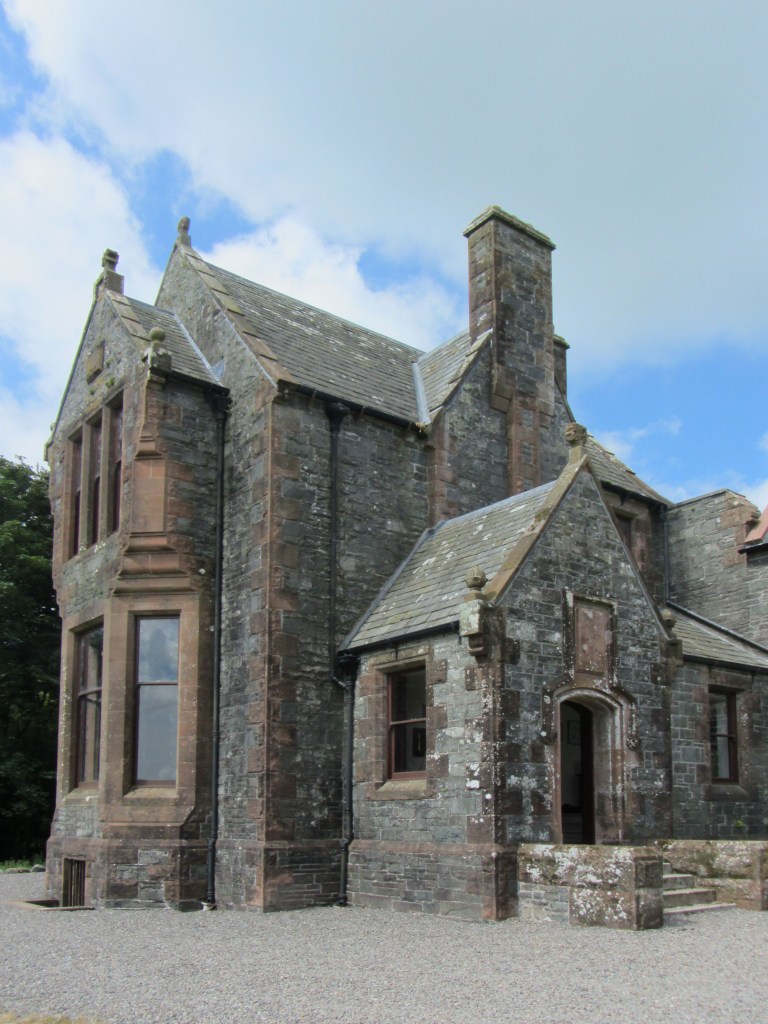
Maxwell built this part of Glenlair House based on a design that had been his father’s. The original house, out of view on the right, was plain and functional because the ever judicious John Clerk Maxwell built it to be functional rather than grand The house was gutted by fire in 1929 but this wing has recently been protected from the elements by the Glenlair Trust and the vestibule has been restored as a small museum.
In this period he also wrote three papers that were directly applicable to civil engineering. They were extensions of an earlier paper, ‘On Reciprocal Figures and Diagrams of Forces’ (Maxwell, 1864b)[78] which had possibly been inspired by the sort of structural calculations that would have been of interest to his cousin, William Dyce Cay. These papers were ‘On Reciprocal Diagrams in Space and their Relation to Airy’s Function of Stress’ (Maxwell, 1866b)[79]; ‘On the Theory of Diagrams of Forces as Applied to Roofs and Bridges’ (Maxwell, 1867a)[80]; and ‘On Reciprocal Figures, Frames, and Diagrams of Forces’ (Maxwell, 1870).[81] The last of these papers, submitted on 17 December 1869, was read before the RSE on 7 February 1870 and subsequently won Maxwell the Society’s Keith Medal for 1871.[82]
On top of this, Maxwell was working on two major books, one of which was his famous Treatise on Electricity and Magnetism in two volumes, (Maxwell, 1873a), Although his Theory of Heat (Maxwell, 1870) is now much less well known, it ran to ten editions by 1891 and was revised by Lord Rayleigh for a fresh edition in 1902.
2.9 Return to the Fray
All the while, the Maxwells made visits to London and James attended the annual meetings of the BA at various places around the country. He would also spend some winter weeks in Cambridge with the Mathematical Tripos. In 1868 he was tempted to apply for principal of St Andrews, but thought better of it, no doubt because it would have involved more administration than scientific work. But it must have been in the back of his mind that he would like to get back into the thick of things, as spending the best part of each year at Glenlair involved a fair degree of isolation, and while it meant that he could do work there aplenty, he was away from the mainstream and had no form of assistance with his paperwork or experiments other than what Katherine could provide.
In the meantime, the Chancellor of Cambridge University, William Cavendish, 7th Duke of Devonshire, had offered funds for a new laboratory there for research into heat, electricity and magnetism. Although this was extremely generous, the Duke had an ulterior motive; Henry Cavendish FRS (1731−1810), the scientist best known for his discovery of hydrogen gas, had been a grandson of the second duke, and the present duke wanted to do something in his memory. Keen to bring this to fruition, in February 1871 the university senate established a chair of experimental physics. But the laboratory was only part of what the duke had in mind; Henry Cavendish had spent nearly fifty years conducting his researches, and while he had kept copious records he had published little of them. The string to be attached to the new chair was that the successful applicant would have to take on the burden of the task that had been left undone. Worthy though that task might have been, for a man at the cutting edge, as Maxwell was, it would be a significant diversion of his talents.
Maxwell’s old friend, now Sir William Thomson, appears to have been the first choice for the new chair, but he would not put his name forward. Thoughts then turned to Maxwell who, at first also reticent, let himself be persuaded, but only on condition he would be able to step down after a year if he so wished (Riddel, 1930, p. 39). Now, the job was a fantastic opportunity: finances were in place; the location was in one of the country’s greatest scientific centres; it was on Maxwell’s home turf, as it were; and there was a brand new laboratory to be designed, built and equipped from first principles. On the negative side was the workload that this would initially involve, on top of which there was the chore of examining and editing Henry Cavendish’s research papers. At least Cavendish had been very highly regarded, and the task would have been worthwhile doing; it could not be turned down out of hand. But as he was no stranger to work, it is unlikely that the workload in itself would have put Maxwell off, and so why did he stipulate from the outset that he should effectively be allowed to try it for a year before committing to stay longer?
There must have been some difficulty in the back of his mind. Certainly, we must think back to the circumstances of him leaving King’s, and with the object of retiring rather than finding a more suitable post. The prospect of doing battle once more with unruly, unwilling students must have been something of a consideration, but he would have doubtless been reassured that he would have only the best students. From another angle, it has been hinted that Katherine was of a somewhat nervy and needy disposition, and recalling Jemima Blackburn’s words:
Her mind afterwards became unsettled … alienated him from his friends and was of a suspicious and jealous nature.
Whether from this or from some other cause, Campbell says that eventually:
The last few years of Maxwell’s life were saddened by the serious and protracted illness of Mrs. Maxwell. (C&G, p. 372)
If Katherine’s health and disposition had indeed been the concern behind his reticence, upon receiving the requisite assurances that he could leave after a year if he wished to, he finally accepted the post and the Maxwells moved to Cambridge.
Maxwell gave his inaugural lecture (Maxwell, 1871) on 25October 1871, and when the year had passed the couple were still at Cambridge and living in a house he had leased at 11 Scroope Terrace.[83] Busy though he was, during this period he found time to publish some novel ideas in ‘Remarks on the Mathematical Classification of Physical Quantities’ (Maxwell, 1871)[84]. The first was dimensional analysis, a simple device that is now a standard for checking physical formulas, and the second was the naming and visual representation of some important mathematical concepts that occur regularly in electromagnetic theory and fluid flow. His diagrams, Figure 2.5, show at once the idea.
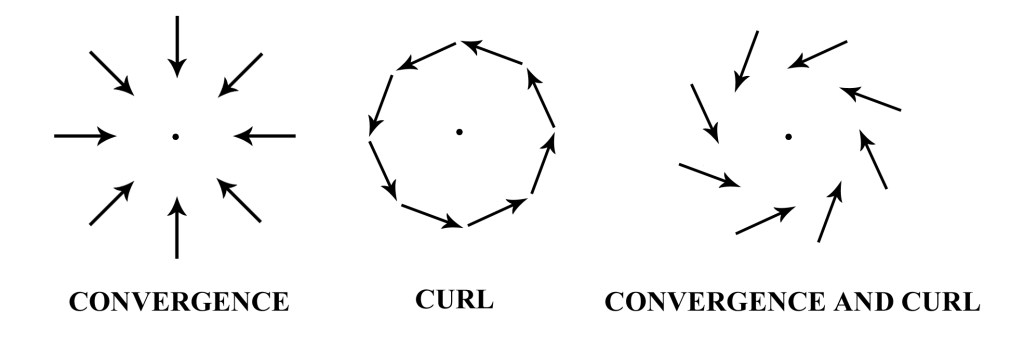
The terms curl and divergence (negative of ‘convergence’) are in regular use today. Maxwell realised that each takes a distinct mathematical form and his diagrams depicting them allude to patterns of fluid flow that we would easily recognise when draining a bath. He instigated these ideas based on Hamilton and Tait’s quaternions when their practical application was still in its formative stages. (WDN2, p. 266)
The laboratory itself was then duly completed and handed over by June 1874. Unfortunately, the money for equipment did not stretch as far as had been hoped and there was a temporary shortage for some time. During this initial period of planning, organising and building, he had also completed Treatise on Electricity and Magnetism, and so from 1874 onwards he was able to return anew to his research. Moreover, he now had some able students to work under him on his experimental work, and by all accounts he was a very patient mentor, unstinting with his time and advice. One such able student was William Garnett who, having graduated in the year before as a fifth wrangler, was appointed by Maxwell as his first Demonstrator in Experimental Physics at the Cavendish. In November 1874, Garnett was elected a Fellow of St. John’s College and he went on to become a close friend of Maxwell’s. It was he who, together with Lewis Campbell, wrote Maxwell’s biography that we refer to so frequently here as ‘C&G’; Campbell wrote his life and Garnett wrote his works.
In this period Maxwell wrote a textbook on mechanics, Matter and Motion (Maxwell, 1876a) and many articles and reviews in various publications including Reports of the British Association, Nature and Encyclopaedia Britannica. Amongst the interesting titles are ‘On the Solution of Electrical Problems by the Transformation of Conjugate Functions’ (Maxwell, 1876b)[85] which pointed out a way of solving a given problem in electrostatics by transforming it to a geometrically related problem for which the solution was already known. This elegant mathematical idea based on ‘conformal mapping’ has since been referred to many of the more advanced textbooks on electricity and magnetism.
While Maxwell also went so far as to write on the protection of buildings from lightning strikes, his note on the subject (Maxwell, 1876c)[86] does not refer to lightning conductor design as much as it does to his opinion that a lighting conductor might only serve to increase the probability of a strike:
It appears to me that these arrangements are calculated rather for the benefit of the surrounding country and for the relief of clouds labouring under an accumulation of electricity, than for the protection of the building on which the conductor is erected.
To which he adds, as a tongue-in-cheek conclusion:
It is hardly necessary to add, that it is not advisable, during a thunderstorm, to stand on the roof of a house so protected, or to stand on the ground outside and lean against the wall.
Nevertheless, a lightning conductor was eventually installed at Glenlair (Plate 2.14) and so we may adduce that it was not installed by installed by him but by his successor.

(By kind permission of Dr James Rautio)
The editing of The Electrical Researches of the Hon. Henry Cavendish from 1771 to 1781 (Cavendish & Maxwell, 1879a) proceeded alongside all else that was going on, and at least the work had an interesting and fruitful side to it. Maxwell was able to uncover important advances made by Cavendish such as his anticipation of Ohm’s law, the measurement of capacitance and inductance, and the exactness of the inverse square law of electric force. The last of these is so fundamental that Maxwell organised a repeat of Cavendish’s experiment. Cavendish had shown that the power of the law could not differ from two by more than 1.7%, but while it may be hard to see the point of redoing the experiment, Maxwell had his reasons and took great pains to make sure that the apparatus for the new measurement would be of the very best quality. The experiment was carried out at the new Cavendish Laboratory in the summer of 1877 by Donald MacAlister, [87] with the result that the power of two in the inverse square was found to be correct to one part in a million! Maxwell may have been relieved to find that the outcome was so conclusive, for an exact inverse square law is highly essential to electromagnetic theory.[88]
In one of his last papers, ‘On Stresses in Rarefied Gases Arising from Inequalities of Temperature’ (Maxwell, 1879b)[89], Maxwell explained one of the key physical mechanisms behind Crooke’s radiometer, a curiosity that was invented in 1873 by the chemist Sir William Crooke.[90] The device in question used to be seen on many a window ledge, spinning in the sunshine seemingly of its own will.[91]
2.10 The End
The ‘Cavendish Papers’, having been published in 1879, saw Maxwell start on a second edition of his Treatise on Electricity and Magnetism; but unhappily it was left to his friend William Thomson to complete. In the spring of 1879 Maxwell realised that he was quite ill; he had been suffering from dyspepsia for about two years and had begun self-medicating with sodium carbonate, but it had now worsened and he had grown very weak. It is characteristic of the man that his first mention of it to his physician, Dr George Paget[92], was made only as an aside in the course of writing to him about Katherine’s health (C&G, p.406)!
The Maxwells returned to Glenlair at the end of term in the hope that rest and fresh air would restore James’ health. From his letters back to Cambridge, no-one would have guessed that this was not having the desired effect, and so when William Garnett came with his new wife to visit the Maxwells that September, he was shocked to see just how his friend’s health had plummeted; he was now so fragile ‘he could not bear the shaking of the carriage’ (C&G, p. 408). Nevertheless, his mind was still alert, his conviviality undiminished, and the Garnetts were treated with Maxwell’s typical generosity and hospitality.
Maxwell’s Edinburgh physician, Professor Sanders, was an old friend, and it was he who broke the news to him that he had stomach cancer, the same disease that had taken his mother’s life at the very same age, and that he had about a month to live. Maxwell took the news with typical resolve and stoicism, and his only concern seems to have been for the Katherine’s well-being:
… unable to nurse him as of old, she seemed more than ever dependent on his care. To the last, he regularly gave the orders that were necessary for her comfort, and endeavoured to see that they were carried out. (C&G, p. 409)
Just as had been the case when his birth was imminent, Glenlair was deemed to be too far away from medical expertise. Dr Lorraine, the local doctor at Castle Douglas, evidently concurred, for already Professor Sanders had been asked to come all the way from Edinburgh to see the patient. But Edinburgh would not do, for Aunt Isabella and Aunt Jane were now gone, and James would not have wanted to be a burden to any of his cousins. In early October it was therefore decided that they would return to Cambridge, where he could be looked after by his regular physician, Dr Paget, and there they would await the inevitable.
Maxwell was attended by Dr Lorraine on the long journey, which he barely managed; his younger cousin Colin Mackenzie, with whom he had played by the shore at Silverknowe on the banks of the Forth nearly forty years before, came to be by his side during his last days. Colin had qualified as a Writer to the Signet and frequently acted as Maxwell’s legal advisor; Colin and he were close, and he may well have been summoned to make sure that the legal formalities to do with the Middlebie entail and provision for Katherine were in order. His parting words to Lewis Campbell during the final days of his illness record his selflessness in the face of adversity:
I have been thinking how very gently I have been always dealt with. I have never had a violent shove in all my life. (C&G p. 421)
When he died on 5 November 1879, his thoughts had once again been for Katherine rather than for himself. His cousin Jemima was to say of him:
He … had the sweetest temper of any man I ever knew. I do not think I ever saw him angry or heard him say a word against anyone. (Fairley, 1988, p. 109).
He was succeeded by his cousin Andrew Wedderburn, who thereby became Wedderburn Maxwell of Middlebie (see §15.8). Although Katherine may have been given the liferent of Glenlair, it was no longer hers and how often she chose to retire there we can only guess at. From the address given in public records after her death,[93] she appears to have stayed on in Cambridge at Scroope Terrace. Maxwell was buried with his mother and father in the family lair within the walls of the old kirk of Parton (Plate 2.15) and Katherine followed him there after her own death on 12 December 1886.

James Clerk Maxwell, his mother Frances Cay, his father John Clerk Maxwell, and his wife Katherine Dewar lie under a simple headstone within the ruined walls of the Old Kirk.
In his early days at school in Edinburgh, when he was awkward and hesitant, being treated as an oddball and labelled as ‘Daftie’ by his school-fellows, Lewis Campbell graciously said that James Clerk Maxwell ‘was a cygnet among geese’. Not only did our cygnet transform into a swan, he had soared even higher than his parents could ever have dreamt of. Yet, like our native swans, he preferred grace and silence to clamour, and never once did he cry ‘look at me!. Maxwell was so far out of the limelight as to be in the shadow of his good friend William Thomson who, through his discoveries and inventions, had succeeded in making himself not only famous but wealthy, on top of which he was also made a peer, and became Lord Kelvin.
But Maxwell was made of different stuff and did not seek such things; he had gone his own way and had done so without any thought of financial reward or public accolade. Although he won several academic prizes and medals, a number of which are listed in Appendix 3, these were the due recognition of his scientific peers rather than the nation. Such recognition came to others, in various walks of life, simply because what they did thrust them into the public eye, for example, Sir Walter Scott and Robert Louis Stevenson, writers of poems and novels; James Young Simpson, pioneer of anaesthesia; David Livingstone, discoverer of Victoria falls. Only in 1931 was James Clerk Maxwell given a plaque in Westminster Abbey, and it was not until November 2008, 129 years after his death, that a statue was erected to his memory in the city of his birthplace, Edinburgh[94] (Plate 2.16).
In Appendix 3 we have attempted to give some idea of the true significance of Maxwell’s scientific legacy. For most of the 150 years and more that have passed since Maxwell gave to the world a substantially complete basis for electromagnetic theory, his name has been known only to the few who have plied their trade in science, engineering or mathematics. Even the majority of those who did know his name knew little more of him than that he had been a nineteenth-century Scottish physicist. More recently, the dawning of the wireless age has increased interest in the man who, as Basil Mahon(2003) put it, ‘changed everything’. The internet has given us ready access to many books and articles about Maxwell and his works, and a simple search for ‘James Clerk Maxwell’ throws up page after page of results. His Wikipedia entry gives immediate access to a considerable body of information about him, and many sites are even dedicated to just him.
However, Maxwell still has a long way to go. The most recently available (2002) BBC poll conducted to find out those regarded as being Britain’s greatest ever people[95] shows that James Clerk Maxwell did make the list, but only at number ninety-three. After stripping the list down to only those people who were scientists or engineers, we are left with just seventeen names,[96] but even so Maxwell is third from the bottom, whereas Faraday is number six. It simply reflects the fact that people in general still know little about Maxwell and what he did, and what is even more depressing is that they do not actually think a great deal about science in general. For example, in the full poll, even Michael Faraday came behind the comedy actor Michael Crawford. On the positive side, many things have been done to commemorate Maxwell, and the most noteworthy of them are to be found in Appendix A17.2 .
Maxwell, as a principled Christian, would have been the first to recognise that due rewards do not always fall to those who most deserve them. The recognition that an individual receives for their achievements is quite a separate thing from the achievements themselves. There are those who will grab for glory, and there are those such as James Clerk Maxwell, for whom glory did not matter. For him, it was enough to do what he did for its own sake, or as he would have put it, for the sake of God. The final words on him must go to his friend Lewis Campbell:
He never sought for fame, but with sacred devotion continued in mature life the labours which had been his spontaneous delight since boyhood. (C&G, p. 431)
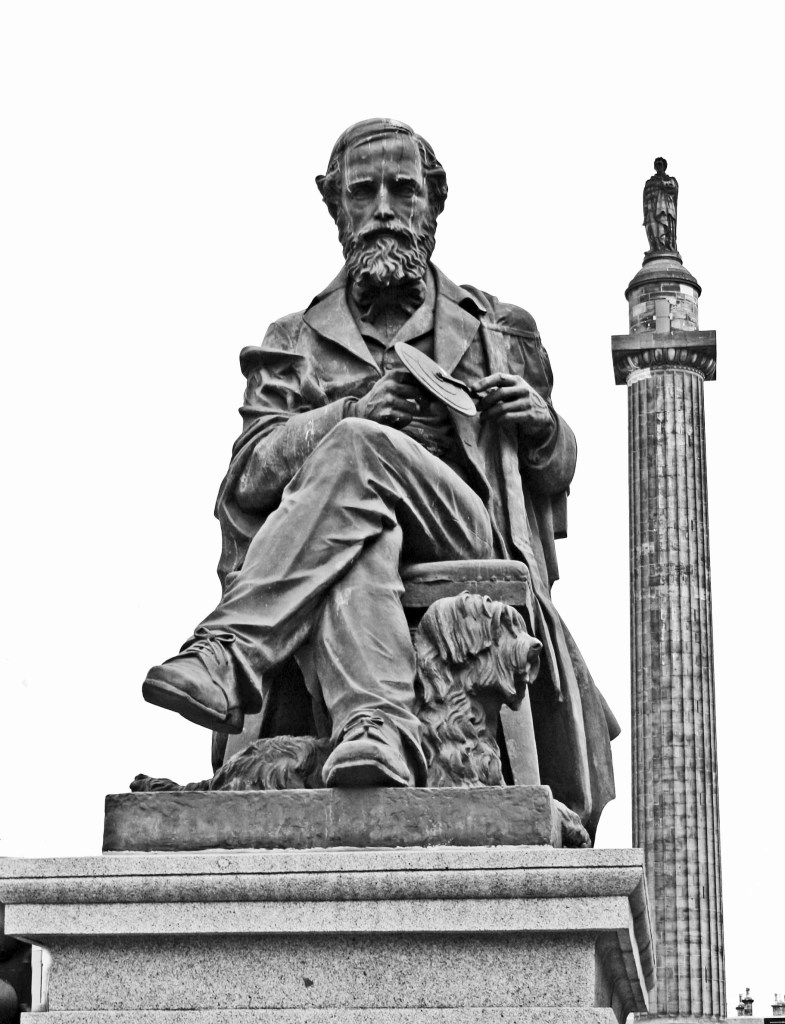
The statue by Stoddart was erected in 2008 through public subscription under the aegis of the RSE. Maxwell is seated with a colour wheel in hand and his faithful companion, Toby, ensconced below. The plinth has two bronze side panels, one depicting the connection between Maxwell and Newton through the science of colour, and the other depicting his connection to Einstein by way of his idea of field theory. Ironically, the column bearing the statue of Viscount Melville towers massively behind it.
From the life and achievements of James Clerk Maxwell we now turn to the lives of his forebears and of some of their better known contemporaries, most of whom hailed from southern Scotland or northern England. A statistically unusual number of them showed the same sort of traits that their remarkable descendant held in abundance. Admittedly, many others showed traits that lay in diametrically opposite directions. All the same, they were not the less noteworthy. As his family name suggests, amongst them were the Clerks and the Maxwells, but who were they? And who were the others whose names did not get passed on? It is only right that we should find the answer, for these were the human ingredients from whom the genius of James Clerk Maxwell was forged.
Notes
[1] ‘R V’ Jones is well known for his World War II efforts as Assistant Director of Intelligence (Science) in which capacity he advised the Prime Minister and his Chiefs of Staff. He told his story in Most Secret War (London, Hamish Hamilton, 1978).
[2] Campbell & Garnett, 1882, hereinafter referred to as C&G. A second edition was published without the scientific papers in 1884. They were then published by W D Niven as two separate volumes (WDN1 and WDN2 herein) in 1890.
[3] CANMORE: ID 212680. At one time, however, he had aspired to being a county sheriff, and had passed some time designing himself a house fit for one (C&G, p. 420).
[4] From John Clerk Maxwell’s diary for 1846 (C&G, p.131), we find an example of just how well James could manage to endure physical pain, and without fear.
Sa., Dec. 12. Jas. still affected by the tooth … got the tooth drawn… and Jas. never winced.
This was in the days before anaesthesia, and it was an eye-tooth at that.
[5] Amongst Andrew Wedderburn Maxwell’s memoranda in DGA: GGD56/4, 1893, is a list of the previous owners of Glenlair (i.e. Glenlair itself plus Upper and Nether Glenlair), which John Clerk Maxwell purchased in 1839 from Sir John Muir Mackenzie to add to Nether Corsock, which in contrast was his by right of the Middlebie entail. He also mentions how John Clerk Maxwell managed to finance the purchase price of £10,530 9s 4d.
[6] Literally a stupid person, but at that time implying someone who behaved abnormally because they lacked mental capacity.
[7] Gulliver’s Travels is now seen as an interesting comic adventure that has thrilled many children, but the original Swift version is an advanced work indeed for a boy of ten to twelve. Samuel Butler’s Hudibras is a civil war epic, see http://www.gutenberg.org/ebooks/4937. Thomas Hobbes was another 17th Century author who published Leviathan, http://www.gutenberg.org/ebooks/3207, a weighty philosophical treatise indeed.
[8] John Clerk Maxwell qualified in December 1811 while John Cay qualified the following March (Grant, 1944).
[9] The lecturer and geologist William Nicol (1770-1851) was the inventor of the Nicol prism, the earliest known device for transmitting only one polarisation of light. He lived at 4 Inverleith Terrace, just a short walk from Edinburgh Academy.
[10] Campbell mentions that class sizes were typically 60 or so. A total of 91 boys registered in James’ class, 70 of whom attended Mr Carmichael’s class during 1842‒43 (Henderson & Grierson, 1914, p. 106‒112).
[11] Campbell describes it as something that would come on under pressure, for example, when asked by the Rector to give his prepared answers in class. To overcome his problem, Maxwell created the idea of breaking the text down into smaller chunks, each of which he would write as entries into a table with the very same layout as the panes of the window in the rector’s classroom. He would commit the text to memory in this form so that when he stood in front of the actual window he could recall all the words, pane by pane, without hesitation.
[12] This medal, with the inscription ‘Edinburgh Academical Club Medal’, was specifically for geometry. The actual ‘Mathematical Medal’ was awarded to Maxwell in 1847.
[13] Maxwell’s parody of Burns’ well-known song ‘Comin’ thro’ the Rye’ not only demonstrates both his poetical skill and sense of fun, but an ability to weave his words about a topic in his mind, in this case Newton’s laws as they apply to the rigid molecules in a gas ‘Flyin’ through the air’:
IN MEMORY OF EDWARD WILSON,
Who repented of what was in his mind to write after section
Rigid Body (sings).
GIN a body meet a body
Flyin' through the air,
Gin a body hit a body,
Will it fly? and where?
Ilka impact has its measure,
Ne'er a ane hae I,
Yet a' the lads they measure me,
Or, at least, they try.               (C&G, p. 630)
[14] The notebook is preserved in the James Clerk Maxwell Foundation’s museum at 14 India Street.
[15] Tait may have gone as far as attempting to make the ‘signature’ look as though it were Maxwell’s own.
[16] This note by Tait has been transcribed by E F Lewis, at https://mathshistory.st-andrews.ac.uk/Tait/Terrot_lecture.pdfCharles Hughes Terrot FRSE (1790-1872) was a mathematician as well as clergyman (as was Kelland).
[17] Tait’s slim manuscript headed ‘Propositions on the Ellipse’ bears no date. The decorative embellishments on the cover page suggests that it dates from his school era, raising the possibility that Kelland was giving him private tuition.
[18] Founded in 1821 by Sir David Breswter under an earlier name, probably the Edinburgh Society of Arts mentioned by Campbell. The new technology of photography was then one of its interests. See http://www.rssa.org.uk/intro.shtml
[19] On Arthur’s Seat, an old volcanic hill that flanks the east side of Edinburgh.
[20] Grant, 1884, pp. 354‒357, vol. 2; Encyclopaedia Britannica, 1911, available at
http://en.wikisource.org/wiki/1911_Encyclop%C3%A6dia_Britannica/Forbes,_James_David
[21] James Forbes was first cousin to James Hay Mackenzie, who had a few years earlier married John Clerk Maxwell’s niece, Isabella Wedderburn (Jemima’s older sister).
[22] Also WDN1, pp. 1‒3
[23] A phenomenon discovered in 1844 by Wilhelm Karl von Haidinger, whereby under suitable circumstances the eye perceives a yellow-tinged bar-shaped area that is perpendicular to the polarisation of the incoming light.
[24] Provided that it is always held aligned with the earth’s magnetic field, a steel blade tends to become magnetised by the action of friction on its surface during the process of sharpening. Alternatively, a steel bar can be magnetised by striking it several times on one end, as recorded by Joseph Henry ( http://commons.princeton.edu/josephhenry/permanent-magnet/ ).
[25] There was indeed one at the south-east corner of his estate. See also Note 24.
[26] 1788‒1856, Scottish academic, Professor of Logic and Metaphysics at Edinburgh University from 1836 [ http://en.wikisource.org/wiki/Hamilton,_William_(1788-1856)_(DNB00) ]
[27] Annealing is the process whereby locked-in stresses within a solid body are relieved by heating it to a significant degree and then letting it cool very slowly. Rapid cooling causes stresses that will remain until they are relieved by either a fracture or by annealing.
The Nicol prism is an optical device that polarise light in the same way that PolaroidTM lenses do. Maxwell’s experiment involved viewing a piece of glass placed between two polarisers, one of which is rotated at 90o to the other so that light is normally blocked from passing through. However, if any parts of the glass are stressed, they will rotate the polarisation of the light a little, allowing it to pass through the crossed polariser. This is an easy experiment to do nowadays with a pair of Polaroid lenses, which an old pair of sunglasses may readily provide. This early work by Maxwell was highly significant because it was eventually taken up by Ernest G. Coker, who won the Royal Society of London’s 1936 Rumford Medal for his investigation of stresses in clear plastic models of engineering structures.
[28] Also WDN1, PP. 4‒29
[29] Also WDN1, pp. 30‒73
[30] At other times Maxwell could be lucid and explain things very clearly when that is what he set out to do.
[31] Born in 1785 near Paisley, John Wilson was Professor of Moral Philosophy at Edinburgh University from 1819 until his death in 1854. He wrote for Blackwood’s Magazine under the pseudonym of Christopher North. There is a statue commemorating him in Princes Street Gardens, Edinburgh.
[32] Charles Mackenzie was one of the voices urging John Clerk Maxwell to send his son to Cambridge. His brother James Hay Mackenzie had married John Clerk Maxwell’s niece, Janet Isabella Wedderburn. He had been a Second Wrangler in the tripos, after which he took religious orders and subsequently became the Archdeacon of Pietermaritzburg and the first missionary bishop for central Africa.
[33] Senior wrangler is first place, 2nd wrangler is 2nd place and so on. See also Forfar (1996). George stokes (1819-1903) was later Lucasian Professor of Mathematics at Cambridge and a close friend of Maxwell’s. Arthur Cayley (1821-1895) became a lawyer and mathematician. His name is remembered in the Cayley-Hamilton theorem. Philip Kelland (q.v.) had been Maxwell’s professor of mathematics at Edinburgh. William Thomson, later Lord Kelvin, was another close friend.
[34] His old school master, Archibald ‘Baldy’ Carmichael, seems to fit, but he could possibly have been referring to David Brewster.
[35] Meaning a cryptic pronouncement such as the oracles gave to enquirers.
[36] William Swan FRSE, FRSSA (1818‒1894) was a lecturer in mathematics and natural philosophy at Edinburgh University and later professor at St Andrews. He showed that a characteristic yellow band in the spectrum of sunlight was due to the presence of sodium in the Sun.
[37] Also WDN1, pp. 80‒114
[38] He did not actually invent the instrument; it had been suggested by William Cumming in 1846 and worked on by Charles Babbage in 1847; the first practical ophthalmoscope was made in 1851 by Hermann von Helmholtz, who became a keen follower of Maxwell’s later work.
[39] Also WDN1, pp. 76‒79
[40] The terms refraction and reflection are quite different. Reflection refers to what ‘bounces off’ a surface, whereas refraction refers to the part that passes through to its other side. While a reflected ray of light bounces off at the same angle, the refracted ray does not pass straight through, it bends.
[41] A similar type of lens was discovered by Luneburg in 1944, and with modern technology it is now practical to make such things.
[42] Also WDN1 pp. 271‒285. Maxwell finished the paper at Aberdeen, on 12 January 1858.
[43] Reproduced in ‘James Clerk Maxwell at Aberdeen 1856‒1860’ (Jones, 1973, pp. 69‒81).
[44] By all appearances, from his niece Jemima Wedderburn’s sketches John Clerk Maxwell was of medium height and overweight. At the age of 54 he weighed very nearly 100kg (C&G, p. 10). He may well have suffered congestive heart disease, for James mentioned that his father suffered from ‘want of circulation’, i.e. heart failure (Hilts, 1975, p. 59). He also had bronchial problems (C&G, p. 202).
He was a favourite uncle of Jemima’s, who was to recall his last visit he paid to her and husband Hugh Blackburn at Glasgow University (Fairley, 1988, p. 107):
He was then in bad health and we had to send for a doctor in the middle of the night. It was a short visit but he feared he had been a trouble to us, which I assured him he had not. We had a very affectionate parting and I never saw him again.
[45] Only two doors down from where John Clerk Maxwell built his town house in 1820. Built by the same builders, there are some differences in outward appearance as number 18 India Street has a first floor balcony to the front and an extra window on the top floor that number 14 lacks.
[46] It was in fact a letter sent to Dr G Wilson, who was writing a book on colour blindness. Wilson published Maxwell’s letter in his book and it also appeared as (Maxwell, 1856).
[47] Also WDN1, pp. 126‒148
[48] See WDN1, p 144. This contrivance was a simplification of an apparatus of Helmholtz reported in the Philosophical Magazine of 1852. Both were based on Newton’s experiment (Newton, 1704) showing not only that white light could be split up into its spectrum by a prism, but the same spectrum could be recombined into white light by converging the diverging colours with a lens and then passing them through a second prism.
[49] This idea completely contradicted the received wisdom of Sir David Brewster which held that yellow, not green, was the third primary colour for light (C&G, pp. 215‒216). He and Maxwell had first crossed swords on the subject at the 1850 meeting of the BA in Edinburgh (C&G, p. 144, footnote). Brewster subsequently gave a paper on the subject at the 1855 meeting of the BA in Glasgow, at which James was present. In the expectation of demonstrating his colour top to Brewster later in the day at a prearranged private gathering, James politely kept silent about Brewster’s error. Brewster may have had wind of James’ planned demonstration that the three primaries for light were red, blue and green, for he did not turn up at the meeting (C&G, p. 203).
[50] WDN1, pp. 445‒450
[51] WDN1, pp. 155‒229. It does not seem to be the case that the paper was held back for some reason as the papers immediately before and after are from a similar period.
[52] Although he was often referred to as Clerk Maxwell of Glenlair, Glenlair was only part of the enlarged Middlebie estate created by his father. It seems that the entail was never changed to make it Glenlair.
[53] Jones (1973) gives the full text in the Appendix, p. 69.
[54] Lodging at 129 Union Street, Aberdeen (C&G, p. 263)
[55] WDN1, pp. 286‒376, contains the full text of Maxwell, (1859) and the later synopsis Maxwell, (1862)
[56] At the same meeting he also read ‘On the Mixture of the Colours of the Spectrum’, published in section 15 of the report. The British Association for the Advancement of Science, usually referred to simply as the British Association, was formed in 1831 and held regular meetings in different cities throughout the UK. The abbreviation was ‘B. Ass.’, which so tickled Maxwell’s sense of humour that he frequently referred to them as the British Asses!
[57] Published in three parts, the first in January and the remaining two in July 1860, (WDN1, pp. 377-409).
[58] A simple but effective animation of the concept is shown on https://en.wikipedia.org/wiki/Kinetic_theory_of_gases
[59] Daniel Dewar was a man of the cloth and a Doctor of Divinity, but his father had been no more than a blind fiddler. On the other hand, his wife, Susan Dewar, was a grand-daughter of George Gordon, Earl of Aberdeen, making her a cousin of the ex-prime minister George Hamilton Gordon (Flood, et al., 2014). Maxwell said that she was ‘a first-rate lady, very quiet and discreet, but has stuff in her to go through anything in the way of endurance’.
[60] DGA: GGD56/Unsorted Box 1, Summons on James Clerk Maxwell by Sir George Clerk, 3/3/1858
[61] Before decimalisation, British currency was based on pounds (£), shillings (s) and pence (d), with twelve pence to the shilling and twenty shillings to the pound.
[62] Also a strict disciplinarian, his students referred to him as ‘the fiend’
[63] The Caledonian Railway between Glasgow and Carlisle opened in 1848. When at James wrote to Lewis Campbell from Glenlair in April 1848: ‘We came here on Wednesday by Caledonian’. The Edinburgh to Glasgow train service began in 1842. Dumfries was not connected to the main line at Lockerbie until 1863.
[64] Maxwell gives 8 Palace Gardens as his address in correspondence, but the house number was later changed to 16.
[65] Charles Henry Fleeming Jenkin (1833‒85), first Professor of Engineering at Edinburgh University, had been in Tait’s class at Edinburgh Academy and therefore knew Maxwell of old. He wrote up the BA eport on the standardisation of the Ohm (Fleeming Jenkin, 1873).
[66] WDN1, pp. 450‒513
[67] Kelvin made numerous references to mechanical models of physical phenomena in his Baltimore lectures. The quotation:
I never satisfy myself until I can make a mechanical model of a thing. If I can make a mechanical model I can understand it. As long as I cannot make a mechanical model all the way through I cannot understand …
appears in Lecture 20 as given in Kelvin’s Baltimore Lectures and Modern Theoretical Physics: Historical and Philosophical Perspectives (Kargon & Achinstein, 1987, p. 206 & 299) which is based on the contemporaneous records of the lectures. However, it does not appear in Kelvin’s own publication, Baltimore Lectures on Molecular Dynamics and the Wave Theory of Light (1904), the reason being that he revised the text because he was not satisfied with lecture 20 as he originally gave it.
The version of the quotation that is generally seen nowadays, e.g. Saxon (2007), takes a different form:
I am never content until I have constructed a mechanical model of the subject I am studying. If I succeed in making one, I understand, otherwise I do not.
[68] WDN1, pp. 526‒597
[69] WDN2, pp. 1‒25
[70] WDN2, pp. 26‒78
[71] See, for example, Earman & Norton (1998).
[72] W D Cay’s notable works were the south breakwater at Aberdeen harbour,1874, and the extension of Lerwick Harbour,1881 (Dictionary of Scottish Architects, 2008a). The bridge still stands (CANMORE: ID 277231). Previously, crossing the river near the house was by way of stepping stones. To bring a carriage in involved taking a long and circuitous route, (Cay, 1887) and (DGA: GGD56/26, Letter, W D Cay to Maj. A Wedderburn Maxwell, 24/6/1898).
[73] The nonsense of the estate being called Middlebie was historical. As explained in §8.15, George Clerk Maxwell of Middlebie was forced to sell off his property at Middlebie (and Dumcreiff) to pay off his debts. He could do so because Middlebie had not been part of the Middlebie entail since 1738. The so called Middlebie estate was finally disentailed in 1922 by Brig. John Wedderburn-Maxwell (NRS: CS46/1922/11/16, 11/1922). However, until then, by the conditions of the entail, ‘Maxwell of Middlebie’ had to be the formal name legally adopted by each successor to the estate. Curiously, however, Maxwell’s entry in Waterston & Shearer (2006) gives him as ‘Maxwell of Glenlair’ but this may well have come from Riddel’s ‘Clerk Maxwell of Glenlair’ (1930), a title referring to Maxwell’s association with Glenlair rather than his formal designation.
[74] For an excellent description see (Cat, 2012). See also CANMORE: ID 212680 and https://www.buildingsatrisk.org.uk/search/ref_no/1038/order/1/ . The plans on the CANMORE website give the date 1868. James Clerk Maxwell told Lewis Campbell:
My father was … always fond of inventing plans for country houses… as early as when he was twelve years old. He wanted to build his house on a scale suited to what he thought he would require… and had so built a small part of it [before] he died. We afterwards completed it, as far as possible according to his idea, but on a much smaller scale. (C&G pp. 420‒21)
[75] Maxwell, 1868a, which was followed by Maxwell, 1869a. The former appears in WDN2, pp. 125-143.
[76] WDN2, pp. 105‒120
[77] He found the differential equations obeyed by governors and showed that that such control mechanisms would be stable only under appropriate conditions. Otherwise they would either veer off in one direction or oscillate uncontrollably. Everyone is familiar with the public sound system amplifier that becomes unstable when the microphone gets too close to a loudspeaker; Maxwell showed us why even before such things existed!
[78] This paper came hot on the heels after WilliamRankine’s presentation of “Principle of the Equilibrium of Polyhedral Frames” in February 1864 (Rankine, 1964). Maxwell’s main interest at that time was in establishing the theory behind the practical technique.
[79] WDN2, XXIII, pp 102-04
[80] Only an abstract appears in the report of the BA meeting.
[81] WDN2, pp. 161-207
[82] The year as engraved on the medal is ‘MDCCCLXXI’ (1871)
[83] A short section of Trumpington Road, where numbers 6‒14 are now the Royal Cambridge Hotel
[84] WDN2, p. 257‒266. Dimensional analysis is also expanded on in his Treatise on Electricity and Magnetism (1873)
[85] Also WDN2, p. 256. Maxwell investigated the same condition in 3D (Maxwell, 1873) and WDN2, pp. 297‒300.
[86] WDN2, pp. 538‒40
[87] Macalister, a fellow of St John’s College Cambridge, later went into medicine and became chancellor of Glasgow University. He was created 1st Baronet of Tarbert.
[88] The inverse square law also applies to gravity and to radiated heat, light and other electromagnetic waves. If Maxwell’s experiment had shown that the inverse power was even slightly different from two, then at least one of Maxwell’s equations would be wrong so that the existence of electromagnetic waves would be in question.
[89] WDN2, pp.681‒712
[90] See for example http://www.oxforddnb.com/view/article/32639 (subscription or UK library card required).
[91] The mechanism has four diamond-shaped vanes that are mounted vertically on the arms of a little cross to make a sort of miniature horizontal windmill that is free to rotate within a sealed glass bulb. Each vane is blackened on one side but shiny on the other, and all they are all mounted with the blackened faces orientated in the same way. Placed in bright sunlight, the vanes will rotate at speed, but the mechanism of its operation has always been significant challenge to explain, for example, it will only operate when most of the air has been evacuated from the glass globe, but it will not work at all in a complete vacuum! In bright sunlight the black sides of the vanes get hotter than the shiny sides, and in so doing they affect the temperature of the gas molecules in their immediate vicinity. Maxwell showed that in a rarefied gas such temperature differences give rise to slight pressure differences that push each vane towards its shiny side, just as observed. While the radiometer appears to be little more than a curiosity, thinking about how it worked allowed Maxwell to his advances in the molecular theory of gases to the test.
[92] He is very likely tohave been Sir George Edward Paget (1809‒92) who was Regius Professor of Physic at Cambridge from 1872. Given that Paget was president of the Cambridge Philosophical Society from 1855–6, Maxwell would have known him from his days as a fellow of Trinity College. Paget’s daughter Rose married J.J. Thomson, who in 1884 became the third Cavendish Professor following Lord Rayleigh and Maxwell. It was his brother, the surgeon Sir James Paget, whose name is associated with Paget’s disease.
[93] Sasines regarding the disposition of 14 India Street by her trustees, 1887
[94] https://clerkmaxwellfoundation.org/html/statue.html
[95] See Appendix A17.2, note 3.
[96] The 17 scientists and engineers appearing in the BBC 2002 poll of the ‘100 greatest ever’ Britons are given as:
2. Isambard Kingdom Brunel, (1806–1859)
4. Charles Darwin (1809–1882)
6. Sir Isaac Newton (1643–1727)
20. Sir Alexander Fleming (1881–1955)
21. Alan Turing (1912–1954)
22. Michael Faraday (1791–1867)
25. Professor Stephen Hawking (1942–2018)
42. Sir Frank Whittle (1907–1996)
44. John Logie Baird (1888–1946)
57. Alexander Graham Bell (1847–1922)
65. George Stephenson (1781–1848)
78. Edward Jenner (1749–1823)
80. Charles Babbage (1791–1871)
84. James Watt (1736–1819)
91. James Clerk Maxwell (1831–1879)
95. Sir Barnes Wallis (1887–1979)
99. Sir Tim Berners-Lee (1955–
 Brilliant Lives