Brilliant Lives
By John W. Arthur
Second edition
Published by the author in 2024
First published in Great Britain in 2016 by
John Donald, an imprint of Birlinn Ltd
Copyright © John W. Arthur 2016, 2024
All rights reserved.
Contents
10.1 Sir James Clerk, 3rd Baronet
10.5 William Clerk (and Sir Walter Scott
10.6 Lieutenant James Clerk RN
10 The Clerks of Eldin and Other Notable Clerks
Thus far we have traced the Clerk line from the first Clerk of Penicuik down to the Baron, Sir John Clerk, 2nd Baronet of Penicuik and his brother William Clerk, whose respective children George and Dorothea began the Clerk Maxwell line. From George and Dorothea, we passed directly on to their sons, Captain John Clerk RN, who succeeded his father as the 5th Baronet of Penicuik, and Captain James Clerk HEICS, who was briefly heir to his mother’s estate of Middlebie. However, we have not yet mentioned George’s elder brother James who, as the 3rd Baronet, was his predecessor at Penicuik. Nor have we mentioned the family of the Barons’ youngest surviving half-brother, John Clerk of Eldin. We now seek to remedy the situation by saying something of the 3rd Baronet and the most notable of the Clerks of Eldin. We also make brief mention of the related Clerks of Rattray, wherein there was a second Baron of the Exchequer, and finally we return to the story of Isabella Clerk, third surviving child of James Clerk HEICS and Janet Irving, for it was she, as Mrs Wedderburn, who took her nephew James Clerk Maxwell into her home at 31 Heriot Row from 1831 to 1847.
10.1 Sir James Clerk, 3rd Baronet
Having remarried in February of 1709 to Janet Inglis, the Baron’s first son by his new wife was born on 2 December of the same year and was named James after Janet’s father, Sir James Inglis of Cramond (BJC, p. 2). He was the Baron’s second son, the first being the child’s half-brother John from the Baron’s first marriage, almost exactly eight years his elder. We learn this, and much of what little we know of James’ childhood, from the Baron’s memoirs. He tells us that just about James’ fourth birthday:
… my third son Hary … was a very strong healfull [sic] Boy as ever I saw in my Life, whereas his elder Brother James was very tender from birth, and continued so till he was 4 or 5 years of Age. (BJC, pp. 85−86)
Sadly, Harry (Henry) died of smallpox, and so it had very much surprised the Baron and his wife that the comparatively weaker James not only survived but was their only child not to catch the full disease, escaping with just some sores and boils. Once again the Baron mentions his son’s frail disposition:
We were in great anxiety about him, because of his weak constitution and bad habit of body… (BJC, p. 86)
Despite his apparent frailty, not only did he survive, his boils and sores were cured when he took smallpox proper just over a year later.
Perhaps one of James’ earliest introductions to the world of antiquities was when, at the age of fourteen, he was allowed to accompany his father and his antiquarian friend, Alexander Gordon,[1] on a trip to see Hadrian’s Wall in the spring of 1724 (BJC, p.117). However, we hear nothing more of him from the Baron until seven years later, when he set out for Holland to follow in his father’s footsteps as a student completing his studies and making the grand tour (BJC, pp. 138−139). Nevertheless, we do know that James had previously been sent to Dalkeith grammar school (note 2 of Chapter 8), for the Baron received a letter concerning James’ future education from William Simpson, schoolmaster there.[2] It must have been a satisfactory institution, for his younger brothers George and John were sent to the same school in due course.
James may then have attended Edinburgh University, but if so, he did as many others did and left without graduating (Laing, 1858). In 1729, he enrolled in St Luke’s Drawing School[3] where he would have made connections with other young artists of his day. Nevertheless, the intention seems to have been that he should become an advocate, for it was with that aim he set out for Holland in April 1731, travelling first with his uncle Robert to London, where he stayed for several months. He then headed for Leiden in the following October; once there, however, he did not find the study of law as much to his taste as his father had hoped. Having stuck it for only one year, his failure to obtain a satisfactory result seems to have occasioned an appeal made on his behalf to the Lords of Council and Session, requesting that he be admitted as an advocate.[4] The attempt must have been in vain because he does not appear in the Scottish Record Society’s publication of those who were admitted (Grant, 1944).
In the years that followed, James travelled about Europe looking for paintings and music to study and to buy, much of which was sent back to Penicuik for his father, including works by Rubens, Rembrandt and Poussin. In January 1736 he was joined in Leiden by his brother George who was belatedly beginning his studies there (Chapter 8), and when George had completed his first year he begged leave of his father to make a tour of Germany with James before he returned in the summer of 1737.[5] But James could not be persuaded to return along with George and stayed on in Europe for another two years, soaking up as much European art and refinement as he could.
It was just as his father had done many years before. The Baron, however, was against it because of the likely expense (BJC, p. 146, marginal notes), for he knew only too well how much debt he had racked up during his own time abroad. He also felt his son, having reached the age of twenty-eight, was letting time slip by. James, on the other hand, was having the time of his life. Nevertheless, in 1738 and 1739 he also found time to study the process used by the Dutch for bleaching linen,[6] which may have been done with the idea of helping George in setting up his linen factory at Dumfries.
In October 1739 he at last returned, much to his parents’ relief and delight, and his father was further pleased to observe that, despite his long sojourn in Europe and the extent to which he had embraced all that he had found there, his head had not been turned against his native land (BJC, p. 154). Within two years, however, James was off again, ostensibly to London. But it seems that he already had a different plan in mind, for once there he wrote home begging leave to go again to Europe, saying he wanted to observe the election of a new emperor at Frankfurt (BJC, p. 163). His father protested, knowing that he could not really do much to prevent James from going, before at last consenting.
James stayed on in Europe, and having spent something close to a third of his life abroad, set off for home only when he caught wind of the impending Jacobite uprising in 1745. James’ first thought on his return was to enlist in the King’s army, and so when he reached London he obtained some letters of recommendation to help get him a commission (BJC, p. 192). The Baron knew well that despite his two eldest sons’ eagerness to fight for King and country, they had not been bred to military life. He had managed to channel George’s enthusiasm towards taking up with a private regiment, the Royal Hunters (Chapter 8), which engaged in supporting roles, such as scouting and acting as guides. But he was more concerned about James, and when at last he met up with him at Durham, where he was taking refuge from the invading Highland army with his wife and eldest daughter (see §4.7), he managed to put him off the idea completely and encouraged him instead to make his way back to Scotland to ‘help the people in our country’. The Baron told George, then at Morpeth, by a letter of 3 November 1745:
… I suppose you have seen James. I wish he wou’d go on to Berwick, for he is not a case to be one of your Hunters (Prevost, 1963, p. 238, my emphasis)
As to what James actually did when he got back to Scotland, we know only that he was present, though not a participant, at the battle of Falkirk Muir on 17 January 1746, when the King’s army was shamefully and unexpectedly routed by the rebels; many of its soldiers fled the field without even engaging the enemy. Although the Baron tells us many details, he merely mentions in a marginal note, which he added sometime later,
N.B. – There were thousands of onlookers who did great harm, for as they came not there to fight, they ran off amongst the first, and came directly to Edin. However, my son James, who was there, continued till our army retired. (BJC, p. 195)
These spectators had gone in expectation of seeing the Jacobites defeated. But, because he makes no mention of James in the main narrative, no mention of any regiment that he was with, nor any other role that he might have been undertaking in any sort of supporting capacity, there is no question that the Baron means that James was with the spectators rather than the army – which was as only as far as his father wished him to go. Unfortunately, Grant states misleadingly in his introduction (BJC, p. xix), ‘but his second son, George, served in the royal army, and James, his eldest son, fought bravely at Falkirk’. If the reference to George here is only mildly inaccurate, the part about James seems quite adrift and is no doubt a misconstrual of the Baron’s note.
The last battle of the rebellion, indeed the last pitched battle to take place in the United Kingdom, took place three months later at Culloden Moor, much to the relief of the Baron and his family. The Baron was now seventy years of age and experiencing further decline not only in his health but also his vitality; he therefore began to think about the day when he would no longer be there to take charge of affairs. In 1748 he had discussions with James about the succession, showing him the family accounts and papers so that he would be adequately prepared when the time came.[7] While the Baron was still far from retired from the management of his affairs and his projects on the estate, by 1750 he had come to the realisation that there were things he could no longer satisfactorily cope with:
… I found my self very ill used by some whom I trusted at Lonhead in the management of my Coal affaires, therefor I put them in the hands of my son James, who had more strength of Body and more leisure to look after them … Besides, as to the choise of my son for chief Manadger, there was a necessity to breed him up a little in the management of these matters. This experiment I found succeeded to my Wishes, for the profits of my coal began to be doubled. (BJC, p. 225)
It therefore seems that James was more than just a lover of the arts and a gentleman of leisure, and that he proved adept at the practical affairs of business. the Baron had built Mavisbank so that he could be close to his coal workings (see §4.8) but the last time that he mentions being there with his family is in December of that year. Although there is no explicit mention of it, it would seem natural that James would now have lived at Mavisbank so that he could be the one on hand to see that things ran smoothly in the mines, which they did. In 1753, the Baron went further, in allowing James to add some rooms onto the west side of his principal residence, Newbiggin, including a library (BJC, p. 228). All the same, he mentions ‘as there was no pressing occasion for these things, the work proceeded slowly’, which is tantamount to saying that, in spite of his agreement and in spite of his son having greatly improved his coal revenues, he did not see any urgent need to spend money on them.
By the age of seventy-eight the Baron was feeling his age. He wrote in his journal:
… I observe a great decay of bodily strength and of my memory, yet I endeavour to keep a good heart and to bear with patience and resignation what I cannot help. (BJC, p. 228)
By then he would have been sure that he had accomplished everything that needed to be done to pass on Penicuik and the Baronetcy to James. He died in the following year, on 4 October 1755, upon which James became the 3rd Baronet of Penicuik:
After about a month as the new Baronet, and no doubt having taken the opportunity to review his new situation and his future options, Sir James decided to go and live in Edinburgh for a while.[8] His father had referred to living in Edinburgh, when it was convenient to do so, at his house there in Blackfriars Wynd (see note 5 of Chapter 4). There is mention of Sir James having also lived there at about this time, or at Sempill’s House off the north side of Castlehill.[9] Unlike his father, he did not have reason to be in Edinburgh because of any office that he had to attend to and so, for a man of his tastes, the reason must have been social, perhaps the opportunity of finding likeminded company, or perhaps even a wife. Had the Baron already sorted out a match for James during his lifetime, he would have been sure to mention something of such import in his memoirs. It therefore appears that even on entering his late forties James had not yet found a life partner. He did eventually marry Elizabeth Cleghorn (d. 1786?), daughter of Rev. John Cleghorn (Anderson, 1878), who until his death in 1744 had been minister at Wemyss in Fife,[10] but no record or other particulars of his marriage has been discovered.
In the years immediately following his father’s death, James attended to family affairs, such as discharging his father’s bequests, providing an annuity for his mother and a bond of provision for his brother John, and helping his brother Adam get a commission in the Navy.[11] At Penicuik he made few changes while his mother was still alive, save for the erection of a monument to Allan Ramsay, a longstanding family friend, who died in January 1758; an obelisk, no doubt to Sir James’ own design, was erected at a high spot near Ravensneuk, on the south-east of the estate in 1759 (BJC p. 229n1; Wilson, 1891, pp. 154−155).
At the end of January 1760, just shortly after his own fiftieth birthday, Sir James’ mother, Janet Inglis, died (Foster, 1884, p. 50). James now felt free to ring the changes at Penicuik (Penicuik House Project, 2014b). He designed for himself a new main residence and stable block[12] and began their construction with the aid of the builder John Baxter snr, the stonemason who had constructed Mavisbank for the Baron. At first Sir James’ intention was to remodel Newbiggin, the old family house, but he soon gave up the idea and tore it down, perhaps to the regret of his brothers and sisters; they simply had to accept that the prerogative was his alone. Sir James’ cousin, Colonel Robert Clerk,[13] offered his opinion on Sir James’ design, and drew up some notes criticising it and proposing alterations (Thom, 2014, p. 121; Penicuik House Project, 2014a). Not only did he do that, he also sent a copy to the architect Robert Adam, son of William Adam who had worked with the Baron, and was now also Sir James’ brother-in-law.[14] Robert Adam apparently agreed with the Colonel, but Sir James had been assiduous in developing his aesthetic acumen and would not have his ideas and desires dismissed as being idiosyncratic. He would again have his own way.
John Baxter snr turned Sir James’ original drawings for the house into detailed plans, and in 1762 work began in earnest, using 200,000 bricks ordered for the project[15] and materials recycled from the now demolished Newbiggin. To help finance the project, in July 1763 Mavisbank was sold to a cousin, another Robert Clerk.[16] Meanwhile, Sir James was helping to support John Baxter jnr (Skempton, 2002), the builder’s son, and Alexander Runciman (1736−1785), then a fledgling artist, who were both studying in Italy. While John Baxter jnr was in Rome, Sir James wrote asking him to commission copies of three statues suitable for Penicuik. Baxter sent him sketches of four to choose from: the Medici Apollo, the Borghese Faun, the Apollo Belvedere and the Campidoglio (or Capitoline) Antinous.[17]
According to Jackson (1833, pp. 341−342), Runciman had been one of the ‘apprentice painter-boys’ working on the new house who had executed the paintings under the colonnade at Penicuik House, so much to Sir James Clerk’s satisfaction, that he sent him to Rome, at his own expense, to complete his professional studies.
Sir James’ patronage of Runciman is confirmed in letters, including those he received from Runciman himself when in Rome, concerning the direction of his studies;[18] after informing his patron that he had finished a particular picture, in one such letter Runciman asked for an advance so that he could do even more. However, he did make clear that he was not seeking ‘pecuniary advantage’ and, on the contrary, ‘my ambition is to be a great painter rather than a rich one’.[19]
When Runciman returned from Rome in 1772, Sir James commissioned him to decorate the interior of the house, which had been structurally completed by 1769. His initial idea was to have him paint the ceiling panels of the main drawing room with themes from the Baths of Titus, but he changed his mind to have it done in themes inspired by The Works of Ossian, a ‘translation’ of ancient Gaelic mythology[20] that had been fabricated by the Scottish poet James McPherson (1736−1796) and published during 1761−65. Although the authenticity of the work was challenged, the ‘discovery’ of an ancient Gaelic mythology caused a sensation amongst the devotees of classical romantic tales and epic poetry, and it is clear that Sir James had been one of them. His great drawing room thence became known as ‘Ossian’s Hall’.
While work was progressing on the house, it was also progressing on the stable block, which is notable for the full-size replica of Arthur’s O’on[21] that was erected as a dovecot forming the centrepiece of its rear elevation. James’ father, the Baron, had much admired the original, an almost intact Roman temple, and declared, ‘I wish I could have redeemed it at the expence of 1000 guineas’ (BJC, p. xxvi). While the replica, built as per the drawings of the monument recorded by Gordon (1726), was Sir James’ touching memorial to his late father, from an architectural standpoint it looks at odds with the tall spire that dominates the front elevation of the building. He was clearly more taken with the notion of recreating the O’on than sticking to classically proportioned shapes based on straight lines and circles.
In all, it seems that Sir James had the financial wherewithal to complete his grand design and to decorate and furnish it in equally grand style within more or less ten years. During the time of its building, Sir James also got involved with John Baxter snr in submitting designs for Edinburgh’s North Bridge, which provided the first convenient link from the Old Town to the New by spanning the chasm across the head of the Nor’ Loch between the High Street and the site of the new Register House.[22] He even sent to John Baxter jnr, who was then studying in Rome, a request for a bridge design in the style of a Roman viaduct. It was, however, William Mylne (Skempton, 2002) who won the contract to build the bridge to a design of James Craig, architect of the New Town. There was much ado in 1769 when part of this bridge collapsed during its construction and killed five people; the bridge was too narrow for modern use, and was consequently demolished in 1896 to make way for the present one.
After Penicuik House and its stable block, Sir James turned his attention to the village of Penicuik itself, which was then very small, and created a new design around a spacious elongated ‘square’, at the far east corner of which was to be a new kirk:
… about the year 1770, Sir James Clerk … planned and laid out a portion of the village as it now stands, giving at the same time pecuniary assistance towards the erection of not a few of the buildings. He also induced a doctor to settle in it, building him a house to dwell in, and providing a large park to graze his horse in the summer. (Wilson, 1891, p. 10)
After giving the schoolmaster notice to quit his property to make way for the development, the foundation of the new St Mungo’s was laid in August 1770.[23] The ruins of the simple rubble-built old kirk still stand in the kirkyard a little to the east, midway between the Clerk family mausoleum and the new kirk. The old and new represent a complete contrast in ideas of what a church should be; small though the new church is, its design is fit for a much grander purpose. Sir James clearly could not resist the classical Graeco-Roman design with portico (St Mungo’s, 2013), just the thing that Robert Adam and Colonel Robert Clerk had criticised in the design of Penicuik House, and which Sir James had so staunchly defended (Penicuik House Project, 2014a).
In 1772, Sir James Colquhoun of Luss, Bt (Collins, 1806) commenced the building of a house at Rossdhu for his new family seat on the west shore of Loch Lomond.[24] He had asked Sir James’ advice on the design, which has some features similar to those of Penicuik House, including the raised portico. Indeed, James is attributed as being the architect, with John Baxter jnr as the builder.[25] Elsewhere it is suggested that there were inputs from Robert Adam (The Gazetteer for Scotland, 2013b. ‘Rossdhu’), but if so, either they did not concern the portico or Adam had now deferred to Sir James on the subject!
If the 3rd Baronet spent lavishly to satisfy his own aesthetic aspirations, he was, like his father, a philanthropist who assisted his protégés, tenants and employees. Not only had he given money for the rebuilding of Penicuik and its church, he acted with all due care by providing financial assistance for rehousing those that were displaced. In particular, his treatment of the old schoolmaster was compassionate, for he gave him a present of a new house and yard (Wilson, 1891, p. 57). Having inherited his father’s coal mines, he did not do as many a laird would have done and simply reaped the financial benefits, he became involved in trying to help his miners, who as a class were then treated as little more than indentured slaves. He interceded when they got into trouble and, in 1772, he even went so far as to write to the Committee of Coal Masters in favour of the abolition of the iniquitous practice of bonding miners to their employment.[26]
Fine tastes in art and architecture and long sojourns abroad apparently did not spoil Sir James’ love of Scottish ways and simple fare. Jackson (1833, p. 342) recounts an anecdote in which Sir James was visited at the newly finished Penicuik House by Henry Dundas, later Viscount Melville, whose statue now stands atop the lofty column in St Andrew Square, Edinburgh. Dundas was seeking Sir James’ vote in the forthcoming parliamentary election, but as Sir James did not know the man well he decided to put him to the test by serving up nothing more than porridge for dinner. Dundas was unabashed by his frugal repast, and thereby gained Sir James’ vote by demonstrating that he was a man who appreciated ordinary Scottish values; of course, the anecdote is meant to reflect that the same quality applied equally well to Sir James.
In 1781, the Society of Antiquaries of Scotland, which had been formed just the year before, made Sir James a fellow.[27] Clearly he had been forgiven for demolishing Newbiggin, perhaps on account of his recreation of Arthur’s O’on?
As we have already seen, Sir James’ younger brother George Clerk Maxwell was involved in lead mining at Craigton on the Solway coast. While James took no active part in George’s mining company, he did take on a financial interest. George no doubt persuaded him that in time he would get a good return for his money and so they borrowed jointly from the Bank of Scotland to finance George in his enterprises (see §8.13). Between Sir James spending a great deal of money on his building projects and lavish furnishings for his house, and George investing in such things as the Forth and Clyde Canal, prospecting, and the eventual lead mine at Craigton, they both had racked up a fair amount of debt between them. As we already know, by 1781 things had gone badly wrong with George’s mining ventures, and the debts were substantial. In 1782, when Sir James was seventy-two years of age and probably quite ill, the two men agreed that in the interests of paying the external creditors, the debts between them would have to be put to one side and Dumcrieff and Middlebie would have to go. Did Sir James have some inkling that, even if this was a hard cross for George to bear, it would not be long before his brother would inherit Penicuik? George’s own health was also deteriorating, and so they may have appreciated that it would all sort itself out soon enough, and the key thing was to preserve Penicuik for the heirs. In the meantime, George would still be left with the other properties that came under the Middlebie entail, at Dumfries and Nether Corsock, in right of his wife Dorothea.
The possibility that George would soon enough come into the baronetcy of Penicuik came to pass within a twelvemonth:
Sir James Clerk Baronet of Penicuik died at Leith whether he had gone for the recovery of his health upon the 6th day of February 1783 at 4 o’clock in the morning and was interred in the burying ground belonging to the family in the church yard of Pennycuik on 10th day of the said month.[28]
George then became the 4th Baronet of Penicuik, as Sir George Clerk, notwithstanding the condition in the Middlebie entail that required him, as Dorothea’s husband, to hold to the name Maxwell. The validity of his juggling with the names of Clerk and Clerk Maxwell had in any case never come to any legal test. Sir James’ widow, Elizabeth Cleghorn, lived thereafter in Edinburgh at Dickson’s Close until her death, apparently in March 1786. She appears as the Dowager Lady Clerk in only one edition of the Edinburgh directory (1784−86), which is consistent both with the time of her husband’s death and the date believed to be of her own.
10.2 Mathew Clerk
Mathew Clerk was the fith son of Baron Sir John Clerk and his second wife, Janet Inglis (see §4.6). The Baron tells us not a great deal about him, except from informing us:
In Aprile and May 1746 my son Mathew fell ill of a Feaver at Dalkieth… (BJC, p204)
and so we may surmise Dalkeith is where he was sent to school. The marginal note adds:
This boy is a fine schollar, and of great application to learning and business of all kinds.
After his schooling he studied mathematics[29] in the hope of training as an officer in the army, and the indications are that in 1751 he went to Woolwich Military College,[30] during which time his father was making enquiries getting him a commission[31] By the spring of 1757 the Seven Years War was well under way and Mathew, now a junior officer, was making preparations to go with his regiment to fight in America[32] but by the end of the year he was writing home from New York to say things were not going so well ‘we have been extremely unlucky in our expedition’[33] Only days thereafter he received his commission as a sub-engineer with the rank of Lieutenant,[34] and by April he is hopeful again, writing to his mother ‘by the time you receive this we must have struck some blow in America’.[35] In July came the battle of Fort Carillion at the Siege of Ticonderoga (McCulloch, 2008; Nester, 2008) and in the days before the battle Mathew was involved in surveying and reporting on the French defences. It seems that, owing to his inexperience, he did not appreciate that the French had disguised them so that the area looked only lightly defended, whereas in reality the very contrary was true. The battle took place on 8July, and Mathew was one of the many British soldiers that lost their lives in the ensuing defeat.[36]
Having perished soon after the battle and so being denied the opportunity of giving his own account, Mathew Clerk was made a scapegoat for the failure of the attack by his superior officer, Captain Abercromby, who maintained that Clerk had grossly underestimated the French defences. Captain Abercromby, on the other hand, had been rash in his own decision making and had not taken due heed of Clerk’s lack of experience.[37] Typically, Abercromby went on to become a general. A great deal of research has been done on who was more to blame; see for example Nester (2008) and Kingsley & Alexander (2008), while McCulloch (2008) gives a strong rebuttal of Kingsley & Alexander.
10.3 John Clerk of Eldin
John Clerk of Eldin (1728-1812) [38] was the second youngest son of Sir John Clerk, the Baron, and the younger brother of James and George, who were respectively the 3rd and 4th Baronets of Penicuik. But the appendage ‘of Eldin’ did not come to this John Clerk by inheritance, it came as a result of a small estate he purchased largely by the fruits of his own labour. Now part of a housing estate in Bonnyrigg Midlothian, it was near Lasswade, on the River North Esk more or less equidistant from Edinburgh and Penicuik. He was connected to the Adam family by his marriage to Susannah, sister of the architects John and Robert Adam. As previously noted, their father, William Adam, had been architect to the Baron for the building of Mavisbank. John and Susannah’s eldest son, also named John, was to become famed as one of the most notable advocates of his time, a ferocious cross examiner and scathing wit who later sat on the bench as Lord Eldin, Another son William, a lawyer and Clerk of the Jury Court, was a particularly close friend of Sir Walter Scott. He was also renowned for his wit and barbed tongue but, in contrast to his brother, he preferred to lead the life of a gentleman, frequently attending dinners that he would seek to enliven with clever remarks (Grant, pp. 70-90, 170). There was also a third son, James, who joined the navy and we will hear more of these brothers in the ensuing sections of this chapter.
In the latter half of the eighteenth century, there were three Clerks who were sailors, this James Clerk and his two cousins John and James Clerk, both sons of George Clerk Maxwell (see §10.6). We therefore have to be careful to distinguish not only between these three gentlemen, but between his father, John Clerk of Eldin and his brother John Clerk, Lord Eldin.
▪ . ▪ . ▪ . ▪ . ▪ . ▪ . ▪ . ▪ . ▪
The fifth surviving son of the Baron and Janet Inglis was born on 10 December 1728 and named John in memory of the Baron’s first son of that name, his only child by his first wife Lady Margaret Stewart, who had died in 1722. Like his older brothers James and George, John was sent to the grammar school at Dalkeith (see §8.2), going thereafter to Edinburgh University where, it is said, he attended the anatomy classes of Prof Alexander Munro along with James Hutton (Bertram, 2012b). The Baron apparently thought his son had the makings of surgeon but, whereas Hutton later qualified as a doctor, John Clerk did not stay the course. Like his older brother George he had a bent for practical things, while like James he had a talent for art and, in particular, drawing. Having befriended Robert Adam and Paul Sandby,[39] as young men the three would often spend time together drawing local lanscapes. The friendship with Adam led to him marrying Adam’s youngest sister, Susannah, in 1753, while the friendship with Sandby led to him taking an interest in etching, which he was to take up as a gifted amateur
As a fifth son, however, the young John Clerk was too far down the pecking order to get a really substantial hand-out from his father to set him up in life. He had a privileged upbringing and had been given a decent education, but in the main he had to find his own way in the world. But perhaps it was also the case that the Baron had also realised that he had made a mistake with George in making things too easy for him, for example, by sorting out the affairs of Middlebie and giving him Dumcrieff outright for George was now heading back to Edinburgh having experienced his first financial failure, the linen factory at Dumfries.
It was John’s lot to be a merchant, and no doubt the Baron went so far as to use his connexions and an advance of money to set up his son in business. To trade as a merchant in Edinburgh or other recognised burgh, it was necessary to have a burgess ticket. The usual way of achieving this would be to serve an apprenticeship following which, if one worked hard enough and could demonstrate the wherewithal to set up on one’s own, admission as a burgess and guild brother could be obtained. For example, this was the route, whereby Allan Ramsay senior had been able to set up as a wigmaker (see §5.1). John Clerk, however, seems not to have undertaken such an apprenticeship, for there is no mention of him in Boog Watson (1929), and he was only 22 when he gained his burgess ticket in July 1751. While he was entitled to do so in right of his father, the fact that the Baron had taken out his burgess ticket just the week before is clear evidence of a helping hand.[40] He was set up in a partnership with Alexander Scott trading in the Luckenbooths,[41] a set of shops in a long block of tenements that since 1440 had occupied the centre of Edinburgh’s High Street close by the then north wall of St Giles Kirk (Figure 10.1). Scott and Clerk seem to have been in the business of selling cloth and clothing at the Luckenbooths[42]
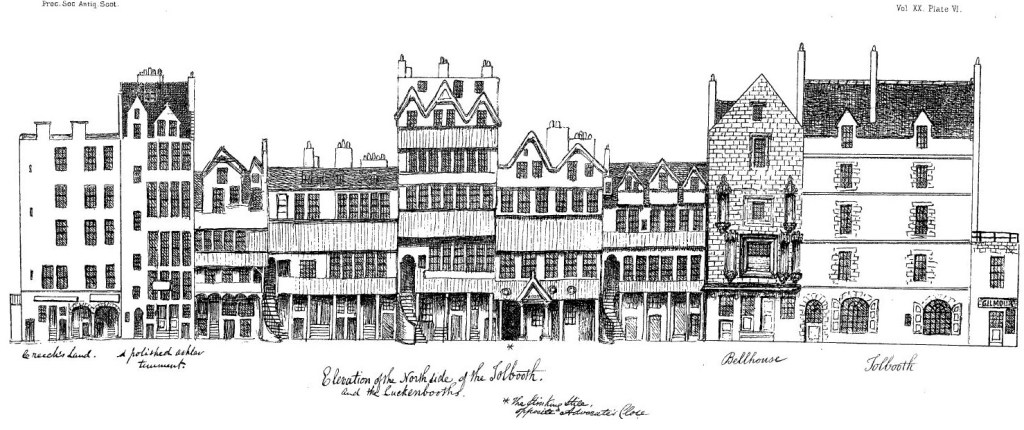
* marks the entry called ‘The Stinking Style’ which leads through to St Giles Kirk and directly faces Advocates Close on the north side of the street.
Based on plates V and VII by John Syme as they appear in Miller (1855‒56)
Bertram also tells us that Clerk continued there until 1762, but afterwards he traded further afield, being at Campbeltown during 1769 and Aberdeen during 1771. However, the Clerks seemed almost to collect burgess tickets,[43] most likely because they conferred on them rights which could usefully be exploited in ways other than just trading in the towns concerned. For example:
Mr Clerk was returned as a Ruling Elder for the borough of Inverurie in the Presbytery of Garioch, from the years 1763 to 1784. From the first date till 1772 he is designated ‘Mr John Clerk, Merchant in Edinburgh; (Clerk of Eldin & Laing, 1855)
Therefore, despite these other burgess tickets John Clerk was still trading with Edinburgh as his principal base. Campbeltown and Montrose, for example, were both places of commercial importance. Campbeltown had access to much coal which by the middle of the eighteenth century was being used as fuel for the distillation whisky and for the evaporation of sea water to make salt, while Montrose was a wealthy trading port bringing in timber and flax from the Baltic, and salt wines and fruit from France and Portugal.[44] Given that the burgess and guild system operated on the basis of trade restrictions which determined who could deal in what commodities or ply certain trades, it can be seen why these burgess tickets could have been an advantage. Moreover, John Clerk’s elder brother, George Clerk Maxwell, was in an excellent position to get to know just where the best commercial opportunities in Scotland were, for not only was he by this time a Trustee for the Board of Manufactures and a Commissioner for the Forfeited Estates, he was also a Commissioner for Customs (see Chapter 8). It would have been surprising if George had not thought to mention any business opportunities that he felt would benefit his brothers.
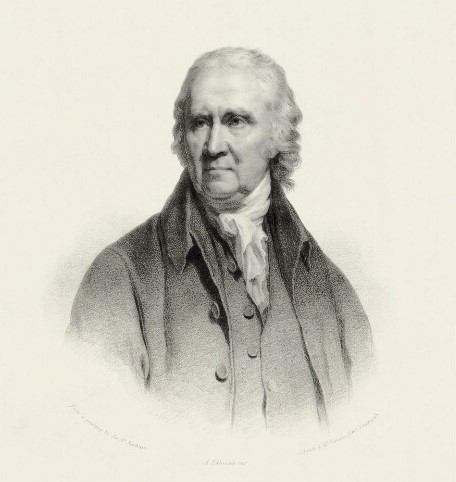
Lithograph, published 1855.
© National Portrait Gallery, London. Reference Collection NPG D33429
▪ . ▪ . ▪ . ▪ . ▪ . ▪ . ▪ . ▪ . ▪
Whatever John Clerk’s involvement was with other towns in Scotland, it must have contributed to his success, for in 1762 he and Alexander Scott purchased a half share each in a coalfield at Pendreich,[45] on the opposite bank of the river North Esk from the Loanhead mine belonging to his brother Sir James. Nevertheless, this was merely another string to his bow and he did not give up his business in the Luckenbooths till 1772. Having done so, in the year following he bought a nearby estate which he called Eldin (Clerk of Eldin & Laing, 1855).[46] Although it was not an estate on any grand scale, it did allow him the dignity of being referred to as John Clerk of Eldin, Esq. and it would seem that he had been able to buy Eldin from the fruit of his labours rather than out of any gift, inheritance or windfall. Having purchased his estate, however, his principal residence was still Edinburgh. In the 1774‒5 Edinburgh Directory, his house is listed as being at ‘the back of the theatre’, that is to say, behind the Theatre Royal just off the north east corner of the North Bridge. In the late 1760’s, tenements had been built there so as to enclose a square with the theatre, opened in 1769, along its northern edge. John Clerk was still there in the year following when this little enclave was given the name of ‘Shakespeare Square’. Unfortunately, the next available directory is for 1784, in which year he had moved about a half mile westward to Hanover Street. Shakespeare Square disappeared with the Theatre Royal in the 1860’s to make way for new buildings, the centrepiece of which was the General Post Office, the grand facade of which still stands.[47]
Successful as he was as a merchant, he was perhaps inclined too much to trust his managers at the mine, as a result of which fell into a situation similar to the one that had befallen his father in 1750 (BJC, p. 225). Being cheated out of nearly half his expected profit, he eventually decided to ‘act as his own coal grieve’, i.e., manager.[48] Like his brother George and their mutual friend Dr James Hutton, he too had invested in the Forth and Clyde Canal, and now, rather than paying out, it was consuming money by way of additional cash calls (see §8.10). But he had also made a much wiser decision to invest in the Carron Iron Works[49] which paid out quite well on at least one occasion (Bertram, 2012, p.26) and thrived as a business until the late 20th C. Nevertheless, how did he get involved in such an enterprise? Interestingly, he was involved along with his brother-in-law John Adam, the architect, who had become a director of the company in 1763.[50] John and Robert Adam designed firebacks and balustrades for the ironworks to manufacture and sell,[51] some examples of which are now in the collections of the V&A Museum.[52]Their father, William Adam, who had been the Baron’s architect for Mavisbank, had become wealthy by developing diverse business interests including mining, salt panning and quarrying; it then fell to his eldest son John to carry these on. Shrewdly, John also added to them, specifically he invested in the ironworks, in which he saw the potential benefit of casting as a means of mass producing architectural structures and ironmongery. It was as they say nowadays, a ‘win-win situation’ for both him and the ironworks, and effectively one of the greatest steps forward in manufacturing by taking it into the era of mass production.
▪ . ▪ . ▪ . ▪ . ▪ . ▪ . ▪ . ▪ . ▪
In addition to the Pendreich mine, Carron Iron Works and the Forth and Clyde Canal, it is likely that in the 1770’s John Clerk, like his brother James, got involved in their brother George’s mining activities (see 8.12 and 8.13). Certainly, he visited Wanlockhead in 1775, for he did a pen and wash drawing there of the mines in operation (Plate 8.3) While he accompanied his friend Dr James Hutton on many tours, researching the mineral deposits and gathering geological evidence, George had done the same thing in 1764 (see §8.14). Occasionally, Hutton visited the mineral prospecting areas in the southwest of Scotland and had offered advice on what possibilities certain places might have to offer. It is therefore credible that John Clerk was fully conversant with the situation and, no doubt being assured by George of the certainty of an eventual profit, he would have either invested in the Craigtown Mining Company or at least lent him some of the money that he needed to get the mine going. But as we have seen, that story did not have a happy ending, for the mine consumed much more cash than it paid back leaving George and his co-investors on the brink of ruin. James forwent the debts George owed him and John may have been left in a similar position, for we find him in 1781, when the problems with the mine were emerging, trying to find a position as Comptroller of Customs at Leith, only to be rebutted by his former friend, Henry Dundas, then Lord Advocate and later Lord Melville:[53]
I perfectly recollect the conversation I had with you respecting the Comptrollership…. Lord North is under engagement… which will not leave it in my power to promote your wishes upon this occasion.
Dundas was a man of political import and major landowner in the neighbourhood of Lasswade, and John Clerk had purchased the parkland for his estate of Eldin from him some years before.[54] In the following year, having swallowed his pride, he tried again, this time for the position of Secretary to the Commissioners for the Annexed Estates,[55] of which George was already a Commissioner. Even so, he was once again unsuccessful, and as a result of Dundas’ apparent offhandedness he vowed he would not further demean himself by going to him again.[56] Nevertheless, he did obtain the position in the following year (Smith, 1975, p. 14) when he had instead the assistance of a Baron of the Exchequer, Sir John Dalrymple, who was also successful in getting appointed as a Commissioner (Smith, 1975, p. 395). Interestingly and somewhat ironically, although Henry Dundas was also appointed as a Commissioner, he did not oppose Clerk’s application for the Secretaryship. In September 1783, Clerk received a letter from Sir John advising him to:[57]
…be so good as not to mention to any one what passed between you and me about the annexed estates.
By that time, the position was likely to have been clear that the Secretaryship was Clerk’s. But Dalrymple could well have been warning him, in the light of Dundas’ appointment, of what was in store, the irony being that Dundas was on a mission to put a bill before Parliament to wind up the Annexed Estates and to reinstate them to the heirs of the former owners. Indeed, Dundas’ Act was given the royal assent in the following August and the Commission was disbanded at Martinmas (November) 1784. It could hardly have left poor John Clerk with any better opinion of Dundas than he already had. A man not to be crossed, Henry Dundas became one of the most prominent British politicians of his day, for which he was created Viscount Melville[58] and gained the soubriquet ‘King Henry IX’.
If John Clerk’s engagement with the Commissioners for the Annexed Estates had been bitter-sweet inasmuch as it was already being wound up, it was not the only bitter pill at that time. His appointment came just months after the death of his brother James, and when George succeeded James as Baronet, he was already ill and lasted just less than a year. Their widowed sister, Janet, also died on 24 January 1784, just five days before George. However, Sir James at least had left him a bond of provision for £2000, and his widowed sister left him everything in her will.[59] It seems to have been a case of bad timing rather than bad taste when John Clerk took out the lease of a new house on Hanover Street on 26January 1784 in the days between these two family deaths, but nevertheless the legacies he received would have helped his finances and meant that he need worry less about his short-lived appointment.
▪ . ▪ . ▪ . ▪ . ▪ . ▪ . ▪ . ▪ . ▪
Drawing seems to have long been a natural ability running in the Clerk family, and John Clerk of Eldin was no exception. We must suppose he developed his expertise with the pencil in his school years, as it is a frequent indoor pastime of youngsters when they have the opportunity of quiet play, but the first to be seen of a serious attempt is a view of St Andrews (Clerk of Eldin & Laing, 1855) that he executed in 1758. Clerk travelled far and wide throughout Britain in the holiday season taking in the sights and sketching them wherever he went. Over the years his travels encompassed such diverse places as the Scottish Highlands, Wales, Arran and Bute,[60] and as far west as the south coast of Cornwall in England, where he drew Smeaton’s new lighthouse on the Eddystone Rocks. With no cameras available for recording the highpoints of such trips, someone who had the facility of drawing scenery made an excellent companion. Many of his excursions were undertaken in the company of his friend James Hutton, with mineralogy and geology in mind, and Clerk’s pencil was just as adept, not only in recording formations of particular interest, but in creating sections of what lay underneath based on Hutton’s interpretation of the evidence they had seen on the surface. In earlier days, Hutton had accompanied George Clerk Maxwell on trips to the north of Scotland on his tours of duty as a Trustee for the Board of Manufactures and Commissioner for the Annexed Estates. On such occasions it had been George’s turn to contribute to Hutton’s geological records, but it is more likely that George would have made the sort of sketches appropriate to a scientific record. His younger brother, on the other hand, produced what were not only scientific records but also works of art. While his surviving drawings provide a clear insight into Hutton’s work,[61] they are also a testament to John Clerk’s own contribution as his assistant and draftsman.
In 1774, however, Clerk turned his artistic inclination towards etching,[62] the object of which is ostensibly to be able to reproduce an original drawing as many times as desired, but which also affords the possibility of creating certain unique effects that depend on the particular etching process employed. The reason he gives for taking up this fairly laborious pursuit is that some friends, Paul Sandby amongst them, had persuaded him to try it (Bertram, 2012a, p. 41). Although he did sell some of the prints he made, it does not seem that his main objective was commercial gain, rather he mainly wanted see what he could achieve. The technique suited him because his eyesight was more compatible with working close up rather than at arm’s length, which is the reason he gave for not attempting drawing or painting landscapes (Bertram, 2012a, p. 47). Another factor very much in its favour was that he would have had, by this time, a fairly large collection of drawings from which he could choose scenes as subjects to work on. Furthermore, he had always liked working with his hands, of which drawing was just one particular manifestation (Clerk and Laing, 1855).
Having struggled at first to master the technique, he at last began to succeed and before long he was experimenting with a variety of effects, eventually including aquatint[63] when he was just about at the end of his active period. Over a period of about seven years, he produced over 100 etchings,[64] a comprehensive account of which has been given by Bertram in his 2012 book The Etchings of John Clerk of Eldin, which we have frequently referred to above. From Kilchurn Castle and Castle Stalker in the northwest of Scotland, to Salisbury in the far south of England, Pembroke in southwest Wales, Newark in the East Midlands, Arran, Fife, Ayrshire, Dumfries, Durham, Glasgow, as well as closer to home, we can see therein fruits of his labours.
Like his brother George, John Clerk, was one of the original fellows of the Society of Scottish Antiquaries, through which he came into contact with David Steuart Erskine, the Earl of Buchan, an antiquarian who had been the prime mover in setting up the Society. Buchan suggested that a set of Clerk’s etchings should be presented to king George III, which he took upon himself, as a courtier who had access to the King, to do in May 1786. Protocol dictated that the presentation be done indirectly through the King’s private secretary, and so the etchings were accompanied by an explanatory letter for the King’s benefit when he got round to taking a look at them. Buchan generously added the following postscript to the letter:
Of these interesting etchings, some of which are tinted by Mr Robert Adam of Adelphi, you will find about fourscore; [65] … Mr Clerk is a most ingenious and excellent man, and the whole family is so respectable and amiable, that if his Majesty is pleased to order any notice of the communication, it shall give great pleasure to me if it shall be addressed to Mr. Clerk rather than to me. (Clerk and Laing, 1855)
As far as we know, after producing just one aquatint, Clerk’s passion for etching came to an end in 1782. He had found a new passion to consume his leisure hours, naval studies. By his own account, he started to think about this in 1770, even before he started etching. John Playfair,[66] who in 1805 gave us the biography of Dr James Hutton, worked on a similar biography of John Clerk but only got so far as a ‘fragment’ of it, which specifically concerned his remarkable acheivement in producing a revolutionary book on naval tactics (Playfair, 1823).[67]
As a boy, John Clerk had read about ships and the sea in such epic tales as Robinson Crusoe. He had played with model boats, some of his own making, on the ponds in the grounds of his father’s estate at Penicuik. When he was at school at Dalkeith, he had learned about boats from some boys who had a model ship and knew boats well, and when staying in Edinburgh he frequently had the opportunity to see the real things close up at the busy port of Leith, and to go on board some of them. He was never to be a seaman himself, but he was fascinated by ships and seafaring. His older brother Henry had been a first-lieutenant in the Royal Navy serving in the East Indies (BJC, p. 203). By way of his occasional letters and even rarer visits home, he would also have heard the sort of tales that would have whetted an interest in ships and seafaring. Following Henry, George’s sons John and James also gone to sea and so, despite his own lack of experience in naval matters, he would have had plenty of exposure to talk of such things within his family circle.
In adult life, John Clerk’s interest in the sea and naval affairs was stirred again by reports of actions at sea during periods of war, in particular the American War of Independence (1776-83). Reports of ignominious losses for the Royal Navy, for example, at the battle of Chesapeake Bay in September 1781, would have been splashed over the front pages of the newspapers of the day, and evidently Clerk studied these reports avidly and wondered why things had gone so badly wrong:
…the actions which were then happening at sea, served to convince Mr Clerk that there was something very erroneous in the methods hitherto pursued by the British admirals… (Playfair, 1823, p. 116)
Naval battles were usually set peices, with the ships on both sides formally lined up broadside to broadside, firing cannon volley after cannon volley in the hope that the opposing ships would be the first to collapse and crumble, and so it was that John Clerk began thinking that there had to be a better way of going about it. It so happened that he had a neighbour at Eldin, Captain James Edgar[68] who was a Commissioner of Customs alongside his elder brother George. Edgar had seen and taken part in many naval battles and so he could give Clerk first hand information on what took place in a battle and the typical sort of tactics that would be employed. This proved to be grist to John Clerk’s mill and so by 1781, having analysed a wide range of possible tactical situations, ‘from that of Admiral Matthews, off Toulon, in 1744, to that of Admiral Greaves off the Chesapeake in 1781’, and taking into account such factors as not only the direction of the wind and the direction of the enemy but also the direction that each side was travelling in, he began formulating new ideas on the subject in an essay entitled An Enquiry into Naval Tactics. Having illustrated it with his own explanatory figures and drawings, he had fifty copies printed for private circulation by the beginning of January 1782 (Clerk of Eldin, 1827).
The nub of John Clerk’s thinking was that in a conventional broadside to broadside attack, the available firepower was spread out far too thinly over the whole of the enemy’s line, whereas:
…the remedy consisted in concentrating the force of the attack, and in bringing it to bear with proportionally greater energy on a single point, or a small portion of the enemy’s line… At the time when this method of attack was proposed, it was regarded as a manoeuvre quite new, and as having never yet been acted on. (Playfair, 1823, p. 119)
The novelty of his method was indeed borne out by his own analysis of the major naval battles over the previous thirty seven years but, as fate would have it, there were to be counterclaims as to who actually originated it.
Amongst his researches, John Clerk had made an analysis of the Battle of Ushant, which took place between the British and French fleets in 1778. Both sides had about thirty ships, but the result was inconclusive and left the British with more than 1000 men killed or wounded, more than twice the number of casualties sustained by the French. The details of the battle had been widely reported as a result of the court-martial of Admiral Keppell furnishing Clerk with all the information he needed. About three years prior to his essay being printed, he had published his conclusions in a pamphlet which he circulated to ‘several naval officers, and to his friends both in Edinburgh and London’. He had followed this up in 1780 with a visit to London where he met with many naval men, including Mr Richard Atkinson,[69] who was a close friend and associate of Admiral Sir George Rodney and Sir Charles Douglas, who later served with Rodney as his Captain at the Battle of the Saints off Dominica in April 1782. By this time some copies of Clerk’s work had come into circulation. According toPlayfair (1823, p.125):
Sir Charles, before leaving Britain, had many conferences with Mr Clerk on the subject of naval tactics, and, before he sailed, was in complete possession of [Clerk’s] system.
The controversy arose when Rodney appeared to follow Clerk’s new system, which was called ‘breaking the line’. Instead of the usual broadside to broadside tactics, Rodney cut through the line of French warships and was able to concentrate the full force of his guns on the nearest enemy ships. Clerk tells of the reaction:
[My essay] was published by the 1st of January 1782. A few copies, only 50 in number, were printed, and handed about among friends: some copies I took the liberty to present to professional men. Very soon, however, I found that my system, so far as it then went, had excited a good deal of attention; and I was much gratified by the many flattering letters of approbation which I received, not only from men of letters, but from naval officers of distinguished merit, and of the highest rank. (Clerk of Eldin, 1827, pp. XLII-III)
While Rodney had sailed before the publication of the essay, it was asserted that a copy had been brought out to him by Douglas and, moreover, Clerk’s pamphlet could well have been known to both men for some time. Rodney was supposed to have had it communicated to him by Atkinson, while Clerk had allegedly met Douglas in London at the house of his brother-in-law, Robert Adam, (Douglas, 1832, p. 45) where in the presence of James and William Adam they had discussed Clerk’s tactics and presumably his pamphlet. While this may all be open to claim and counter claim, as certainly was the case for years afterwards, it is quite likely that neither of these very senior men took Clerk at all seriously. New ideas are not always welcome, and coming from a landlubber who got his theories by reading newspaper accounts and playing with cork boats, they would have been most unwelcome. One can well imagine John Clerk and his ideas simply having been humoured for politeness’ sake.
All the same, by April 1780, Rodney had attempted to depart from the orthodox battle formation at the Battle of Martinique. On this occasion he signalled his fleet to focus their attack on the French rear, but some of his captains were nonplussed by what they thought was an erroneous signal and carried on regardless. The opportunity had been lost, and the day ended with Rodney blaming his captains for disobeying, while they in turn blamed him for not giving them prior notice of his unusual battle plan. Almost exactly two years later at the Battle of Saints off Dominica, Rodney apparently had a repeat of his earlier inspiration. Followed by several of his ships, he broke through the enemy line about its middle and was able to pour devastating fire on the French ships thus caught out, including the French Admiral’s flagship which was severely damaged. But the reality was a little more prosaic, for the battle had started conventionally enough with both fleets broadside to broadside. In spite of this, when the French ships had passed down the line of their enemy, they had to manoeuvre so as to turn and go back along the line to give the British ‘some more of the same’. A few of the turning ships were caught out by an awkward change of wind, and a sufficient gap formed between them to let the watchful Rodney seize upon the opportunity to break through. The question is, did Rodney have Clerk’s ideas in mind when he did so, or did he simply seize the opportunity that lay before him?
The story gets even more complicated, for Major-General Sir Howard Douglas Bt. (1776‒ 1861) was later to maintain that Rodney was incapacitated by illness during the action, and that it was his father, Captain Charles Douglas, whose idea it was to break the line. Howard Douglas eventually wrote a book (1832) in which he systematically, and in great detail, set about refuting every other possibility. In particular, he declared in the strongest terms that neither his father nor Admiral Rodney had any knowledge of Clerk of Eldin’s Naval Tactics prior to Dominica. On the other hand, by John Clerk of Eldin’s own account written in 1804 (Clerk of Eldin, 1827, pp. XXIX‒XLV) the story is different, the meetings with Richard Atkinson and Charles Douglas did take place, and Rodney thereafter wrote some notes in a copy of Clerk’s book (these notes were eventually included by Clerk in the 1804 and subsequent editions). In addition, Clerk tells us that Rodney had privately given him credit for the idea of ‘breaking the line’ and had praised the value of his book in general. Even Lord Melville, who had been condescending towards John Clerk (see above), had declared before witnesses that Rodney had indeed acknowledged his debt of gratitude to John Clerk’s opus.[70] Certainly, Howard Douglas regarded Rodney as being vainglorious and ready to ignore inconvenient truths when it came to an opportunity to take the credit for a victory. Since Rodney had publicly claimed credit for himself, the only way he could have avoided embarrassment would have been to admit to the thing in private while playing it down in public.
It would be a fair reading of the situation that Rodney had heard about Clerk’s ideas, either through the good offices of Richard Atkinson or by hearing talk of the pamphlet, but had dismissed them with a sniff, as almost every dyed-in-the-wool naval officer would have done at the time. But whatever he thought of Clerk’s ideas, it is possible that once he actually saw the situation arising before him during the development of a battle, he did not hesitate to capitalise on it. The fact that it happened twice, and that the circumstances came about more by chance rather than by intention, seem to support this. However it came about, those who knew John Clerk could not believe that he would stoop to embroider claims about imparting his ideas to Rodney (albeit through Atkinson) and Douglas in London. Moreover, there were family witnesses to the meeting with Douglas. In spite of the considerable brouhaha, in due course John Clerk, sailor or no, was generally credited with changing the fortunes of the Royal Navy by coming up with the idea of ‘breaking the line’.
The debate, often heated, dragged on for nearly fifty years. Individually, naval officers would commend Clerk, but as a body the Navy would not yield up the discovery of the breaking of the line to a landsman; that would have simply been admitting they did not know their own craft. Playfair’s assessment was:
It might seem to derogate from the glory of our Naval Officers, to recognise a Landsman as the author of one of the most valuable discoveries that had been made in their own art… Jealousy, in the present instance, was a weakness that deserves no indulgence… it is a duty which I most willingly discharge, to say, that the Naval Officers with whom I have had the honour to converse on this subject, have all in the most unequivocal terms expressed their conviction of the importance and originality of Mr Clerk’s discovery… A National Monument that would have marked the era of this great improvement, and testified the gratitude of the Nation to the author, [John Clerk,] would have been …an acknowledgment from the Navy… would have been highly becoming… (Playfair, 1823, pp. 136‒7)
Even Sir Walter Scott, who was a friend of the Clerk family through John Clerk’s sons William and James, got involved in defending John Clerk as being the first to suggest ‘breaking the line’. He even inserted a footnote in praise of Clerk into his Life of Napoleon Buonaparte (Scott, 1827, p. 237f).[71] Howard Douglas, however, was intent on his father having been the originator of the successful manoeuvre at the Dominica, and during 1829‒32, so carried away was he by his cause that he published three books on it, (Douglas, 1829, ‘30 and ‘32). The first two of these publications were accompanied by a spate of letters[72] and they were also ‘reviewed’ in The Edinburgh Review (1830, pp. 1‒38), in what was effectively a refutation of Douglas’s claim that the facts spoke out for his father. The author’s name is not stated, but it has been suggested that it was Sir John Barrow, who had been a naval secretary during the time of Napoleonic Wars;[73] William Clerk was also active in defending his father’s claims about that time.[74] In Douglas’ last publication, which followed this review, he asserted that Sir Walter Scott had given in to the weight of evidence in support of Douglas’ father, and urged him to publish it (Valin, 2009, p. 72).
When all was said and done, John Clerk of Eldin was remembered and revered for ‘breaking the line’ for many years to come, for in one way or another it proved instrumental in changing the fortunes of war, in particular during the French Revolutionary and Napoleonic Wars. Had his ideas never come to light, the Battle of Saints in 1782 could have gone either way. If it had been a victory, the idea of ‘breaking the line’ would have been either Rodney’s or Douglas’ to claim; but if so, it would nothave been the result of a revolutionary rethink of naval tactics. In plain, battles are unpredictable and mistakes create advantages to be seized, and as is often said, the victor not only claims the glory but writes the history. Had either of these gentlemen been thinking long and hard about it beforehand, such an original idea would surely have been much discussed and would have become known by a sufficient number of people for Clerk’s work, when it appeared, to be widely dismissed as being unoriginal. The evidence appears to be to the contrary.
With Clerk’s book having been printed three months before the battle, and having been circulated to such important figures as Lords North, Shelburne and Sandwich; to Henry Dundas; and eventually, at Lord Montagu’s suggestion, even presented to the King,[75] it was plain for all to see that at the very least John Clerk had fairly well predicted how the Battle of Saints was actually won by Rodney and Douglas. This single fact on its own gave Clerk, the landsman, all the credibility he needed.
If Rodney and Douglas had been unaware of Clerk’s work, they must have been completely dumfounded to discover such a prediction had been made by anyone at all, let alone a landsman. The ensuing controversy achieved two things, first of all it simply amplified the publicity surrounding Clerk’s feat; everyone was talking about it and he was encouraged to publish more. But more importantly, the real naval brains of the day sat up and took note; whether or not they actually followed Clerk’s book to the letter, they did now think differently. Nelson was one such hero who was prepared to innovate. A resounding example of the new tactics being put use was the Battle of Trafalgar, which took place in October 1805; Nelson’s plan was to break the line of the combined French and Spanish fleets and to concentrate his forces on the weaker of the two parts. Nelson attacked from the west with his fastest ships running ahead to strike in the centre of the enemy fleet, which was lined up conventionally in a north to south arc. Despite his own death from sniper-fire, the result was a decisive victory, with no ships lost and two thirds of the enemy fleet captured.
By the time of Trafalgar, Clerk’s book had no doubt been assiduously studied by the admirals of every country possessing a navy and so Villeneuve, the French Admiral, must have had some inkling of what was likely to happen:
…[he] was painfully aware that the incomparably more expert British fleet would not be content to attack him in the old-fashioned way, coming down in a parallel line and engaging from van to rear. He knew that they would endeavour to concentrate on a part of his line. (Hannay, 1911)
Why, therefore, did he have no suitable counter-plan? The answer is that his fleet was a mixture of French and Spanish ships that he did not feel he could rely on to execute anything out of the ordinary. In short, they had not yet learned the lessons that the British Navy had by now taken to heart, and Villeneuve knew it.
▪ . ▪ . ▪ . ▪ . ▪ . ▪ . ▪ . ▪ . ▪
By 1788, John Clerk had moved his Edinburgh residence from Hanover Street to 70 Princes Street.[76] He was in his sixtieth year and a famous man, celebrated as the genius of ‘breaking the line’. He still travelled, he still liked to draw, and he was working on completing the remaining parts of his Enquiry on Naval Tactics, which was republished in 1790 and then again in 1797, this time with the addition of parts two, three and four. In 1804 it was published again under the title An Essay on Naval Tactics, Systematical and Historical, and it was this edition that first included Rodney’s notes to Part 1, as well as a preface giving John Clerk’s own version of the events and circumstances surrounding the communication of his idea to Rodney and Douglas. In addition to his continuing work on tactics, he had also time to think up a scheme for raising sunken ships, in particular HMS Royal George, which had sunk at Spithead in 1782.[77] Although parts of the Royal George were salvaged, it was never refloated.
From 1799, Clerk no longer listed himself in the Post Office directory, which suggests that by the age of seventy he wanted to lead a quieter life. Eventually he and Susannah moved to 16 Picardy Place to live with their eldest son John; it was 1805 and they had been married for over half a century. None of their children had married, and so their daughters moved with them. While we must presume William moved there too, their sailor son James was already dead, having died of yellow fever at Antigua in August 1796.[78] Susannah died in April 1808 and by 1811 John senior retired to live out his final days at Eldin, where he died on 10 May 1812. In later life he had become somewhat forgetful, for it is told by Kay (vol 2, No. CCCXX, 1877) that he put the printing of the 1797 edition of Enquiry on Naval Tactics in the hands of William Smellie but, despite having read the proofs and marked them up in his own hand, he dumfounded Smellie by refusing to pay his account on the grounds that he had never engaged him to do the work. In every account of John Clerk of Eldin, he is much admired for his two greatest achievements, his etchings and his ground-breaking book on naval tactics. But he was also successful in business and contributed much to Hutton’s work, for which his drawings were to become an integral part of Hutton’s legacy. He had enjoyed society and had been a member of the Oyster Club[79], the Select Society and its successor the Poker Club, and like his brother George he had been a founder fellow of the RSE. Lord Henry Cockburn’s assessed him thus:
…he was an interesting and delightful old man; full of the peculiarities that distinguished the whole family – talent, caprice, obstinacy, worth, kindness, and oddity; a striking-looking old gentleman, with grizzly hair, vigorous features, and Scotch speech, equally fond of a joke and an argument. (Cockburn, 1856, pp. 258-9)
He was laid to final rest beside his wife in the family lair at the Old Kirk in Lasswade.
▪ . ▪ . ▪ . ▪ . ▪ . ▪ . ▪ . ▪ . ▪
Over the years, John Clerk of Eldin and his wife Susannah had several children: Mary born 1754, Sarah 1756, John 1757, Susannah 1759, Elizabeth 1764, William 1770 and finally James in 1773. Of John and William, who both became lawyers, John was better known, for he was a familiar character in his day and there are many interesting anecdotes about him. William was rarely in the limelight, but the youngest James is so little known that it is seems to be forgotten that he ever existed. In 1784, John was entering his final year of training as an advocate while William would have been in his final year at the High School, and young James, at the tender age of 11 was being readied for a career at sea, following in the footsteps of his much older cousins John and James Clerk who were the subjects of the previous sections of this chapter, but both men were at the end of their careers when young James was just starting out on his. As to the daughters, Elizabeth was a favourite of the author Elizabeth Grant, who was a neighbour of the Eldin family and knew her as ‘Miss Bessy’ (Grant, 1988). Miss Bessy is consequently the only one of the daughters that anything more is known of.
Sadly, none of John and Susannah Clerk’s children had a family of their own to carry on the Eldin line. The next three sections, however, will give a more detailed account of the lives of John Clerk of Eldin sons.
10.4 John Clerk, Lord Eldin
On John Clerk of Eldin’s death his estate was inherited by the elder of his two surviving sons who was also named John after his grandfather the Baron. At the age of fifty-five he became the new John Clerk of Eldin, but he is now always distinguished from his father by referring to him by his judicial title, Lord Eldin, which he did not assume until some twelve years later. By the time he succeeded to Eldin in 1812, he had earned himself a fearsome reputation in the courts and was generally regarded as the foremost advocate of his day. But originally he was not destined to become a lawyer, for it had come to his father’s attention that great fortunes were to be made in India. His nephew James Clerk, his brother George Clerk Maxwell’s second son (see §9.3), had joined the HEICS merchant fleet and from him and others he must have heard that the prospects there were enormous. There was great demand for young men to go to India as writers. The role was somewhat of a variation on the typical Scottish ‘writer’, for these were clerks trained rather more in accountancy than in the law; bookkeeping was an essential function for a company which required to keep vast quantities of goods and money flowing smoothly and to the right destinations. For the young writers the prospects seemed good: adventure in an exotic land, an office job with the prospect of climbing rapidly up the ranks, and ample opportunity to deal for themselves on the side. John Clerk senior had been a successful merchant, and it no doubt appealed to him as being a good prospect for his son. John junior was not to be a soldier or a sailor, for he was lame in one leg.[80] In 1782, James Clerk HEICS was writing to John Clerk senior in an attempt to persuade him to participate in the funding of an HEICS trading voyage with himself as captain.[81] He would sail back from Madras or Calcutta with the cargo, whereupon it would be sold at a huge profit to himself and the individual investors. At the same time, John Clerk senior’s nephew, William Adam MP, wrote to him concerning his attempts to get John Clerk junior a position as an HEICS writer, no doubt in the face of stiff competition.[82] These two events occurred closely together, probably in the late spring or early summer of 1782, because the letters concerned both refer to the reception received by John Clerk’s book on naval tactics. Adam tells him that Lord North had read it while James Clerk mentions that Admiral Barrington and Lord Howe had received it well. John Clerk must therefore have been seriously thinking about India as being the place where money was to be made, and indeed he may have had it in mind for some time, for John junior was by then training as an accountant, presumably through apprenticeship as a clerk.
But as we know, by 1782 Clerk senior was having difficulties with Henry Dundas, who was perhaps miffed by Clerk’s sudden rise to fame in matters naval, a sphere of interest in which he probably felt that he needed to be preeminent. Later in that year, preparations were being made for John junior’s departure for India[83] but for some reason or other, it was called off. As to the likely reason, we can only speculate, but there are two which readily emerge. The first is suggested by Paton:
…the expectations of his friends having been disappointed by the occurrence of certain political changes, his attention was turned to the legal profession. Kay & Paton, 1877, Part 2, p. 439
In late 1783, Charles Fox had introduced a Bill in Parliament that attempted to reform theEast India Company, it was defeated, but William Pitt the Younger passed such a Bill under his administration of the following year. The timing would seem too late to have prompted an abrupt change of career for young John Clerk, but of course the Bill would have been introduced to deal with a situation that had already been demanding attention. The previous legislation, whereby the East India Company had borrowed a huge sum of money from the government ,would have brought the Company’s monopoly to an end in any case by 1783. It therefore seems likely that by late 1782 hopes of an extension to that monopoly would have been fading, and indeed Pitt’s Act brought about a complete reformation the Company and its modus operandi. Paton’s suggestion is therefore credible.
The second plausible reason was that, as the Clerk’s gleaned more information about John junior’s prospects and the likely conditions he would meet in India, the truth would have emerged about the horrific mortality rate amongst the young writers. It is said that only one in ten returned to Britain to enjoy their wealth; of the rest, Calcutta, for example, is full of their graves. In addition, even at home in Scotland health was ever an uncertain matter; John may have by chance taken an illness which may have resulted in his doctor’s advising against the Indian climate; many such diseases and infections were ever on the go, and something as commonplace as a broken limb could end in permanent disability. Walter Scott, for example, had been struck by infantile paralysis as a child, and the Baron had nearly lost his life following a compound fracture of the leg. We simply do not know how John came to be lame, in indeed if it was at this critical time, but it is a possibility that cannot be dismissed.
Disappointed in his prospects of making his fortune in India, John Clerk had to look for another career. Paton, writing in 1838, says:
After completing his apprenticeship as a Writer to the Signet, and having practised for a year or two as an accountant, he qualified himself for the bar, and was admitted a member of the Faculty of Advocates in 1785. (Kay & Paton, 1877, Part 2, p. 438)
There is no mention of any of the Clerk family ever being admitted as a Writer to the Signet (1890), which in any case may have been the wrong sort of training for a career as an advocate. Given that Clerk did train as a ‘writer’ , Paton probably took it in the usual Scottish context; nevertheless it seems to have been the case that Clerk had already done sufficient legal training to become accepted as lawyer.

Mezzotint, published 1815.
© National Portrait Gallery, London. Reference Collection NPG D36131
This is confirmed by the fact that he obtained without further ado a ticket of admission to the Judicial Society, which was sent to him by Robert Dundas, its secretary.[84] He had already been apprenticed as a trainee advocate since the start of 1783, and within the space of three years was admitted as an advocate on 6 Dec. 1785 (Grant, 1944). During the while he seems to have had sufficient energy to continue practising as an accountant in Parliament Square.[85] John was another of the Clerk family who demonstrated a penchant for drawing. When, in 1787 he accompanied his father and Dr James Hutton on their geological excursion to Arran, it was mainly he who undertook the drawings on Hutton’s behalf (Playfair, 1803, p. 70). Modelling was another pastime that he not only excelled at but also exploited in some boyish pranks:
… having a great genius for art, [he] used to amuse himself with manufacturing mutilated heads, which, after being buried for a convenient time in the ground, were accidentally discovered in some fortunate hour, and received by the laird with great honour as valuable accessions to his museum. The most remarkable of these antique heads was so highly appreciated by another distinguished connoisseur, the late Earl of Buchan,[86] that he carried it off from Mr. Clerk’s museum, and presented it to the Scottish Society of Antiquaries — in whose collection, no doubt, it may still be admired. (Lockhart, 1837, vol 1, p. 94)
Lockhart (1820, p. 193) further says of him:
…he is himself a capital artist, and had be given himself entirely to the art he loves so well, would have been… the greatest master Scotland ever has produced.
An exaggeration, perhaps, but it serves to demonstrate the popular opinion of Clerk’s artistic abilities at the time. Lockhart expands on this in a sketch in which Peter, the supposed writer of the letter, tells of visiting a saleroom where he bought:
…a little pen and ink sketch by Mr. Clerk, drawn upon the outer page of a reclaiming petition… I assure you I value it very highly… they all agree it is quite a bijou. The subject is Bathsheba, with her foot in the water. The David is inimitable. (ibid., pp. 193-194)
No such incident may ever have taken place, but again, we get an idea of the level of Clerk’s talent. Indeed, the story may have been transplanted from another given in(Kay & Paton, 1877, vol. 2, p. 267 ). We are first informed:
He was a skilful doodler… he was known to gratify his fondness for the ludicrous, by pencilling any object that might strike his fancy.
But the anecdote that follows gives more an impression of how highly John Clerk thought of his own abilities than of how others may have perceived them. One of John Clerk’s agents had called on to collect his 100 guinea fee. On enquiring where it was, Clerk pointed it out for him:
On looking up the agent perceived a small painting of a cat, which he said he would not have given one shilling for. (ibid.)
It is interesting; however, that Clerk was from his early days as an advocate a friend of Henry Raeburn,[87] who eventually painted both him and his father. Raeburn was just a year older, and it is possible that they may have met at the Trustees Drawing Academy (see §8.14). There is a tale from the days when they were both starting out in their professions and Clerk, at least, was struggling to make ends meet. It goes as follows; when Clerk invited Raeburn to dine with him one evening, his landlady served dinner, the entirety of which consisted of three herrings and three potatoes! Clerk is supposed to have remonstrated with her:
Didn’t I tell you, wumman, …that ye were to get six herrin’ and six potatoes !? (Greig, 1911, p. xvii)
Even that would hardly have made a meal fit to serve a guest; clearly his words were merely a distraction from the fact that three of each was all he had the money for. Greig also suggests that, rather than being short of income, Clerk’s apparent lack of funds was more to do with him being a spendthrift. From about 1805, Raeburn and Clerk lived a mere 200m from each other, effectively in the same street; Raeburn in York Place, at number 34 and Clerk, on its eastward extension, Picardy Place, at number 16 (EPD , 1811 numbering).

Plate 10.3 : John Clerk, Lord Eldin
from John Kay’s ‘Twelve Advocates who Plead with Wigs on’ (Kay & Paton, 1877, vol. 2, fp. 436)
If a high opinion of himself and being a bit of a spendthrift were amongst his failings, John Clerk was also careless in his dress and perhaps even slovenly (Kay & Paton, 1877, vol. 2, p. 439). Nevertheless:
[he was of a]…convivial disposition, and the contrast between the crabbed lawyer and the good-natured bonvivant was great. (ibid., p. 441)
As a bon viveur, he perhaps had a tendency to overindulge, for on one occasion, after a dinner at the Bannatyne Club where Sir Walter Scott had been in the chair and there had been ample ‘libations to Bacchus’, he took a tumble down the stairs as he was stepping out into the fresh air and ended up with a broken nose. In the days that followed Clerk no doubt received a great deal of ribbing about the state of his severely bruised olfactory member. But though he would have been understandably much discomfited by attention being drawn to his ridiculous appearance and the circumstances behind it, he did not lose his sense of humour. His retort to one such enquirer was full of his usual wit:
Ye’ve heard, nae doot, about Cole upon Littleton,[88] but I suppose you never before heard of Clerk upon Stair! (ibid., p. 441‒42)
Clerk’s remark gives a clear illustration of his typical form of speech. Paton points out that until that time, the early part of the nineteenth century, even the genteel lowland Scots spoke ‘broad Scots’. Thereafter, as the Scottish upper classes sought to become indistinguishable from their English cousins, the Scots language became the language ‘of the hall, or the stable’.[89] More accurately, it became the vernacular that survives in a variety of forms to this day. But at that time, even in court, the plaintiffs, witnesses, advocates and judges shared a common brogue, many examples of which are preserved in the records. Many of the authors who have reported Clerk’s remarks have tended to anglicise obscurer words and phrases, but one example by Ramsay (1861, p. 97) gives the full flavour of the both Clerk’s mode of speech and his legal wit. When pleading one day on behalf of some tradesmen who had been accused of building houses illegally on the grounds that one of them was not a freeman of the city, his address to the bench began:
My lord wad hae thocht naething o’t [of their actions], had hooses been a new invention, and my clients been caught ouvertly impingin’ on the patent richts o’ the inventors!
That is to say, a disproportionate amount of fuss was being made about his clients’ trivial infringement of the bye-laws. His wit was ironic and scathing; he was not the least bit afraid of upsetting opponents and judges alike, in fact it is said he frequently baited the judges, and he mostly got away with it. Lewis Campbell gives a fine example (Campbell & Garnett, 1882, pp. 21n3). When Clerk was putting an appeal before the House of Lords concerning the diversion client’s water supply, it appears that his accent irritated Lord Mansfield, who asked him if he spelled ‘water’ as ‘watter’. Clerk replied:
Na, my laird, we spell water wi’ yae ‘t’, and we spell manners wi’ twa ‘n’s
Likewise, on another occasion, after being told by the Lord Chancellor that he should pronounce ‘enough’ in the accepted fashion as ‘e-nuff’ rather than the typical Scottish pronunciation of the day ‘e-now’, Clerk insisted on referring to his client as a ‘pluffman’ rather than a ‘ploughman’ (Morton & Malloch, 1913, p. 168).
In yet another case, Lord Eldon[90] also found John Clerk’s accent irritating (ibid., p. 167). On completing his case, Clerk concluded with the remark ‘That’s the whole thing in plain English, ma lords’, at which Eldon jibed ‘In plain Scotch, you mean, Mr. Clerk.’ Unabashed, Clerk simply gave as good as he got:
Nae maitter, in plain common sense, ma lords, and that’s the same in a’ languages.
His wit was ready and available on any occasion, in court and out. When Alexander Maconochie, presumably the younger,[91] asked him for a suitable suggestion as to the title he should take on his appointment to the bench, Clerk replied ‘Lord Preserve Us’ (ibid). Of a man who was claiming a peerage on the basis of some very dubious evidence, he quipped:
Nae doot he might be a peer, but it would be a peer [pear] o’ anither tree! (Ramsay, 1861, p. 95)
His wit was just as keen away from the court. For the gravestone of a man he had regarded as an inveterate scoundrel, he suggested replacing the conventional ‘here lies’ with ‘here continues to lie’ (Grant, 1988, p. 70). At that time, despite their individual capacity for gentlemanly conduct,[92] highlanders had a reputation of being a nation of raiders and plunderers.[93] John Clerk had a dislike of of them, and on the founding of the Celtic Club he provided his own translation of its motto, ‘Olim Marte, Nunc Arte’. Properly meaning something like ‘Once for war, now for the arts’, his version was ‘Formerly robbers, noo thieves’ (ibid.). This is not, as may first appear, simply mindless doggerel, it is a subtle play on the legal difference between robbery and theft.
Henry Cockburn (1872, pp. 194‒5) gives us the essence of John Clerk’s remarkable physical appearance when in the prime of his years:
A contracted limb, which made him pitch when he walked, and only admitted of his standing erect by hanging it in the air, added to the peculiarity of a figure with which so many other ideas of oddity were connected. Blue eyes, very bushy eyebrows, coarse grizzly hair always in disorder, and firm, projecting features, made his face and head not unlike that of a thorough-bred shaggy terrier.
A little later, he lets us view Clerk ensconced in his consulting room at Picardy Place:
Walls covered with books and pictures, of both of which he had a large collection; the floor encumbered by little ill-placed tables, each with a piece of old china on it; strange boxes, bits of sculpture, curious screens and chairs, cats and dogs (his special favourites), and all manner of trash, dead and living, and all in confusion; – John himself sitting in the midst of this museum in a red worsted night cap, his crippled limb resting horizontally on a tripod stool, – and many pairs of spectacles and antique snuffboxes on a small table at his right hand; and there he sits, perhaps dreaming awake, probably descanting on some of his crotchets, and certainly abusing his friends the judges when recalled to the business in hand. (ibid. pp. 198‒9)
His legal career must have been as hectic as it was fruitful. According to Cockburn, when in his prime at the bar he amassed something like £100,000 in fees over twenty years, fifty times what the chair of civil law at the University of Edinburgh[94] would have brought him. Clients flocked to him because he combined incisive logic and lightning-quick responses with a combative, almost bullying, style of cross examination. He famously represented George Smith, Deacon Brodie’s co-defendant in the famous case that gave Robert Louis Stevenson the idea for his novel, Dr Jekyll and Mr Hyde. The trial took place in 1788 when Clerk had been at the bar for only three years. Nevertheless, the manner in which he tackled the judges and played to the jury was quite remarkable, as the following excerpt clearly demonstrates. John Clerk, unhappy that the judges have ruled the evidence of a convicted felon as being admissible, is here attempting to tell the judges their own business by insisting that the jury can judge the law as well as the facts which, for a trained advocate, is an absurd stance:
The Lord Justice-Clerk — Sir, I tell you that the jury have nothing to do with the law, but to take it simpliciter from me.
Mr. Clerk — That I deny.
[Consternation in Court.]
Lord Hailes — Sir, will you deny the authority of this High Court?
Mr. Clerk — Gentlemen of the jury, notwithstanding of this interruption, I beg to tell you, with all confidence and all respect, that you are the judges of the law as well as the facts. You are the judges of the whole case.
The Lord Justice-Clerk — You are talking nonsense, sir.
Mr. Clerk — My Lord, you had better not snub me in this way. I never mean to speak nonsense.
The Lord Justice-Clerk — Proceed — gang on, sir.
Mr. Clerk — Gentlemen, I was telling you that this infernal witness was convicted of felony in England, and how dare he come here to be received as a witness in this case?
The Lord Advocate — He has, as I have shown you, received His Majesty’s free pardon!
Mr. Clerk — Yes, I see; but, gentlemen of the jury, I ask you, on your oaths, can His Majesty make a tainted scoundrel an honest man?
[Great applause in Court] (Roughead, 1906, pp. 177-8)
John Clerk, as yet relatively inexperienced, knew perfectly well that he was in the wrong, but he badly needed to discredit the witness. He therefore used his inexperience to advantage and deliberately pushed the judges to the limits of their patience with his effrontery. Right or wrong in law was not the issue for him, he simply wanted to register his point with the jury, and if the response of the spectators is anything to go by, his little set piece found its mark well. To the judges, it was quite astonishing, causing one, Lord Eskgrove, to remark:
I never heard the like of this from any young counsel at the beginning of his career at this bar.
Many years after, when Thomas Carlyle first visited the Edinburgh law courts in November 1809 he saw such notable figures as John Clerk, George Cranstoun, Henry Cockburn, Francis Jeffrey and Walter Scott. Nevertheless he was to write of his experience:
The only figure I distinctly recollect and got printed on my brain that night was John Clerk, there veritably hitching about, whose grim strong countenance, with its black far-projecting brows and look of great sagacity, fixed him in my memory… the truth is, except Clerk I carried no figure away with me…. (Carlyle, 1881, p. 171)
By now, Clerk the advocate was also an accomplished showman:
Even in his highest fits of disdainful vehemence, he would pause, lift his spectacles to his brow, erect himself… and cheer the audience, by some diverting piece of Clerkism, and then, before the laugh was well over, another gust would be up. (Cockburn, 1872, p. 198)
Lockhart’s assessment of John Clerk as an advocate was somewhat more flowery than Carlyle’s, but just as flattering:
…by the unanimous consent of his brethren, and indeed of the whole of the profession, he is the present Coryphaeus [leader of the chorus] of the Bar – Juris consultorum sui seculi facile princeps [the prince by far amongst the legal counsellors of his time]. (Lockhart, 1820, vol 2,p. 190)
In the prime of his career he was ever in demand, and it is said that at his peak he had half the available legal work of the town lying on his desk (DNB00, Vol.11) and he would be pleading in several cases on the same day. When he was not in court, he must have spent many hours at home in his study preparing briefs. Eventually, he got so busy, and perhaps with it not a little forgetful, that on one occasion he got caught out when flipping from the one case to the next by mistakenly arguing the case against his own client. The opposing counsel was kind enough to point out his mistake, but only after much damage had been done. Hesitating for a moment, but otherwise nonplussed, Clerk turned to the judge and addressed him in all solemnity:
Having now, my Lord, stated as strongly as possible the case of my learned brother, I shall now proceed to refute every word of it! (Grant, 1988, p. 69)
In 1805, having previously lived with his parent’s house at 70 Princes St, he bought a new house of his own on Picardy Street, [95] the eastward extension of Queen Street that was built as part of Edinburgh’s Second New Town. Here he set up house with his now elderly parents, his sisters and quite likely, for a while at least, with his brother William too. Having been a fellow of the RSE since 1784[96] (that is, before he even qualified as an advocate), in 1823 he became a founder member of the Bannatyne Club along with Sir Walter Scott, the club’s founder; David Laing (1793-1878), who was to write a biographical sketch of John Clerk of Eldin as a preface to the book of his etchings that was later published by the the club (Clerk of Eldin & Laing, 1855); his cousin, William Adam MP; Henry Cockburn (1779-1854) later a judge and chronicler of his times; and James Skene of Rubislaw, whom we will later encounter together with William Dyce concerning the promotion of Edinburgh’s drawing school (see §8.14).
While the club was set up to promote the publication of rare texts, it was at one of its annual dinners that Clerk overindulged himself and gave himself a bloody nose by taking a tumble down the stairs on leaving. It would be hard to think that he would have been able to find the time for such leisure activities, but it may well be that he was used to living life to the full. An example which serves to indicate the extent to which he was reputed to have done so is given by (Morton & Malloch, 1913, p. 171). It was told of him that one Sunday morning he appeared at his front door in his dressing-gown, lighted candle in hand, in full view of the morning churchgoers.[97] He was showing out two friends who had been making merry with him the night before ‘in the firm belief that it was about midnight instead of next mid-day’.
In 1823, when he was sixty-six years old and past the high-point of his illustrious career as an advocate, he was appointed to succeed Lord Bannatyne on the bench. Having been John Clerk of Eldin since the death of his father in 1812, he now took the judicial title Lord Eldin. His appointment, however, was not a success. When one of his old agents saw him for the first time rising up to the bench, he exclaimed ‘Eh! is he gaein’ up amang them!?’, meaning that ‘the wolf [had] got among the lambs’ (Cockburn, 1856, p. 384), for he had spent his career baiting judges and mostly getting away with it[98]. Even many years before, in 1806-7 when he had been appointed Solicitor General by the Whig government of the day, he did not have the right touch and had a tendency to inflame matters rather than to settle them (Cockburn, 1856, p. 209).
While it may be true that on the bench he had less opportunity to indulge in quick-witted remarks, he did not altogether give up the habit. A young advocate, having argued his case for all he was worth, reached the end of his tether when the sitting judges brushed his plea aside with what seemed to him a perverse decision, whereupon he lost his temper and cried out in frustration ‘My Lords, I am astonished!’. He was just about to get his comeuppance for his breach of etiquette when lord Eldin stepped in to save his bacon, telling his fellow judges in his usual broad speech:
Dinna be ill at the laddie! it’s just his inexperience. Gin he had kenned ye, my lairds, as lang as I hae, he wad no been astonished at onything ye might dae. (C&G, p21n2)[99]
Cockburn’s clear assessment was that John Clerk was never cut out for a judge; while his legal mind was second to none, he had to be not only part of the action, but leading it, and when he was not part of the action he had a ‘tendency to torpidity’ and ‘let himself settle into the habit of having little intellect except under excitement’ (ibid., p 384). It may be recalled that Clerk was an excellent doodler, a habit which reflects that the doodler is bored by the proceedings going on around them; such was Clerk’s nature. On the other hand, a judge must do the opposite, and while not taking an active part the proceedings before them, the judge must maintain a keen interest in all of the details, interceding only where necessary, and otherwise just listening, sifting and weighing.
That was not John Clerk. Surprisingly, however, he had once been much sought after as an arbitrator, but here the setting would have allowed his direct involvement, reading the case for both sides and then resolving the issues at hand; to the parties before him, his decisiveness would have been the attraction. But that too was another problem for a judge, who needed to see things in shades of grey rather than black and white, and according to Paton (1877, p. 266 (No. CCCXX)):
Perhaps at no period of his legal career, would John Clerk ever have given satisfaction as a judge; for, with all his talent and professional skill, he was one of those persons who could only see one side of a cause; and although this may be an advantage to the bar for the client, it is assuredly a serious disadvantage on the bench for a suitor.
Like his father before him, in his latter years Lord Eldin began to get quite forgetful, and he too had an episode of sending a manuscript to be printed only to deny later that he had ever done so. At the end of 1728, there was much consternation when a particular case he was hearing had to restart from the beginning because he could not remember what had taken place earlier in the day (Kay & Paton, 1877, p. 439, n1). After five unspectacular years on the bench this was the final straw and he was persuaded to resign. He was replaced on the bench by Lord Fullerton on 17 February 1829 (Anderson, 1878, vol. 2, p. 274).
By now seriously incapacitated, he retired to Picardy Place; it is not known whether he ever made much use of Eldin, but certainly Picardy Place was the place he chose to keep the collection of art and antiquities that he had been amassing over the years. Although he had made a fortune, he was never flush for money as he spent most of it on the works with which he filled his four drawing rooms, one of which was enormous, about 6´8m square:
…[they] were just a picture gallery, hung with paintings by the ‘ancient masters’, some of them genuine! There were besides, portfolios of prints, clever caricatures, and original sketches, these last undoubted and very valuable. John Clerk was a Collector; a thousand curiosities were spread about. (Grant, 1988, part 2, p. 68)
This comment by Grant was not just hearsay, for during 1817‒20 her family lived at 8 Picardy Place and so were close neighbours of the Clerks at number 16. She was in her early twenties and she and other members of the family were often invited to the Clerks, whereupon she became a particular friend of John Clerk’s sister, Elizabeth, whom she refers to as Miss Bessy. She and her siblings ‘half lived in [the Clerk’s] house’, and so she was in a position to know both it and the Clerks very well indeed. Although she found John Clerk junior a kindly man, she also found him cynical and severe, and severer still when offended. She did not like him; he was forty years her senior and ‘the immorality of his private life was very discreditable’. Whatever scandal was being hinted at we can only guess for now.
Neither did she approve of his art collection, for she describes it as being mostly ‘trash’ and one painting in particular as being:
A hideous daub called a Rubens, a crowd of fat lumps of children miscalled angels … for if it was a Rubens it must have been a mere sketch, and never finished. (ibid., p. 68)
Her judgement on it, however, may have been somewhat retrospective, for after his death there was a great deal of such talk when his paintings were all sold off, of which we will hear more later. She goes on to say, however, that it had been in John’s eyes ‘the wonder of the world for ever so long’, that is to say, for ever so long as it took him to find something new to take his fancy. We may note, however, that it was the active collecting of art that was his passion, and not the mere passive admiration of it. In all she sums him up rather unkindly:
I always thought him the personification of the devil on two sticks, a living, actual Mephistopheles. (ibid., p. 68)
This is not, however, entirely what it seems, for ‘devil on two sticks’ was the name given to the ‘diabolo’ toy comprising two sticks and a grooved wheel that often amused James Clerk Maxwell (C&G, p.65) . The term came from the English subtitle of the 1707 novel Le Diable Boiteux by Alain-René Lesage, which in turn was a nickname that Lord Byron (1788‒1824) used with reference to himself:
…his deformed foot became the crucial catastrophe of his life. He saw it as the mark of satanic connection, referring to himself as le diable boiteux, the lame devil. (Eisler, 1999, p. 13)
The scandal attaching to Byron’s life was well known, and since both Byron and Clerk were lame, it seems clear from this context that this was Grant’s intended metaphor. While she did not actually see John Clerk as the incarnation of evil, she is nevertheless pointing at something in his private life that she was unwilling to say more about. Certainly, it was not serious enough to put her off spending so much time in his home, for she says ‘The young ladies played with the monster, for he was very gentle to us.’
One gets the impression that in later life, servants excepted, Lord Eldin lived alone. His youngest sister Elizabeth, Miss Bessy, died in 1826 and his brother William had eventually set up house at Rose Court.[100] Whether his other sisters were still alive by then we do not know, but for companionship he filled his house with cats and dogs:
… a stock of dogs that would serve to keep the whole population of a Mahometan city in disgust, and a perfect menagerie of the genus Felinum. (Lockhart, 1820, p. 194)
It seems that such had been the case even before he was appointed a judge, for Lockhart continues:
If one goes to consult him in his own chambers, I am told he is usually to be found sitting with a huge black Tom cat on his shoulder, (like the black Poodle of Albertus Magnus) and surrounded in every direction with familiars of the same species…
It was said that he even kept a cow to supply this tom with milk! But if he loved cats, he also hated the local toms when they were drawn to his window late at night to serenade his resident tabbies. Alone in his study late one evening, he had found it impossible to concentrate on a legal paper he was working on because of the caterwauling ascending from the back green below. Flinging up the sash window, he found it equally impossible to quell the noise by merely shouting at the felonious felines below. His last resort was to read them the Riot Act of 1714, whereupon, if the rumbustious gathering did not disperse, they would be liable to the severest penalties of the law. But the law was not sufficient to his purpose, and so he soon took it into his own hands by firing a pistol to send them scattering. It has to be wondered if there is any truth in the story; it is possible that, being in his early dotage, or drunk, or both, he did rant at the cats and fire a pistol at them, but was it a case of the facts being embroidered? As a man who wielded the law like an axe against his legal opponents, he must have made numerous enemies; any bit of gossip that could be turned to good effect would have been seized upon in order to mock the man when he was no longer thus capable?
Lord Eldin died less than four years after retiring on 30 May 1832. The contents of his library alone were auctioned at Tait’s in Hanover Street over a period of ten days beginning 10 January in the following year (Tait, 1833). The sale of the pictures, however, took place the following March at Picardy place. Given Elizabeth Grant’s description of the four drawing rooms as an art gallery, this would have seemed far easier than moving them all and rehanging them elsewhere. The works included original paintings by Correggio, Nasmyth, Poussin, Rafael, Rembrandt, Rubens, Runciman, Stothard, Titian, Tintoretto, van der Neer, van Dyck, Vernese and Wilkie, together with ‘…engravings, painter’s etchings, and original drawings by the greatest masters.’ and finally, a collection of ‘articles of virtu’ comprising a ‘… rare assemblage of ancient china, bronzes, terra-cottas, casts from the antique, coins, &c.’ The catalogue (Woodburn & Winstanley, 1833) was over 100 pages long and the sale was to span fourteen days commencing 14 March. Admittedly, not all of the items may have been exactly what Lord Eldin supposed them to be, but even so if it is true that he did lavish a great deal of his income on this vast collection[101], it must have been worth a great deal, certainly in excess of £5,000 at the time.
Not all went to plan at the auction, however, for on the third day, when the house was packed with ladies and gentlemen of the well to do classes seeking a fine bargain, the floor of the main drawing room collapsed (Howell, 1833; Caledonian Mercury, 18/3/1833) at two thirty in the afternoon just as lot 152 went up for sale. Howell says that, being the last day of the sale of the paintings, the crowds were smaller but much more concentrated around the auctioneer’s easel (perhaps because they had now got down to the smaller paintings). The floor had been supported by wooden joists that spanned the entire room without any other form of support from below, and usually the structure of these old houses was so sound that this generally would not have been a problem. However, later examination of the wreckage showed that the original timbers had been of such inferior quality that the builder had resorted to bracing them with oak planks. Even these were of makeshift quality for, having been the nearest available old ship’s timbers they were too short, and so two lengths had to be used and merely abutted at the centre of the span, where presumably the majority of the crowd was standing at the time of the collapse.
A hundred or so people who were one minute intently following the bidding suddenly found themselves lying amongst a heap of broken furniture and timbers in the library below; dust was everywhere and in the silence that followed the terrible crash, moaning could be heard. Those who were relatively unhurt soon began to extricate themselves and helped those lying near them by lifting what they could of the wreckage. John Howell was one of the victims that had to be rescued in this way, but he was lucky to the extent that one of those who lay close beside him had been killed, and indeed by some miracle was the only fatality. Howell suffered severe bruising on his upper body, and when at last he was able to get to his feet, he could hardly recognise those around him because their faces were thick with settling lime dust. The final toll was one dead; thirty-five injured, some of them seriously;[102] forty-seven unhurt by the fall; and thirty-six who remained safe on the part of the floor that held. A total of 119 people had been in the room at the time. William Dyce the artist had been there, no doubt attracted by the paintings on show, and fortunately for him he was one of those who were left standing on the remnant of floor. Incidentally, it was thereabouts, or shortly afterwards, that he met the Clerk Maxwell’s and sketched the young James Clerk Maxwell as Puck.
▪ . ▪ . ▪ . ▪ . ▪ . ▪ . ▪ . ▪ . ▪
John Clerk of Eldin senior had been justly proud of his son’s achievements, saying of him: [103]
I remember the time when people, seeing John limping on the street, used to ask, ‘what lame lad was that?’ and the answer would be, ‘that’s the son of Clerk of Eldin.’ But now, when I myself am passing, I hear them saying ‘what auld gray-headed man is that?’, and the answer is, ‘that’s the father of John Clerk.’ (Cockburn, 1856, p. 259)
Howell mentions that lot 152, a painting by Teniers, had just reached 60 guineas at the time the floor gave way – it hardly seems to have been the sort of trash that Elizabeth Grant alluded to. By his testament recorded on 19 January 1833, the assessed value of Lord Eldin’s total household goods and antiques came to £1160, while his collection of paintings and drawings came to £3380. As a basis for comparison, his pension as a retired judge was approximately £900 per annum, a good sum at that time perhaps equivalent to an income of £90,000 today, a factor of 100 greater. But his paintings and drawings would be far much more than 100 times £3380 at today’s art prices. Surely his paintings would now be valued in the millions, perhaps many times over.
After leaving a number of legacies and annuities, the residue of his estate went to his ‘dear friend Charles Ross Esquire advocate[104] whom failing to my brother William Clerk’.[105] While Charles Ross was his ‘dear friend’, he expressed no such fond terms for his brother. However, William was not altogether left out for the heritable property, in particular Eldin, went to him as of right. But Lord Eldin did not just leave money, art and property, he left a son, Lieutenant Francis North Clerk,[106] however he did not directly refer to him in his will.
10.5 William Clerk (and Sir Walter Scott)
John Clerk of Eldin and his wife Susannah had a second son, William, born in 1770; he was named, according to the conventions of the time, after Susannah’s father, the architect William Adam. Little of note would have come to us about this William Clerk if it had not been for the fact that in his youth he met and befriended a young man who, like his elder brother John, was somewhat lame. The young man in question was Walter, son and namesake of Walter Scott, a solicitor who had recently moved into number 25 George Square, one of the terraced town houses built in the small New Town enclave on the south side of the town (Figure 1.1). In years to come, this Walter Scott was to become a baronet and a literary giant, one that dominated his age and whose name still endures across the world.
It is not exactly clear from Scott’s autobiographical memoir of 1808 as given by Lockhart, (1837i, pp. 1‒46) when it was that he first met William, but it seems that it was more likely to have been at college rather than school, and certainly they did not become close friends until they attended civil law class together, when they would have both been in their mid-teens. Scott mentions John Irving[107] and some other boys who lived near George Square as being his closest boyhood friends; moreover, Lockhart records Clerk as saying that:
… he had been struck from the first day he entered the civil law class-room with something odd and remarkable in Scott’s appearance … he thought he looked like a ‘hautbois[108] player’ …
… He rallied Walter during one of their first evening walks together on the slovenliness of his dress. (ibid., p. 93)
These excerpts suggest that this was their first real encounter. From then on, William Clerk and Walter Scott became inseparable friends. Scott, who was partially lame in one leg due to childhood polio, was by now fit enough to ride a horse and walk considerable distances, albeit at three miles an hour rather than his companions typical pace of four (ibid., p.95), and they were all considered mature enough to be left to rove freely in the countryside to the south of Edinburgh during vacation time. A walk of twenty miles in a single day became the norm and weather permitting a fishing expedition to the lochs and streams around Penicuik would be undertaken, necessitating an overnight stay at some wayside hostelry. On one such occasion, William took it upon himself to invite Scott and John Irving to go with him to drop in on his uncle, Sir John Clerk, and his wife at Penicuik house, and having done so they were then prevailed upon to stay the night. With no care as to the passage of time, a couple of days went by before they returned home. But because Clerk and Scott had given no indication of their intentions to their fishing companions who had all gone directly home to Edinburgh, the parents of all three, certainly Scott’s, were in a considerable state of alarm until the thoughtless young rascals at last turned up back at their own front doors (ibid., p.41). This story may be typical of carefree and adventuresome youth, but it also serves to demonstrate the bond, with Scott at the centre, that had formed between these three young men.
Scott and Clerk studied civil and municipal law together at Edinburgh University, possibly some of the last students to do so in the medieval buildings that were then being replaced by the Georgian ‘Old College’ that was commenced under Robert Adam. In his memoir, Scott described Clerk as:
…a man of the most acute intellects and powerful apprehension, and who, should he ever shake loose the fetters of indolence by which he has been hitherto trammelled, cannot fail to be distinguished in the highest degree. (ibid., p.41)
William simply found it hard to rouse himself into activity whereas, as we have seen, his elder brother John had almost demoniacal energy. But the reader will already have noted that this was only one side of John Clerk’s nature, the one that showed itself when he was motivated by a cause. The other side to his character was torpidity, which revealed itself when there was nothing to arouse him. Being in either in one of these states or the other, we could describe him as being bistable, whereas his brother William tended to be in a more or less permanent state of laziness. Scott was not the only one to observe this flaw in William, Elizabeth Grant said of him:
[Lord Eldin had] a younger brother William who, likewise a bachelor, had some office with a small salary and lived in lodgings … He was as clever, if not cleverer, but too indolent to make any use of his great natural abilities. He had never practised at the bar and was quite content with his small income and his large reputation … (Grant, 1988, p. 70)
Clerk and Scott passed their law examinations on the same days, civil law on 30 June 1791 and Scots law almost exactly one year later, whereafter they both qualified together on 11 July 1792. Clerk had reached the age of majority in the previous year and Scott was just one month behind him (Lockhart, 1837i, p. 45). Indolent or not, Clerk had managed to do sufficient work to get through his courses without falling behind, but had it not been for Scott turning up at his room at seven am sharp, six days out of seven, to rouse him out of bed for an early morning question and answer revision session, things might have turned out much the worse for him. Scott had consistently rendered this service despite them having had a prior agreement that they would take it in turns to do so (ibid., p. 45).
As young men are still wont to do, Clerk, Scott and their company enjoyed a night ‘at the pub’. We may surmise that Scott was not at all musical, for in response to Clerk saying on their first meeting that ‘he looked like an hautbois player’, he had protested that ‘he had never touched any musical instrument of any kind’. It also seems that he never took part in any of the singing that took place on these nights of conviviality, but after one such evening at which Scott, in his cups, had fallen asleep as the party went on around him, Clerk and his friends took the opportunity to convince him that he had been the life and soul of the party, and having sung extremely well (ibid., p.95). They were just the same as other high spirited young men, unashamedly living life to the full and enjoying every minute of it. But they had their serious interests too; they formed the Literary Society as a debating club, and one called simply ‘the Club’ which had ‘less ambitious views’. John Irving gave information to Lockhart about the Club by way of a letter:[109]
The members of The Club used to meet on Friday evenings in a room in Carruber’s Close, from which some of them usually adjourned to sup at an oyster tavern in the same neighbourhood. In after life those of them who chanced to be in Edinburgh dined together twice every year … The original members were, in number, nineteen, viz. Sir Walter Scott, Mr. William Clerk … and John Irving. (ibid., p. 95ff.)
Clerk and Scott had everyday nicknames from their college days; from his cousin Sir John being the 5th Baronet of Penicuik, Clerk was dubbed ‘the Baronet’, whereas Scott, with his Borders roots, became ‘Duns Scotus’;[110] these nicknames feature regularly in the correspondence of the two men. In addition, because of his often slovenly appearance, Scott was given the nickname ‘Colonel Grogg’[111] by members of the Club. He wrote to ‘the Baronet’ on one occasion to apologise for Mr Grogg’s ill behaviour as though he, as Duns Scotus, had merely been the innocent bystander! On another occasion, Clerk caught Scott in the act of ‘stealing’ one of his bawdy stories, and not only that, disguising it to pass it off as his own. It is likely that what really annoyed Clerk was the laughter that Scott was getting from it. Scott passed off the offence as making Clerk’s stories ‘fit for going into company’, but in reality he was already harvesting all sorts of tales and polishing them in his mind. When he started to write, many such gleanings appeared in print under some sort of disguise:
When … [William] Clerk read ‘The Pirate’, he was startled by the resurrection of a hundred traits of the tabletalk of the lugger. (ibid., p.94)
‘The lugger’ refers to an episode in which, amidst much merriment, William Clerk, Scott and other friends had once dined aboard a Leith lugger commanded by Williams’s younger brother, James Clerk, then a lieutenant in the navy, of whom more in the following section. Scott also remembered a story told by the Clerks’ father, John Clerk of Eldin, perhaps on one of the occasions that the young Scott had watched the old man demonstrating his Naval Tactics with model ships made of cork. In his youth Eldin had gone with his family on their summer visits to Dumcrieff. On one such occasion, his father the Baron was showing off some obscure formations in the ground to some antiquarian guests, expounding on them as being the vestiges of an ancient Roman praetorium. However, the Baron’s exposition of the subject was soon demolished by the comment of a simple farmworker who had stopped by to listen:
Praetorium here, Praetorium there, I made it wi’ a flaughter spade!! [112] (ibid., p.94)
This same episode was to reappear many years later in The Antiquary. In addition, traits of William’s character were cast onto Dairsie Laitimer in Redgauntlet,while his father had unknowingly lent his character traits to George Constable in Jonathan Oldbuck (ibid., p. 94).
By November 1792 Clerk, Scott and their other fellow graduates began their attempts to make a living In order to do so they had to take apprenticeships with various firms; in addition, many of them began thinking of the attractions of women in a more serious way, and were drawn into the process of courting. By and by they began to see much less of each other except at their periodical club dinners, which gave them the perfect excuse and opportunity to hark back to those former times when life had seemed like one long party. Even after Scott’s marriage to Charlotte Charpentier in December 1797, the two men continued to remain the closest of friends and to be frequently in each other’s company. Scott by then had made some headway in his profession; while Clerk said that Scott:
‘…by and by crept into a tolerable share of such business as may be expected from a writer’s connexion.’ …in that dreary every-day task-work… (ibid., p. 120)
As to his own part, despite having the very characteristics that should have made him a first rate advocate, he had no propensity for the hard drudgery required to establish himself in the practice of the law. In addition, although he was clever and witty, he may have lacked the extempore lightning wit that served his older brother so well in the courtroom, for it was said of him that he used to:
…read up in the mornings for conversational purposes, and at dinners adroitly brought in the prepared subject; (Grant, 1988, p.170)
It would appear, therefore, that he was ill suited to the law and would not have even qualified in it had it not been for Scott day by day pushing him along.
William was thirteen years John’s junior, and by then John had already been a leading advocate in the famous Deacon Brodie case. It would have been a very hard act for him to follow and he would have lived ever in his older brother’s shadow. What work William did when he was first engaged at the courts is not known. Elizabeth Grant, quoted above, says that he never practised at the bar, but simply lived on his own means, but that is not to say he did not have some work, it simply did not amount to much, and he always retained the appelation ‘advocate’ after his name. It may also be the case that he had found some other form of employment in the courts, such as a junior clerk’s position that did not require too much industry, for over ten years later he was eventually appointed as Clerk of the Jury Court,[113] the sort of position that may have been most readily obtained through connections. By then he had some important friends in politics and the legal profession: for example, in addition to Scott himself, who since 1806 had been Principal Clerk to the Court of Session, there was George Cranstoun (1771‒1850), who was by then well on his way to being Dean of the Faculty of Advocates and later became Lord Corehouse; George Abercrombie (1770‒1843) who was a Whig MP and became Lord Abercrombie; David Boyle (1772‒1853) Lord Justice Clerk at the time; and last but not least own brother John, the illustrious advocate who had himself been Solicitor General. His brother excepted, all of these men had been part of Clerk’s coterie of friends from their university days.
That Scott always held fast with Clerk was the source of some annoyance to some of their other friends of old, so much so that at one of their evening soirees Scott was upbraided by some of them for doing so at their expense. Scott was defiant in his response:
I fairly own that though I like many of you very much, and have long done so, I think William Clerk well worth you all put together (Lockhart, 1837i, p. 120)
Fortunately, Scott’s heated words passed as jest and the conversation reverted to its former good natured banter. The fact is, whatever feelings of friendship Scott had towards William, he was truly and deeply impressed by his intellect and his apparent ability to address any subject under the sun. This is illustrated in an anecdote that Scott gave in a letter. It concerns Clerk trying to find a subject of common interest upon which it would be possible converse with a rather taciturn stranger:
My friend [William Clerk], who piqued himself on his talents for conversation, assailed this tortoise on all hands, but in vain, and at length descended to expostulation. ‘I have talked to you, my friend, on all the ordinary subjects – literature, farming, merchandise, gaming, game-laws, horse-races, suits at law, politics, and swindling, and blasphemy, and philosophy – is there any one subject that you will favour me by opening upon? (ibid., p. 120)
His high opinions of his friend William are reinforced several times over, for example, in his first mention of him in his newly started personal journal:
November 20th 1825… W.C. is the second son of the celebrated author of ‘Naval Tactics’. I have known him intimately since our college days; and, to my thinking, never met a man of greater powers, or more complete information on all desirable subjects. In youth he had strongly the Edinburgh ‘pruritus disputandi’; [114] but habits of society have greatly mellowed it, and though still anxious to gain your suffrage to his views, he endeavours rather to conciliate your opinion than conquer it by force… Clerk will, I am afraid, leave the world little more than the report of his fame. (Scott, 1890, 20/11/1825)
Elizabeth Grant (1988, p. 70), however, thought a little less highly of William. Around 1822 she said of him:
William Clerk, the clever oddity … made himself most agreeable any way with his shrewd mother wit … had some office with a small salary and lived in lodgings, dining out every day, for no party was complete without him. He was less kindly than John [his brother], but his manners concealed this. He was as clever, if not cleverer, but too indolent to make any use of his great natural abilities … and was quite content with his small income and his large reputation…
She does, however, give us an example of one of William’s witticisms:
He could not bear a pompous little man, who had married [William’s] cousin, Mr Wedderburn the Solicitor-General. As this little body was parading the Parliament house one day with the air of a Socrates, he was thus weighed and valued by the Cynick – ‘Oh, gin I could buy you at my price [i.e., very low] and sell you at your own [very high].’
The cousin here of course refers to William’s cousin once removed, Isabella Clerk (see §9.3), aunt of James Clerk Maxwell!. But even if he did rehearse his dinner-time witticisms repartee beforehand, it is clear from Scott’s opinion of him that he had no need for it; given that William had never put his great intellect it to any productive use, those who did not know him well may have simply dismissed his faculties out of hand.
In the weeks after first starting a journal in November 1825, Scott was aware of a looming crisis at Ballantyne the printer, a company in which he had a considerable share; in fact, his share was so substantial that if Ballantyne went bankrupt then he too would go under.[115] His misery was further aggravated when the situation became public. On his first appearance in court as an advocate thereafter, he felt that all eyes were upon him, and all fingers pointing him out ‘in no very pleasant way’ (Scott, 1890, 17/1/1726). Yet, he managed to put on a brave face and dined afterwards with William:
They discussed the whole affair, its causes and probable consequences, openly and playfully; till at last they laughed over their noggins at the change, and Sir Walter observed that he felt ‘something like Lambert and the other Regicides, who … going to be hanged and quartered, were as cheerful and comfortable as any gentlemen could be in that situation.’ (Cockburn, 1856, p. 385)
It was to William Clerk that he had turned for consolation under these difficult circumstances and, above all his other early friends, it is William that is mentioned time and again in his journal –William Clerk; William; Willie; W.C. ; or just Clerk. On the evening of 25 January 1829, when Scott was grieving the death of a friend, Clerk turned up, whether by accident or design, and soon enough he and Scott were enjoying a smoke, a drink and a joke:
We drank some whisky and water, and smoked a cigar or two, till nine at night. (Scott, 1890, see 25/1/1829)
Directly after mentioning this Scott quotes two lines from Ode on the Death of a Young Lady, by John Logan (1748–1788):[116]
No after friendships ere can raise
The endearments of our early days.
These words were as much for his friendship with William as it was for the friend he had lost, for he stopped to write it only after thinking of the beneficial effect that William’s company had had on him. As to William Clerk’s other attributes and abilities, Scott paid tribute not only to his talent for drawing, but indeed to that of the whole Clerk family. The art of drawing obviously came so naturally to William that Scott felt that his friend could not comprehend Scott’s own lack of ability in that department, despite having had drawing lessons:[117]
He … wondered at me as a Newfoundland dog would at a greyhound which showed fear of the water.
Nevertheless, William did his best to help him learn, and when Scott tried for himself a drawing of Hermitage castle during a visit to Liddesdale, he had managed to make a fair go of it. Later, on Scott’s prompting, William had improved it, whence it went to the engraver H W Williams to create the plate for the frontispiece of the first volume of the Kelso edition of Minstrelsy of the Scottish Border. What pleased Scott more than anything was that ‘this thrice-transmitted drawing’:
…was extremely like Hermitage, which neither of my colleagues in the task had ever seen… (Scott, 1890, see 1/3/1826)
So far we have just seen the one side of the coin in which William Clerk is the apparently outgoing socialiser, wit and bon-viveur, but what is to be found on the obverse reveals a different picture. William’s home life was away from the limelight and withdrawn into a smallish house in a forgotten courtyard off a lane between Queen Street and George Street. Rose Court, now called Thistle Court, is an anomaly that did not feature on James Craig’s New Town Plan, according to which both Thistle Street and Rose Street were designed for two-storey tenements to accommodate artisans’ houses and shops. Between these two minor streets and the principal East-West streets (namely Princes Street, George Street and Queen Street) are service lanes which had stables and coach houses on the side adjacent to the rear of the big houses on the principal streets, and workshops etc. on the opposite side, the tenement side. Thistle Court is to be found tucked away between Thistle Street and its southern service lane (Wallace, 1987, pp. 74‒76). The old buildings around it are gone and it is now hemmed in by ghastly modern office blocks. But wherein was the anomaly? While two semidetached houses are built in Thistle Court, they are aligned at 90degrees to the original plan; one occupies the west end, the other the east end, and they face each other across the court. Luckily, this anomaly led to their preservation, but it is now even a greater anomaly for, surrounded by the new higher buildings as it now is, it seems as odd as an ancient Greek temple hidden in the middle of Manhattan.
The houses are charming, almost cottage like, and are in complete contrast with the ostentatious edifices built in conformity to James Craig’s plan, against which they seem like an act of rebellion. But, incongruously, it was James Craig himself who laid the foundation stone of the first house there in October 1767. He did not actually specify that the houses should have the harmonious frontages that one sees now, particularly in the Second New Town. In the First New Town it is now hard to distinguish the original buildings, but there were only rare exceptions to the idea of having uniformly terraced rows with an exclusively street-facing frontage, and the odd exceptions seem to there to a purpose, for example, Lawrence Dundas’ house on St Andrew Square is situated some distance behind the general frontage line and accommodates a garden and statue to the front (Wallace, 1987, pp. 52‒55), and York Place Lane is oblique to the New Town alignment because it was convenient service road for Broughton Market.
In the midst of his financial crisis, Scott wanted to be away from the public eye and to live quietly without the trappings of life at the top. Clerk’s seclusion at Rose Court appealed to him:
I have been led… to think of taking chambers near Clerk, in Rose Court. Methinks the retired situation should suit me well. There a man and woman would be my whole establishment. (Scott, 1890, see 25/2/1826)
He then gives us some insight into William Clerk the host, which is very much in contrast to Elizabeth Grant’s description of him as the socialite who lived on doing the rounds of his friends’ dinner parties. He was a generous and attentive host when he took his turn; that he did so infrequently was not due to any lack of means, but his chosen way of life was to socialise outside his home and thereafter, to withdraw back into it. Entertaining at home for him was a rare exception, but less than two weeks after his musings on Rose Court Scott described the following scene:
I went to Will Clerk’s to dinner. As a bachelor, and keeping a small establishment, he does not do these things often, but they are proportionally pleasant when they come round. He had trusted Sir Adam to bespeak his dinner, who did it ‘con amore’; so we had excellent cheer, and the wines were various and capital. As I before hinted, it is not every day that ‘McNab mounts on horseback’, and so our landlord had a little of that solicitude that the party should go off well, which is very flattering to the guests. We had a very pleasant evening … In short, we really laughed, and real laughter is a thing as rare as real tears. I must say, too, there was a ‘heart’, a kindly feeling prevailed over the party. Can London give such a dinner? (Scott, 1890, 7/3/1826)
Who could gainsay such an occasion? Given the timing, it could have been given for Scott’s benefit. Does it sound like the behaviour of the dissembling and unkindly man portrayed by Elizabeth Grant? Rather not. Perhaps it was the case that his kindliness was reserved for his intimate friends, in whose circle she really did not figure.
Scott died in September 1832, not long after the death of Lord Eldin, and what William’s thoughts and feelings were then we do not know, for unlike Scott he was not wont to record things for posterity nor, did anyone, to our knowledge, think to preserve his correspondence.
▪ . ▪ . ▪ . ▪ . ▪ . ▪ . ▪ . ▪ . ▪
William Clerk was also a friend of his much younger Clerk cousin once removed, John Clerk Maxwell, in whose diary there were ‘many notices of William Clerk’. Unfortunately we have only the last, as recorded by Campbell:
1846, Sa., Nov. 5. Called on William Clerk, and sat a good while with him. He was in bed, and not able to raise himself, but spoke freely and well, though very weak and thin. His appetite quite good, and eats plenty, but gains no strength.
Dec. 12, Sa. Called on W. Clerk, and sat 45 minutes with him. Weak, but hearty to talk.
1847, Jan. 7. Wm. Clerk died early this morning. (C & G, p. 22n1)
Unfortunately, the diaries were lost after the writing of Campbell and Garnett’s Life of James Clerk Maxwell, and so for the time being we can find no more about the connection between the two men. It would have been interesting to know, for example, if William Clerk had ever visited 14 India Street or 31 Heriot Row, or indeed, had he ever met his young kinsman, James Clerk Maxwell, who would have been in his last year at Edinburgh Academy when William died? It is fairly certain that that all of these must have happened if William had featured so often in John Clerk Maxwell’s diary.
Did William Clerk’s life amount to much? By the usual standards the answer is no, and certainly not in comparison with his friends who had become judges, generals, authors and baronets; or his brother, the most famous advocate of his day; or his father, still remembered for his etchings and essay on naval tactics. But did he not enrich the lives of others? What would Scott’s eulogy have been for William if it had been he who had died first? There is no doubt Scott would have been heartbroken, and his tribute would have been great and flowing, like the mighty Tweed itself. Fortunately, as we have just seen, everything that Scott said or wrote about William Clerk was in itself a form of tribute, and from these words we could even now compose an eulogy for him on Scott’s behalf.
William Clerk inherited Eldin on the death of his elder brother John in 1832. He was, however, the last of the Clerk of Eldin line. His younger brother James had died many years before, his sister Elizabeth had died in 1826, and Susan was the only one of the four sisters mentioned in his will dated July 1839. We may suppose that Susan predeceased William sometime before he composed his will, for he mentions on the first page ‘…my house in Portobello, lately the property of my sister Susan Clerk.’[118]. Since the Eldin family line ended with William, this house, together with the one at Rose Court, the house and estate of Eldin, and the rest of his heritable property including shares in mines in England and Wales,[119] went collaterally to his cousin, Sir George Clerk, 6th Baronet of Penicuik. Despite his lack of any noticeable success in his profession, William died a fairly wealthy man. He had no doubt inherited most of his wealth, but on the other hand, it seems that he was happy to live modestly in a smallish house, wherein he did not entertain often. What need did he have for a large collection of artworks and antiquities to fill his house with? Of the legacies he left, one was for Lieutenant Francis North Clerk, ‘reputed natural son of my brother John Clerk’, mentioned in the previous section, and a second went to:
William Clerk, my reputed natural son presently at sea and following the profession of a sailor
while yet a third went to:
Mary Ann Clerk or Johnston or Gray sometime reputed my daughter (natural) the sister of the above William.
It would have been useful to know what he meant by including ‘sister of the above William’. If William and Mary Ann Clerk were both his children, then they would of course been natural brother and sister irrespective of who their mothers might have been. If, on the other hand, he meant that in addition to being William’s natural sister, Mary Ann had also been raised as his sister, then the most likely implication is that he had had some sort of relationship with their mother. Such situations were then not uncommon, they were simply kept hidden from the public gaze. If a man from a well-to-do family had an affair with someone of the same social class and it resulted in the unfortunate lady getting pregnant, then every endeavour would be made to find some suitable solution for avoiding a scandal. For example, there could be a hasty marriage if the errant couple were a suitable match, otherwise the mother-to-be would be sequestered with far-off relatives so that the child could be born in all secrecy and adopted. On the other hand, if it had been the case of a woman from some lowly station having being taken advantage of by a so-called gentleman, not much would be done about it, perhaps only as much as giving the woman some money to go away and not come back again. But often enough it was not a case of reckless behaviour, a bachelor and his housekeeper, say, could find themselves in a relationship. They could be master and servant in public and yet good as man and wife behind closed curtains; the mores of the times were that rarely if ever did such couples marry. If William Clerk’s two natural children were raised by the same mother, it would not be surprising if this had been the case. Here was a man who clearly enjoyed socialising, yet he lived tucked away out of the limelight and rarely entertained; a man who inserted in his will ‘not to be delivered [for public record] till after my Death.’ These facts are certainly consistent with such a possibility, a man with a secret life. Unfortunately, it is most unlikely that the full story of his children will ever come to light.
10.6 Lieutenant James Clerk RN
While searching in the National Archives of Scotland catalogue, it emerged that the name James was shared by two Clerk cousins who both went to sea: the first was the third son of George and Dorothea Clerk Maxwell who appears in §9.2, while the second was the youngest son of John Clerk of Eldin and Susannah Adam. The first of these, James Clerk HEICS, was latterly a merchant seaman in the East India Company fleet, while the second, James Clerk RN, was in the Royal Navy, and figures but little in our overall story. Nevertheless, since it seems that there has been no previous mention of him in any history relating to the Clerks of Eldin, we offer what we have discovered as the bare headlines of his life. From it we learn that just as William Clerk had been the close friend of Sir Walter Scott, a similar friendship developed between Scott and this James Clerk.
James Clerk was born on 15 January 1771 at Lasswade, that is to say, at Eldin his father’s estate. The first we really hear of him is during 1786‒89, when he was serving as a midshipman on HMS Kingfisher under Captain George Lumsdaine and his tour of duty was taking him from London to Portugal, Gibraltar, Morocco, France and Russia[120]. However, things came to an end with Kingfisher being wrecked, and it must have been after this that James met Walter Scott, who had then only recently befriended his older brother William:
William Clerk’s brother, James, a midshipman in the navy, happened to come home from a cruise in the Mediterranean shortly after this acquaintance [between Scott and William Clerk] began and Scott and the sailor became almost at sight ‘sworn brothers’. (Lockhart, 1837i, p. 93)
Later, particularly when James was back at sea, Scott would ask after James in the course of writing to William, for example:
Rosebank, 6th August, 1790
Dear William,
… Remember my most respectful compliments to Mr. and Mrs. Clerk and family, particularly James; when you write, let me know how he did when you hear of him. (ibid., p. 104)
A month later, when writing to William again, Scott speculates on some interesting news concerning James[121]:
…I rejoice at James’s intimacy with Miss Menzies. She promised [sic] to turn out a fine girl, has a fine fortune, and could James get her, he might sing, ‘I’ll go no more to sea, to sea.’ Give my love to him when you write [to him]. (ibid., p. 105)
Before James went back to sea, as part of his training he was given command of a lugger at Leith, the very vessel aboard which he subsequently invited Scott and some others to dine (see §10.5). By December of 1790, James was back at sea aboard HMS Inconstant at Spithead, under the charge of Captain Pringle on HMS Royal George.[122] By this time his father’s book on naval tactics was well known and even the King had his copy; James must have been somewhat of a celebrity amongst his fellow officers, but at the same time they were likely to have been very watchful that he got no sort of preferment as a result of it. The book was reprinted and published in 1790 in good time for James going back to sea, and indeed according to (Playfair, 1823, p. 130) James had a copy of this second edition with him.
It appears, however, that in the following year James’ parents were concerned at not having heard from him for some time, for they received a letter of reassurance from a Mrs Shaw, at Gunwharf Quay in Portsmouth, who had been trying to find some news of him on their behalf. She was able to report in the letter that he was well and still aboard HMS Inconstant (NRS: GD18/4246, 6/5/1791). Meanwhile John Clerk of Eldin was also anxious to have his son, now aged about nineteen, promoted to lieutenant. In 1792 he wrote to Lord Howe asking about it, and he also sent a copy of the second edition of his book to Lord Hood, most likely with the same request.[123] Hood replied that although he was powerless in the matter he would all the same mention it to the First Lord of the Admiralty, then John Pitt, the Earl of Chatham, who was the brother of the Prime Minister of the day, William Pitt the Younger. However, in 1793, the year in which the French Revolutionary War started, James was still serving as a midshipman aboard Admiral Howe’s flagship, the Queen Charlotte . By 1794 he was in the West Indies, where he was present at the siege and capture of St Lucia on 1 April.[124] In the aftermath, he was at last promoted, on 17 April, to lieutenant on the 50-gunner HMS Adamant, which was part of a different fleet, possibly Admiral Duncan’s.[125] Consequently, he missed the battle of the ‘Glorious first of June’ that took place some weeks later.
In a letter of November 1795, James was still with HMS Adamant and telling his sister Mary of having voyaged from Martinique in the West Indies to Newfoundland in Canada and thence to Lisbon in Portugal.[126] In February 1796, John Clerk of Eldin was once again discussing the possibility of his son’s promotion, this time writing to his nephew William Adam MP.[127] In a further letter to his father of 4 May 1796, James was back in the West Indies, this time at Carlisle Bay, Barbados, having voyaged from Britain aboard the 74-gunner HMS Invincible.[128] But by November 1796, the Clerks were once again anxious for news of their son. Communications from ships at sea were clearly difficult at the best of times, but in times of war they were most unpredictable. No-one would know for sure when any ship was heading for home, and mail could be shunted from place to place before at last it found a ship heading back to Britain; and no ship carrying mail was ever certain of making any destination at all, let alone its intended one. Eventually Susannah had written to Captain William Cayley, commander of the Invincible, asking for news of her son,[129] but she did not receive a reply for some months. When at last she did get the reply, Captain Cayley, writing from Martinique in the West Indies, informed her that James had died of yellow fever.[130] His death had actually occurred at Antigua on the previous 28 August. He was just 22 or 23 years of age; amongst Europeans in particular, yellow fever was the scourge of the West Indies, and when it struck, the risk of fatality was high indeed.
In his memoir on the naval tactics of John Clerk of Eldin, Playfair paid James Clerk the following tribute:
…a young man of great promise, who, had he lived, would have done honour to [his] profession…
We have discovered little more of the short life James Clerk other than the bare bones of his naval career, but at least in so doing we have managed to catch a glimpse of one who has been long forgotten.
10.7 The Clerks of Rattray
We divert here from the families who were descendants of Baron Sir John Clerk to mention the origins of the Clerks of Rattray, a cadet branch of the Clerks of Penicuik, whose story crosses our own at several points. We have already mentioned that the 1st Baronet, the Baron’s father, had a younger brother Robert (1664‒1720) who trained as a ‘surgeon apothecary’. This was the Robert who was called upon by the 1st Baronet when his eldest son John, the young ‘Baron’, sustained a compound fracture of the lower leg as a result of a schoolboy prank (see §4.1). Septicaemia resulting in death was likely to follow, but at that time, medicine was primitive and surgery brutal; amputation of the leg was normally deemed to be the only course of action. Dr Clerk, however, was unwilling to let his young nephew lose a leg and attended him so diligently that he very gradually he recovered, all but for a permanent limp.
Dr Robert Clerk’s eldest son, John (1688-1757), also trained in medicine. His abilities were such that he eventually became known as ‘the first physician in Scotland’ and from 1740-44 he was President of the Royal College of Physicians in Edinburgh. He was further distinguished by becoming, from its inception in 1739 until the year of his death, a co-vice-president of the recently formed Edinburgh Philosophical Society along with his cousin John Clerk ‘the Baron’ (C&G, p. 165 n4).
In 1720 John Clerk MD married Margaret Rattray of the Rattrays of Craighall and purchased the lands of Listonshiels and Spittal in the Pentland Hills.[131] Their third son Dr David Clerk (1724‒1768) was also a doctor and held the post of Physician to the Royal Infirmary of Edinburgh; in turn, his eldest son James Clerk Rattray[132] (1763‒1831) was an advocate and Sheriff-depute of Edinburgh from 1794‒1809. It is remarkable that in 1809 he was the second Clerk to become a Baron of the Exchequer. For a time he lived George Square (1793‒95), but probably sometime before Janet Clerk (Irving) came there with her children. Thereafter he lived in Princes Street quite near to Lady Mary Clerk (Dacre) and the Clerks of Eldin – in fact, had it not been for the deaths of Dorothea Clerk Maxwell and her son James Clerk in 1793, James Clerk Rattray would have been their next door neighbour! He inherited Craighall from his grandmother and bought Bonnington, on what is now the Bonnington Road in Edinburgh, to add to his estate.
Notes
[1] Alexander Gordon (c. 1692−1754) was a celebrated Scottish antiquarian whose magnum opus was Itinerarium Septentrionale (1726). According to Goodwin (1890):
His great patron was Sir John Clerk of Penicuick … he was a frequent guest at Old Penicuick House, where he had access to a splendid museum of antiquities, and was accompanied by Clerk in his Northumbrian explorations.
[2] NRS: GD18/5357, 5/9/1727. That William Simpson was a schoolmaster at Dalkeith is known from Scott (1925a, vol 3, p. 47) under the entry for ‘Claud Hamilton’
[3] Rock, 2013b. The school was the forerunner of the Trustees Drawing Academy set up by the Board of Manufactures (Chapter 8; Laing, 1869). It was established by Richard Cooper in October 1729 under the formal name of the Edinburgh Academy of St Luke. Through the practice of anatomical drawing, it had had a close connection with the classes of Alexander Munro Primus at Edinburgh University.
[4] NRS: GD18/2321, 25/11/1732. The appeal was made by ‘James Clerk, son of Sir John Clerk’. There could therefore be scope for confusion here between James Clerk, son of the 1st Baronet by his second marriage, and James Clerk, the Baron’s son and subject of this chapter. The former, having been first a merchant and then a customs officer, died in 1730 and so the reference must be to our present subject.
[5] NRS: GD18/5340.6, 8/6/1736 and GD18/5396.2, 25/9/1736.
[6] NRS: GD18/5340.8, 21/8/1738 and GD18/5340.9, 27/11/1738−23/1/1739.
[7] NRS: GD18/2334, ?/2/1748.
[8] NRS: GD18/5463, 10/11/1755.
[9] CANMORE: ID 254568 and Wilson (1886, p. 144−145).
[10] John Cleghorn was a minister in the Church of Scotland first at Burntisland and then Wemyss in Fife. Note that his entry in Scott (1925b, vol. 5, pp. 82 and 121) contains information concerning a dispute with the Church that appears to be about him whereas it actually refers to the subsequent presentee.
[11] NRS: GD18/1986, GD18/1987 and GD18/1988, 11/12/1756−25/2/1758.
[12] CANMORE: ID 51637 and ID 51638.
[13] Later a general, he was the second son of the Baron’s cousin, Dr John Clerk, MD (Burke, 1834−38, vol. 3, p. 188; Thom, 2014)
[14] As a consequence of his younger brother John’s marriage to Susannah Adam.
[15] NRS: GD18/1408, 12/5/1762.
[16] NRS: GD18/1700, Minute of Sale, 4/11/1761 gives the purchaser as having been ‘Robert Clerk, merchant in Edinburgh’. Robert Clerk (1722−1814) and his father Hugh, were both merchants in Edinburgh (Boog Watson, 1930). This Hugh Clerk was the son of Robert Clerk the surgeon, uncle of the Baron (Foster, 1884, p. 53; BJC, Note M on p. 248). This Robert Clerk was therefore the nephew of General Robert Clerk mentioned in note 13.
[17] NRS: GD18/5015, 3/1/1765; Penicuik House Project, 2014a.
[18] NRS: GD18/4679, 19/4/1768 and GD18/4680, 16/5/1770.
[19] NRS: GD18/4682, 12/1/1771.
[20] Curiously, the Gaelic poet Dugald Buchanan (Cooper, 1886) wrote to Sir James asking him to impress upon the Commissioners of the Forfeited Estates (of which his brother George was one) the need for a Gaelic dictionary to preserve the ancient Gaelic language (NRS: GD18/4529, 31/1/1767). Together with his interest in Macpherson’s Ossian, it suggests that the 3rd Baronet was known for having more than just a passing interest in the Gaelic language and culture.
[21] Part 1 of Gordon (1726) contains a plate of Arthur’s O’on (CANMORE: ID 46950), a beehive-shaped Roman monument at Stenhousemuir that had been much admired by the Baron, but was scandalously demolished in 1743. The monument was said to be similar in shape to an old brickmaking oven, of which ‘o’on’ appears a likely corruption. While any connection with Arthur is obscure. a similar example is ‘Arthur’s Seat’, Edinburgh’s largest hill.
[22] Skempton, 2002; NRS: GD18/5832, 1765.
[23] NRS: GD18/1247, 29/3/1769 and CANMORE: ID 213296.
[24] Collins (1806). He also had a house in Edinburgh, in Peebles Wynd (EPD: 1773−76, Appendix)
[25] CANMORE: ID 120626.
[26] NRS: GD18/1116, 26/3/1771; GD18/4208, 11/7/78; and GD18/1119, 20/2/1772.
[27] NRS: GD18/5072, 22/5/1781.
[28] SOPR: Deaths, 697/00 0030 0292 Penicuik.
[29] NRS: GD18/5475, 22/8/1750
[30] NRS: GD18/4197, 11/12/1750
[31] NRS: GD18/4198, 1751
[32] NRS: GD18/4201, 2-5/1757
[33] NRS: GD18/4202 20/12/1757
[34] NRS: GD18/2063A, 4/1/1758
[35] NRS: GD18/4203 28/4/1758
[36] NRS: GD18/1989, Testament of Lieutenant Mathew Clerk, 14 /7/1758
[37] NRS: GD18/4204 25/8/1758
[38] C&G, pp. 19−21 ; Clerk of Eldin & Laing, 1855; Bertram, 2012b
[39] DNB00: “Paul Sandby”, 50, pp. 251–254.
[40] In Boog Watson (1930) the entry for John Clerk is given as ‘in r. of fr. Sir John C. of Pennycuik, B. and G.’ The Baron’s entry in the previous week used exactly the same right citing his father: ‘by r. of dec. fr. Sir John C. of Pennycuik, B. and G.’
[41] Little is known for certain about Alexander Scott, but of the several entries under Alexander Scott in (Boog Watson, 1930), the most plausible is:
Scott, Alexander, mt. B. and G. by r. of fr. Thomas S., mt. B. and G. 13th June 1739
This would tie in with an Alexander Scott (1718−1802) who was a merchant and sometime Baillie in Edinburgh before he retired in later life to St Andrews. As to the Luckenbooths, there are several theories about the origins of the name, for example, from the old words ‘lucken’, meaning enclosed or locked up, and ‘lacken’, which was a type of rough cloth. While the prevailing idea is that these shops could indeed be locked up, it is rather obvious that any shops where the merchandise was permanently on site would have had to be kept locked when unattended. On the other hand, taking the meaning to be enclosed together describes these shops exactly, contrasting them to the other shops that were here and there along the street, often in peoples houses; the luckenbooths may therefore have conveyed the same idea as an arcade or shopping centre.
[42] NRS: GD18/548, ?/9/1758; Bertram, 2012a and 2012b
[43] Besides Edinburgh, the Baron, who was by no means a merchant, had burgess tickets for Sanquhar (NRS: GD18/2061, 3/5/1729) and Musselburgh (NRS: GD18/2062, 15/12/1739). He obtained a burgess ticket of Stirling for his son George (NRS: GD18/2060, 5/6/1722?). Not only did John Clerk [Eldin] obtain a burgess ticket for Campbeltown, his eldest brother Sir James also obtained one on the same day (NRS: GD18/2064−2065, 27/4/ 1769). In 1771, Sir James further obtained a burgess ticket for Wick, while John Clerk got one for Montrose (NRS: GD18/2066−2067, 23/5 & 20/7, 1771).
[44] http://www.angus.gov.uk/history/features/rbmontr.htm
[45] The following extract gives some idea of the coal workings at Lasswade. What proportion of the total output came from Pendreich is not stated:
The coal is diftinguifhed by the terms of fplint and rough only, and poffeffes little of the quality of newcaftle coal… It is not known at what time thefe coals were firft begun to be taken out, but, in the lands of Pendreich, it muft have been above 200 years ago.
The annual produce has fluctuated much; at an average at 30,000 tons… There are from 90 to 100 colliers (pickmen). Women are ftill employed as bearers below ground; their number may be from 130 to 150. (Statistical Account of 1791‒99, vol. 10, p.281 : Lasswade, County of Edinburgh)
MacIntyre, however, (1999) implies that Clerk was far from wealthy and bought the coalfield with Hutton’s assistance:
…his finances were a constant source of anxiety, and we find him acknowledging his indebtedness to ‘our most benevolent and worthy friend Doctor Hutton’. Clerk had to direct the colliery operations himself.
Contrary to this view, in NRS: GD18/5486, Letters 1756−1809, John Clerk reveals that it was much later that he took the decision to manage the coal works for himself with the reason being that his coal grieve had been cheating him (he should therefore have paid attention to his father’s advice).
[46] Bertram (2012, p.23), mentions that the estate was bought in 1763, but according to Clerk & Laing (1855), Clerk did not take the appendage ‘Eldin’ until 1773. As Bertram suggests, part of his estate probably came from the southern extents of Pendreich on which there was already a house, but he thereafter developed and extended it over a number of years. It is possible that the appearance of the appendage ‘Eldin’ in the year 1773 signified that he by then considered the estate to be in a sufficient state of completeness that he could now risk advertising himself as a minor country laird. Formally, this would be done through a charter, but no signature for one has been found on the NRS database.
[47] The redeveloped interior is now let out as offices etc. For the original GPO building, a previously well-known landmark with reference to which all distances to other places were measured, see CANMORE: ID 74026.
[48] NRS: GD18/5486, 19/1/1775
[49] Founded in 1759, it was situated within sight of Falkirk Moor, where his brother Sir James had watched the battle many years before (§10.1). Its initial years saw many ups and downs, but by the 19th C. it was the most important ironworks in Europe (Wikipedia).
[50] http://www.davidcross.us/classes/zen/RobertAdam.pdf
[51] http://www.falkirklocalhistorysociety.co.uk/home/index.php?id=107
[52] http://collections.vam.ac.uk/item/O62431/balcony-panel-adam-robert/
[53] NRS: GD18/5517, 15/8/1781
[54] NRS: GD18/5756, 1775. Dundas owned, for example, Melville Castle and Arniston.
[55] NRS: GD18/5529, 1782
[56] NRS: GD18/5486, 1783.
[57] NRS: GD18/5536, 9/9/1783
[58] Within the Cay family at least, the Dundases may have been better thought of, for Robert Hodshon Cay (q.v.) named his youngest son, born in 1807, Robert Dundas Cay, possibly after Henry Dundas’ nephew, Robert Dundas of Arniston (1758−1819), a contemporary who, like himself, was also an advocate (6 July 1779) and a judge. While John Kay (Kay & Paton, 1877, vol. 1, pp. 100‒103,) paints a fairly generous picture of both Robert Dundas and his rather more illustrious cousin Henry, his praise for Robert is more than just for the sake of politeness, for he seems to have been an exceptionally humane and generous man, one of the sort that would have been likely to impress as being a worthy namesake, and it is likely the men could have been friends rather than just colleagues in the courts. If, as Kay says, Henry Dundas had a ‘disposition amiable and affectionate’ in private life, judging by the meteoric rise of his career, his public side must have been somewhat different. A 2012 news article reviewed him thus:
For three decades Dundas was the Grand Manager of Scotland, or Great Tyrant to his enemies, and the trusted lieutenant of British prime minister William Pitt. He was the most powerful man in eighteenth century Scotland… He was a crucial figure in the expansion of British influence in India, and dominated the East India Company. Dundas promoted harsh punishment for rebellious colonists in the Americas and prolonged the abolition of slavery … Effigies of Dundas, known as ‘the uncrowned king of Scotland’, were burned… (BBC News Scotland, 2012)
It is Viscount Melville’s monument that towers over the buildings on St Andrew Square, dwarfing James Clerk Maxwell’s statue to its west.
[59] NRS: GD18/1988, 25/2/1758; GD18/1997, 19/12/1783.
[60] NRS: GD18/5486, 4/3/1763
[61] Craig, et al., 1978; Images of these drawings can be found on many websites. See for example, Bertram, 2012c
[62] He says it was ‘At the age of forty-five years when I began …’ (Bertram, 2012b, p. 41). The basic process of creating an etching is similar to making a pencil drawing but with the paper replaced by a waxed metal plate and the pencil replaced by a sharp steel point. The ruling of the scratches must correspond to a mirror image of the original drawing, but otherwise the pencil lines of the drawing are recreated as scratches in the waxy coating. On subsequently exposing the scratched surface to an acid that will attack the metal, an image of the scratches becomes etched into the plate itself. When the wax is cleaned off and the plate smeared with ink, the etched lines will retain a volume of ink (according to their depth and width) which persists even after the excess ink has been wiped from the bare surface of the plate. When the plate is then firmly pressed onto a sheet of paper, a print of the original drawing is produced as a true image, and the process of re-inking and printing can clearly be repeated as many times as desired. The process differs from engraving inasmuch as the latter requires the scratches to be made directly into the metal rather than the wax, so that a soft copper plate generally needs to be used, and also dark areas have to be created by the tedious process of hatching them with closely spaced lines. The two techniques can also be combined by the scoring of additional lines directly onto an etching (drypoint).
[63] NRS: GD18/4221 and 4223, 1782
[64] His own register of etchings listed 104 of them (Clerk and Laing,1855)
[65] From the King’s library, Clerk’s book of etchings found its way to the British Museum where it was described as comprising ‘sixty-two etchings by Mr Clerk’ (Clerk and Laing, 1855). Perhaps some of the etchings had been removed for framing?
[66] John Playfair FRSE, FRS (1748−1819) was professor of natural philosophy at the University of Edinburgh from 1805 until his death. He was a champion of both Dr James Hutton and John Clerk of Eldin, publishing Illustrations of the Huttonian Theory of the Earth (1802); A Biographical Account of the James Hutton MD FRSEdin (1803); and Memoir relating to the Naval Tactics of the Late John Clerk of Eldin, Esq. (1823). He also published a textbook Elements of Geometry (1795), which is known for Playfair’s Axiom that offers an alternative to Euclid’s parallel postulate. He was not immediately connected to Lord Lyon Playfair mentioned elsewhere.
[67] Playfair died the year after his ‘fragment’ on Clerk was read at the RSE, and so it is very unfortunate for us indeed that his full work on Clerk’s life was never completed.
[68] James Edgar (d. 1799) was an old soldier who had been drafted into the marines in 1756. After his military service he became a collector of customs at Leith, from where he went on to become a colleague of Adam Smith and George Clerk Maxwell as a Commissioner of Customs (Smith, 1987, Appendix D, p. 405 ). While he had not been an actual naval officer, he would have seen plenty of naval battles in his day and would have been almost certain to have taken part in them, for example, in boarding parties. His further connection with the Clerks is that his country house, Pendreich Cottage, also known as Pittendreich (Stewart, 1997), neighboured John Clerk’s estate at Eldin; it could have been one of the original houses there when Clerk bought his share of the Pendreich mine (Kay & Paton, 1877, vol. 1, CLIII, pp. 384‒88).
[69] Richard Atkinson was Lord Rodney’s friend and ‘contractor’, that is to say, a naval contractor who provisioned his ships (Douglas, 1832, pp. 9, 37). He may have been related to another Atkinson, Christopher Atkinson MP (c.1738−1819), who was also a victualing contractor for the British fleet. After the war, however, the latter was jailed, pilloried and expelled from the House of Commons for overcharging the Admiralty for supplies during the American War of Independence.
[70] NRS: GD18/4283, c.1811.
[71] Scott also mentions in this footnote that when he was as a boy he had watched John Clerk’s table-top demonstrations of ‘breaking the line’ using model ships made out of cork. Not satisfied with simply looking on, he would surreptitiously remove one of the little pieces, which Clerk good naturedly let pass until the crucial moment, whereupon he would pretend in mock outrage that the missing piece had been key to the entire demonstration.
[72] NRS: GD18/4290, 1829‒1830
[73] John Knox Laughton, ‘Clerk, John (1728‒1812)’, DNB00, Volume 11; Frank B. Jackson, ‘Clerk of Eldin and the British Navy’, Historian, 23, pp. 303–315, 1961
[74] NRS: GD18/4292, 1830
[75] NRS: GD18/4225; GD18/4227, 1782
[76] EPD: 1788 and 1789. The original 70 Princes St was later renumbered as 112. It was for some time the address of the Conservative Club, later the site of Debenhams department store.
[77] http://www.royalnavalmuseum.org/info_sheet_RoyalGeorge.htm; NRS: GD18/4239.
[78] The Mariner’s Mirror ( 1934); NRS: GD18/4261, 24/1/1797
[79] Amongst the other members of this small but very select club that used to meet weekly in a simple Grassmarket tavern were: his brothers George and James, Robert Adam, Dr Joseph Black, Sir James Hall, David Hume, Dr James Hutton, Henry Mackenzie, John Playfair, and Dugald Stewart (McIntyre, ?)
[80] It is not known at what period in his life he became lame, and so this would only have been a factor if he was already lame at this juncture.
[81] NRS: GD18/4228, 1782
[82] NRS: GD18/4227, 1782.
[83] NRS: GD18/5486, 1782?; the letter is undated but the sequence of events suggests late 1782
[84] NRS: GD18/5534A, Letter Robert Dundas to John Clerk, 25/6/1783.
[85] NRS: GD18/5539, Letter to John Clerk, accountant. from George Herriot, 15/4/1784.
[86] The earl who presented a collection of John Clerk senior’s etchings to King George III.
[87] Walter Armstrong, ‘Raeburn, Henry’, Dictionary of National Biography, 1885‒1900, Volume 47.
[88] Cole upon Littleton, meaning the legal opinion of Cole on the Littleton case. As well as referring to the cause of his injury, Stair refers to a legal case, possibly Lord Stair’s 1809 divorce to which scandal was attached.
[89] Lockhart (1820, p. 193) also called the Scots tongue ‘Scotch’, which although it upsets some people today, is de facto the vernacular form of ‘Scots’. There are those who hold out that ‘scotch’ refers only to whisky. According to (Johnson, et al., 1984) the drink we know as scotch derives from ‘scatch’ or ‘Scalck’, anglicised forms of ‘sgailc’ a gaelic word meaning a ‘hit’ or a ‘shot’. It is nevertheless fanciful to think that the word ‘scotch’ can be redefined as though it had never been used in any other context.
[90] No relation to Eldin. Since he was from Newcastle, which has its own ‘Geordie’ accent, his remarks were likely to have been a case of the pot calling the kettle black
[91] His father was already on the bench as Lord Meadowbank
[92] For example, the behaviour of Captain Macdonald in §9.1.
[93] Prejudice was probably kept alive by memories of the ’45 rebellion, for at the end of the eighteenth century there were many highlanders in Edinburgh itself, where they were found to be sufficiently trustworthy to be employed as caddies (messengers) and in the town guard.
[94] Alexander Irving, professor of civil law from 1800−1826, would have received approximately £2,600 during his entire tenure. He would have known John Clerk well, not only because he was also a judge, but because his half-sister Janet had been married to John Clerk’s cousin, James Clerk HEICS.
[95] Shortly thereafter renamed Picardy Place. In 1811, the house number 16 was allocated..
[96] He was elected on 26 January 1784, and therefore was not one of those, like his father, who transferred by right of having been a Fellow of the former Edinburgh Philosophical Society. (Waterston & Shearer, 2006).
[97] Certainly his house was only 100m distant from St Paul’s Church on York Place, erected in 1816.
[98] There are only two recorded instances of John Clerk being put in his place by the judges. In one that occurred between 1819−23, he was forced to apologise to Lord Glenlee, who had given him a ticking off for interupting him. It may have been because Clerk had not, on this occasion, intended to give any offence that he flared up at the judge and told him he would do no such thing. After a longish standoff between the two men, with Clerk repeatedly offering to apologise to the court but not to Glenlee, Clerk eventually gave his apology in the form:
…since your Lordships insist upon’t, I now make an apology to Lord Glenlee, IN RESPECT OF YOUR LORDSHIPS’ COMMANDS!! (Cockburn, 1856, p. 210)
with the last words making it plain to all that it was no apology at all. But it was enough to cool things down and that was the end of what could have been a very serious matter.
In the other reported case, Lord President Blair dismissed in just a few words, Clerk’s carefully constructed plea, which he had spent much time in arguing, as though it had amounted to a mere trifle. For once Clerk was not angered but impressed; he received the rebuff calmly, merely saying of Blair, ‘God Almighty spared nae pains when he made your brains.’ (Lockhart, 1820, p. 190).
[99] While Campbell states that Clerk was then on the bench, (Morton & Malloch, 1913, pp. 168‒169) give a seemingly embroidered version of the story in which this is not so clear.
[100] At number 1, but later the address is given as 4 Rose Court.
[101] He sold the mineral rights under his estate at Eldin, and so the proceeds presumably funded additions to his collection (NRS: GD51/11/115, 30/4/1816).
[102] One of the more seriously injured eventually died of ‘inflammation’ – infection?
[103] A derivative version of this is also told, in which John Clerk junior, having overheard a remark made behind his back, ‘That’s poor Johnnie Clerk, the lame lawyer’, is supposed to have replied, ‘Madam, I may be a lame man, but I am no lame lawyer!’
[104] Charles Ross (d.1836) was the second son of the Judge Lord Ankerville (Kay & Paton, 1877, vol. 1, pp. 248−49), whose family seat was near Tain, far in the North of Scotland. Charles Ross or Ferguson qualified as an advocate in 1789, and so he was probably born sometime in the 1760’s. When his father was alive the Ross family lived at 3 St Andrew Square. Charles was appointed Advocate-Depute in1806, in the same administration in which John Clerk was Solicitor General, and he was later Sheriff of Sutherland and then a Judge of Consistorial Court of Edinburgh (Mackenzie, 1908, p. 201).
[105] SWT: SC70/1/48, 19/1/1833
[106] Francis North Clerk joined the Navy on 20 January 1810. Having passed his examinations in 1816, he obtained his commission as a lieutenant on 9 July 1825. From 13 July 1829 served in the Coast Guard, and was still in that post in the Navy List of January 1845. From his date of entry into the service, it is likely that he was born sometime before 1800 (O’Byrne, 1849, pp. vi, 200).
[107] See §12.3 and §12.4. John Irving’s name has already cropped up more than once. Not only did he marry Agnes Clerk, daughter of George and Dorothea Clerk Maxwell (§8.6), his half-sister Janet Irving married James Clerk HEICS (§9.3).
[108] 18th C. form of the word ‘oboe’.
[109] Dated 29th September, 1836 (Lockhart, 1837, p. 96).
[110] Duns Scotus was an important thirteenth century theologian associated with Duns, a well-known Scottish Border town.
[111] To whom this alludes is not known, but it concerns Scott wearing corduroy breeches that had seen better days.
[112] A plough for cutting turf.
[113] The Jury Court was instituted in 1815 for the purpose of allowing certain civil cases be tried before a jury, but in 1830, along with the Commissary and Admiralty Courts, it was absorbed into the Court of Session. In 1822, William Clerk was one of four such clerks (Royal Kalendar, 1822).
[114] Meaning ‘itch for an argument’.
[115] He was saved from doing so by the generosity of friends and patrons, not the least of which was the Duke of Buccleuch. Scott was determined to pay them back, declaring ‘This right hand shall work it all off!’
[116] Sometime minister in Leith.
[117] Scott mentions he had the lesson’s from a rather fearsome looking Mr Walker.
[118] SWT: SC70/4/3, 1847.
[119] The rights to the mines at Pendreich had been sold back to Viscount Melville by his brother John (NRS: GD51/11/115, 30/4/1816). It had been an old mine and by then had probably seen its best days. New mines, on a bigger, industrial scale, were by then being developed in the surrounding area and beyond.
[120] Probably via the Mediterranean and the Black Sea, NRS: GD18/4238, 1786‒89
[121] Another James, James Ramsay, is mentioned in the same letter, but it is clear from the footnote that the James referred to here is James Clerk.
[122] NRS: GD18/4244, 12/12/1790
[123] NRS: GD18/4247 and 4249, 1792
[124] NRS: GD18/4242.
[125] HMS Adamant was in his fleet at Camperdown in 1797.
[126] NRS: GD18/4256, 17/11/1795
[127] NRS: GD18/4257
[128] NRS: GD18/4258
[129] NRS: GD18/4260, 15/11/1796
[130] NRS: GD18/426124/1/1797. Yellow fever is a viral disease spread by mosquitos. The toxic phase of the disease causes liver damage resulting in the skin turning yellow, hence the name. The disease was endemic in Africa and was carried to the Americas by the slave trade.
[131] They actually lie about 7km apart on opposite flanks of these hills, Spittal, at least, is close to habitation, near Habbies Howe in fact, whereas Listonshiels on the northern side is quite remote.
[132] See http://archive.stjohns-edinburgh.org.uk/ClerkRattrayJames.html
 Brilliant Lives